



Does it seem that things are falling apart?
Prices going through the roof? And you can’t get a real answer because everything now is wrapped in politics. Welcome to the U.S. in 2025.
Last week at the Stuart Commission Meeting, one commissioner uttered the word bulls*** half a dozen times from the dais. Does he believe that is the only way to express anger? He has young children. How is he teaching them to behave?
 I never met so many people claiming to be Christian and then do such unchristian things. Maybe things were just as bad before, but they had a veneer of civilization coating them. We even lack the veneer today.
Please take a look as we report on Martin County, Stuart, Indiantown, and Ocean Breeze. I don’t know how  much longer Ocean Breeze will be around if some residents have their way. Take a look and find out for yourself.
We have a great nonprofit section. If you are in that world r serve on a board, make sure you are sending your notices and press releases to F&N.
Dr. Michele has a wonderful article on heat illness and their different stages. Fletch is talking about what is going on at Boys & Girls Club and Rob fills us in about House of Hope. Ric Hartman nails it with his piece on the craziness going on at the City of Stuart.
So, sit back have a cup of coffee and enjoy your Sunday Morning
Have a great Sunday Morning!
I was reading the paper this morning, and there was an article about how Italians want their coffee good, reasonably priced, and plentiful.
 Unlike Americans, who tend to buy a Starbucks compilation of milk, ice, sugar, soy, flavorings, and God knows what else, Italians want espresso with a little sugar several times a day. Just walk through any Roman or other Italian city’s neighborhoods to see how many espresso bars there are. Italians drink a cup several times a day.
I am a big coffee drinker. In the morning, I am definitely an American. We brew a pot, and I have my three mugs, and my wife has her two. If there happens to be some still left, I might have another half cup. We both drink it black…no sugar or dairy. Even in Italy, we both need that American fix to start the day. 
During the day I may have another cup or if possible, an espresso. There is something a little comforting in drinking coffee. At night after dinner, I will have three or four more espressos. It wouldn’t be a complete meal without it. While my wife claims that after 10 am coffee is a no no, I have no problem with my night’s sleep.
 Growing up there was always a pot of coffee on the stove from morning to bedtime. My grandparents would have what they called the La Machina for after dinner. That was a pot that made espresso by having hot water come up over the grounds. They were ubiquitous in restaurants before espresso machines were common. The brand of coffee used was Medaglia D’Oro.
When I first set up housekeeping, I had a Melitta pour over. The coffee I bought was Medaglia D’Oro. When my former wife moved into the apartment, being Puerto Rican, she wanted her Bustelo with lots of sugar. In our household, they became interchangeable.
From what I can see, Italians, Puerto Ricans, Cubans, and Dominicans have a similar coffee culture. As a kid, I would occasionally have coffee with lots of milk and sugar. I witnessed that countless times once I was in the company of the other ethnic groups mentioned.
Yet coffee was an occasional thing only until I was about 14. I was interviewing and being shown the ropes as a busboy. The maître ‘d was showing me how to make coffee in a Bunn Machine as my last lesson that afternoon. He told me to sit down and have a cup of coffee. He said to bring him a cup black. I brought over two cups of black coffee carrying them in the same hand (a feat I had been practicing for a week).
Drinking my black coffee and answering my new boss’ questions, I believed I was becoming an adult. From that time to this, I never put another drop of milk or spoon of sugar into a cup of coffee. For that matter, I don’t think I ever said another word to that maître ‘d while I worked there except on the floor. I may have been drinking black coffee, but I was still a lowly bus boy.
I was watching talking heads on television discussing how lowering taxes on wealthy people has the effect of creating more jobs. The second economic chestnut brought up was that if tax rates are too high, people will not work as hard, and the economy will suffer.
 The first statement has been proven untrue many times over the past 50 years since “trickle down” economics first appeared with the prominence of Arthur Laffer. The second statement does in fact ring true but what is missing is what the rate itself should be. We can assume for the wealthy and their politically elected lap dogs, any rate would result in less output and therefore would disincentivize.
Sure, if the government taxes at a 100% rate there is no incentive to work. Is the rate to achieve the most tax money 30%, 50% or 70%? Until Kennedy, marginal tax rates could be as high as 90%.
 Taxes are collected to allow the government to function. If the tax rate is zero, then the government will collect no money. If the government taxes at 100%, they collect zero because people either stop working or they begin avoiding paying taxes.
What we have never done in this country is ask what the government should provide for its citizens. Most people believe that they receive nothing for their tax dollars. In most other countries, there are things like universal healthcare and other social benefits that the entire population enjoys. The primary reason that Social Security and Medicare are universally popular is because everyone gets a piece of the pie at some point in their lives.
The need to work and to be productive is primarily about making money. We need to buy food, shelter, and other things to live. Yet working is more than just a financial need. There is gratification in seeing a product well made that others want to buy. Immense satisfaction comes from performing a job well.
The very essence of one’s work is so much more than material to many of us. For instance, putting this publication out is a full-time job. I may have retired from the workforce earning a paycheck, but I work just as hard now as I ever did. I even pay for the privilege of doing so by picking up the expense of bringing this to you free of charge.
 In Martin County there are numerous retired people who spend their days volunteering. They work just as hard as they did in their careers. But their labor brings them no economic benefit.
Looking for that magical tax rate that results in more income being collected by the government but does not discourage people from working is the point…not tax cuts. We are far from a nation that is overtaxed. If anything, we have severed the relationship between tax rates and productivity. It is now all about greed and selfishness. How much more money do Elon Musk or Jeff Bezos need?
President Trump and some in his cabinet such as his billionaire Commerce Secretary Howard Lutnick have remarked that turn of the 20th century America was the peak of American greatness.
 That was a time before much government regulation. There was no income tax. Tariffs were Washington’s chief funding source. Citing that as your goal to return to that era, you must be bonkers. The late 19th century was one of America’s most exploitive decades.
 The rich had everything. They completely bought and paid for senators and congressmen. Children slept in the streets. Medical care was non-existent for workers. Life expectancy was 47.
The accumulation of wealth has always been an American trait. It was done by cunning and for the most part by successive waves of immigrants bringing a burning desire to fit into society. How else would you fit in except by the great equalizer of having a fortune!
From Plymouth Rock and Jamestown, our colonial society grew through the exploitation of Native Americans and those that came after from Europe. Our Boston Brahmans who persecuted the Catholic Irish were the descendants of the Puritans. They arrived soon after the Pilgrims who became the families we still speak about as members of today’s Mayflower Society.
John Hancock, whose great-great grandfather landed in Boston in 1634, was the President of the Continental Congress with the boldest signature on the Declaration of Independence. He was one of the richest men in the colonies. His uncle Thomas left him a merchant business and other holdings that he parlayed into a very large fortune. He lived in Boston, and had several slaves, not to mention ships and landholdings.
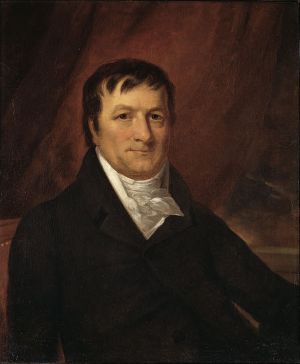 John Jacob Astor may have been truly America’s first billionaire. He migrated from Germany first to England and then Baltimore in 1783. His first venture in the U.S. was a flute-making company. He then moved to the Big Apple where he became a merchant in furs, real estate, and even the importation of opium.
His fur trading company brought Astor the fortune that he then invested in real estate. John Jacob sired the 19th century family that was synonymous with wealth and society. One of his progenies went back to England where that side of the family has two peerages today.
 Coming full circle Caroline Astor, the wife of grandson, William Backhouse Jr., was called “the Mrs. Astor.” She enforced the rules of New York and Newport society during the height of the Gilded Age. She coined the term the “400.” That was the number of people who could be in her social circle because that is the number of people who could fit in the ballroom in her mansion at 34th Street and 5th Avenue where the Empire State Building stands today.
She favored “old money” people on her society list. Besides America’s founding Anglo-Saxon families, there were the contingent from when New York was a Dutch colony. They included names like Van Rensselaer and Roosevelt. The new money people were too crass to be part of the “400.”
 Men like Gould, Carnegie, Mellon, Rockefeller, and Morgan were not invited to high society. They needed to form their own social groups. Guess what? Howard Lutnick with his Jewish ethnicity would never have been in either group regardless of his billions. It took another 70 years for Jews to be accepted and now they are New York society.
Immigrants have continuously remade America. They are like the fresh breeze that blows out the old stale air. One group comes and builds their fortune, becoming the new High Society. Their grandchildren and great-grandchildren live off their trust funds and eventually recede into history.
Mr. Trump and Mr. Lutnick are the children and grandchildren of immigrants. They have become successful wealthy businessmen not because of the Gilded Age but because of the policies of the New Deal, Fair Deal, and Great Society. One based on a helping hand from the government. Fred Trump’s real estate empire was the result of government subsidies and the Democratic club house.
 You never heard Fred knock the Democrats. Donald never did either as he was gobbling up subsidies for his real estate projects. Becoming a Republican was just another expedient move in his quest for fame, power and wealth.
I don’t want to go back to 1890 to see a better America. You can find it in 1990. Tariffs are a sucker’s game that will kill American ingenuity and growth. That along with the end to plentiful legal immigration, the American dream will die.
In the past when a Florida governor came to Martin County, the place he would stop would be the City of Stuart. Governors don’t come to the city anymore.
Instead, they visit the Village of Indiantown where the action is. On July 11th Governor DeSantis was in Indiantown to help dedicate the Terra Lago development. A development with homes starting in the low $300,000s which is what is considered affordable today.

DeSantis mentioned the recent mayoralty election in New York and said that the new Democratic nominee, Zohan Mamdani, wants to abolish the police department. That isn’t true, but Mamdani does call himself a Democratic Socialist.
DeSantis used it as an example of how things like that drive people to Florida and they all will need places to live. For some transplants, Terra Lago will be that place. It will add 2000 single-family homes, 173 townhomes, 300 apartments, an assisted living facility, and commercial space on a little over 800 acres in the middle of the village. No gates, no walls, no impediment to being part of today’s village for anyone.
In ten years, Indiantown’ s population will double and probably sooner if everything that is forecast comes online. By 2035, it will have a bigger population than Stuart and probably more industry. The village has growing pains while the city has begun to decline.
Stuart’s housing stock is growing old and tired. The visionaries are going west to bring new housing and new jobs. Think Stuart in the 1970s may ultimately be the city’s fate once more.
I will leave you with two starkly different outcomes. Senator Harrell and Rep. Snyder sponsored a bill to appropriate $500,000 for the Guy Davis improvements. The governor gave that a line-item veto and neither of our legislators outwardly went to bat for Stuart keeping it.
Last week Harrell, Snyder, and Representative Overdorf along with stakeholders like the developers of Terra Lago, lobbied and received $22 million for the Indiantown water plant. Indiantown needs the new plant to grow.
No one from Stuart did any lobbying for the $500,000. Stuart property owners did lobby to have SB 180 passed which stopped the Boss Collins and Politburo farce of their moratorium and LDR rewrites. Stuart’s businesspeople need to have Tallahassee’s help to prevent the commission from destroying their businesses. There is no working together for common goals because there are no common goals.
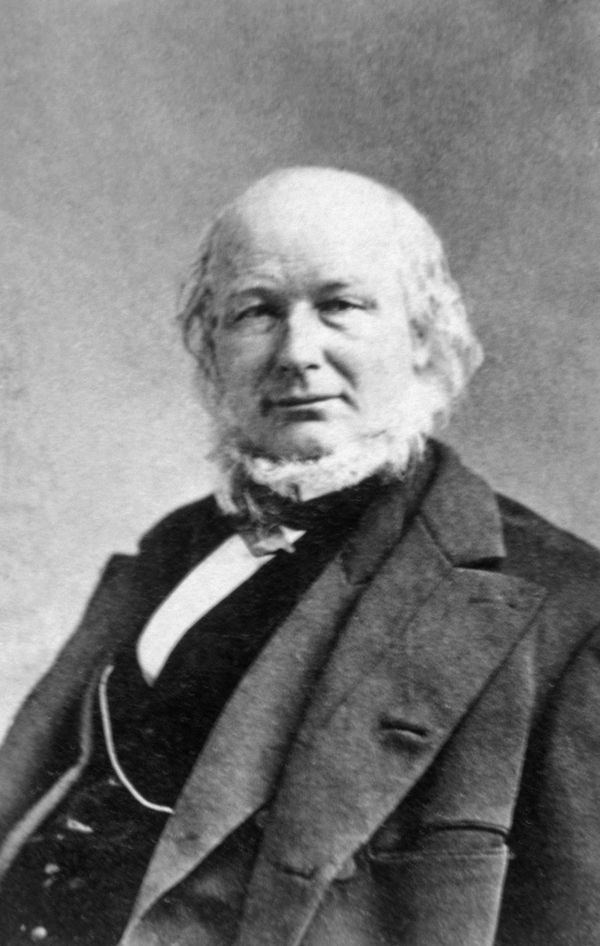
As Horace Greeley wrote in an 1865 editorial, “Go west young man, and grow up with the country.” I would tweak that a bit and say, “Go west young man and woman, and grow rich and prosperous in Martin County.” A place either grows, or it dies. There is no such thing as the status quo.
Florida’s farming community, a cornerstone of the state’s economy and fresh fruit and vegetable supply, is facing an unprecedented crisis. For years, Florida farmers have battled not just unpredictable weather and rising input costs, but an overwhelming surge of low-cost imported produce. With the imported produce flooding U.S. markets, Florida growers are finding it harder than ever to compete.
Our local farmers are being squeezed out of business by artificially low prices and unfair trade practices that favor foreign producers. It’s a devastating blow to domestic agriculture. One that all of us, as consumers, can help push back against.

A key contributor to this crisis is the United States-Mexico-Canada Agreement (USMCA), which replaced NAFTA. While the deal brought some modernizations to trade policy, it failed Florida’s fruit and vegetable producers by leaving out seasonal protections. Florida’s harvest season directly overlaps with peak import periods from Mexico. Without safeguards that account for this seasonal competition, Florida growers are forced to go head-to-head with lower-priced foreign produce in their most critical market window.
This influx of cheap imports often subsidized or produced under lower environmental and labor standards has driven down prices and undercut Florida farms. For crops like tomatoes, strawberries, blueberries, cucumbers, and bell peppers, the results have been devastating. Many family farms have already gone out of business, and others are barely hanging on.
However, there is a glimmer of hope on the horizon. The U.S. Department of Commerce announced its intent to withdraw from the 2019 Tomato Suspension Agreement with Mexico. This agreement had allowed Mexican tomato exporters to sell at a minimum price in the U.S. in exchange for a pause on anti-dumping investigations. Florida lawmakers and agricultural groups have long argued that the agreement was ineffective at protecting U.S. growers. The agreement’s termination is being hailed as a win for Florida farmers, who hope to see a more level playing field and renewed attention to enforcing fair trade practices.
Florida Farm Bureau President Jeb Smith stated, “The Department’s decision is an encouraging step toward ensuring our domestic farmers are not unfairly disadvantaged.” The withdrawal signals a renewed commitment to standing up for American agriculture and that message needs support from all levels: government, industry, and consumers.
Policy alone will not save Florida farms. As consumers, we play a vital role in preserving local agriculture. So, what can you do to help?
- Buy local and seasonal: Support Florida farmers by shopping at farmers markets or buying produce labeled “Grown in the USA” or “Fresh from Florida.” When you buy seasonal Florida crops, you’re directly helping to preserve local agriculture.
- Ask your grocer: If you don’t see Florida-grown tomatoes or other produce during peak season, ask your store manager why. Consumer demand can influence purchasing decisions.
- Stay informed: Support policies that promote fair trade and protect U.S. farmers from predatory pricing.
The decision to end the Tomato Suspension Agreement is not without controversy. Some worry it may lead to higher prices at the grocery store. However, the long-term benefit of a stronger domestic agricultural industry far outweighs short-term price fluctuations. A stable, self-reliant food system is a national asset.

Florida’s farmers feed America but they can’t do it alone. With conscious choices and a little advocacy, we can help ensure that the Sunshine State remains a vibrant agricultural hub for generations to come.
David Hafner’s opinions are his own and may not reflect Friends & Neighbors viewpoint.
Pawsitive Workplace Visits
The Humane Society of the Treasure Coast is very excited to announce a new networking initiative called “Pawsitive Workplace”!
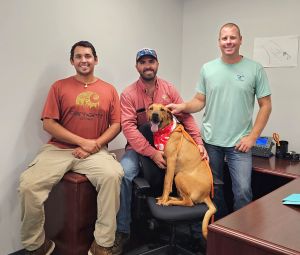 We are actively seeking business partnerships and networking opportunities to showcase the valuable community services we provide through in-person presentations at your workplace. On a "Pawsitive Workplace" visit, our shelter staff will bring two to four adoptable dogs to your place of business for a fun day out. This is not just a chance for business employees to meet some furry friends; it’s also an opportunity for these lovable pups to get out of the shelter and connect with new people, potentially finding their forever homes.
During this visit, our dedicated staff will present an engaging PowerPoint or print collateral presentation showcasing all the amazing programs we offer at the shelter. While many know that we are dedicated to finding forever homes for our animals, we also offer a wide range of community services that we are eager to share, such as affordable obedience classes, low cost spay and neuter services, pet therapy opportunities, and much more. Plus, we give away fabulous swag bags filled with goodies that your team will love.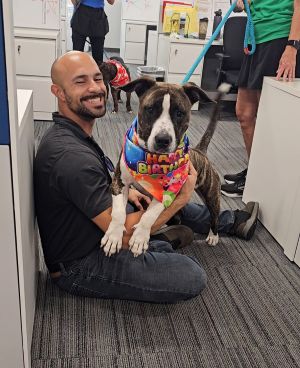
On a recent workplace visit at a local business last month, our dogs had the opportunity to participate in a photoshoot for an upcoming calendar. In addition, the staff generously gathered dozens of bags of treats, which we were able to bring back to our shelter dogs, who were thrilled to receive such a wonderful surprise.
The photoshoot was a huge success, and we can't wait to see the final calendar, which will not only feature our adorable dogs but also help raise awareness and funds for our shelter. We're so grateful to the local business for hosting us and to their employees for their kindness and generosity.
Overall, a Pawsitive Workplace visit is a great way for employees to break from their routine and enjoy a fun time learning all about our shelter with our four-legged companions. It's a unique opportunity to boost office morale, encourage team building, and give back to the community.
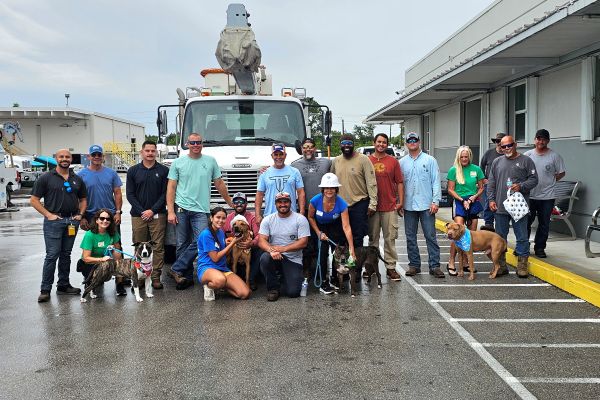
If your business or organization is interested in hosting a visit from the Humane Society of the Treasure Coast, we would love to hear from you! Please reach out to Sarah Fisher at Sfisher@hstc1.org to arrange a visit and learn more about how we can work together to make a positive impact in our community.
Frank Valente's opinions are his own and may not reflect Friends & Neighbors viewpoint.
Heat Illness
As the temperature outside is climbing, I figured it would be appropriate to talk about the different heat illnesses that people can be affected by.
Increased body temperature can be caused by environmental factors as well as by exertion. Normally your body has safeguards in place to help cool you down when your body temperature rises. Sweating is one such mechanism. As sweat evaporates from your skin it lowers the body temperature to try to prevent it from getting to dangerously high levels. But sometimes these defense mechanisms can be overwhelmed.
Heat related illnesses vary from mild inconveniences like heat rash to life threatening emergencies such as heat stroke. Heat rash is a cluster of tiny pimples or blisters that form on the skin when sweat gets trapped underneath your skin. It is easily treated by moving into a cooler environment and applying powders to help keep the skin dry.
Heat cramps (also called exercise associated muscle cramps) are cramps in your arms, legs and even your abdomen that occur when you are overexerting yourself in the heat and sweating a lot. The sweating depletes the body’s salt and moisture levels. Low salt levels in muscles cause painful cramping. The treatment is to replenish the salt by drinking an electrolyte drink. If you know you are going to be out in the heat for extended periods, then drink an electrolyte drink every 15-20 minutes. If the cramps do not subside within an hour, you should seek medical care.
Heat exhaustion is more worrisome in that it can turn into heat stroke without intervention. This occurs when your body loses too much salt and fluid usually due to exerting oneself in the heat. Your internal body temperature is elevated but usually below 104 degrees.

Symptoms include dizziness, nausea, vomiting and a headache. If you are with someone suffering from heat exhaustion the best thing to do if you are unable to immediately transport them to the ER or if you are waiting for EMS to arrive is to try and move them to a cooler spot out of direct sunlight. Remove unnecessary clothing like shoes and socks. Try and get them to drink fluids. Apply cool compresses to their head and neck
The most serious of conditions is heat stroke. This is a potentially life-threatening emergency. It occurs when the body can no longer control its internal temperature. Body temperature rises rapidly, and the sweating mechanism fails so the body is unable to cool itself down.
Body temperature can exceed 106 degrees within 15 minutes!! Heat stroke can cause permanent disability or death if not promptly treated!! There will be signs of brain dysregulation such as confusion, altered behavior, and slurred speech. The extremely high body temperature can also cause your internal organs to malfunction and shut down. If you happen to be with someone who is experiencing a heat stroke call 911 and while waiting for EMS to arrive try and cool the patient down by applying ice packs or pouring cold water on their body. There is NO place for anti-pyrectics such as Tylenol or Motrin!! These drugs can make things worse!
Some people are at higher risk for developing heat related illnesses. These include the elderly, pregnant women, people with obesity or underlying cardiovascular problems. Diabetics are also at increased risk as well as people suffering from substance abuse disorders.
Certain medications can affect the bodies temperature regulation such as beta blockers, several seizure medications, opiates, diuretics and many more. People who have very bad burns or a condition call anhidrosis, both of which interfere with sweating are at increased risk. Obviously, people who work outside in the heat are at high risk as well. If you exercise outdoors or are a first responder or in the military where you can be stuck outside in very high temperatures it is important to be proactive and stay as well hydrated as possible.
Michele Libman’s opinions are her own and may not reflect Friends & Neighbors viewpoint.
Recently, our main thrift store at House of Hope, affectionately known as the Hope Shop, received some incredible and well-deserved accolades. According to the online publication Family Destinations Guide, the Hope Shop is the tenth best thrift store in the entire state of Florida. “This Stuart gem,” the Guide states, “has mastered the art of the upscale thrift experience without the upscale prices.”
Family Destination Guide highlighted the inviting storefront at the Hope Shop, a clothing section that feels “curated” rather than collected, furniture that often looks barely used, housewares displayed with artistry, and the friendly atmosphere “that encourages browsing and discovery, making it easy to lose track of time as you examine potential treasures.”
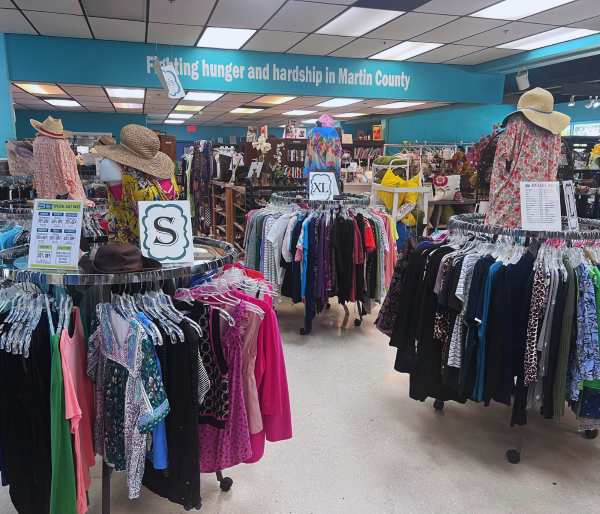
For House of Hope and the community we serve, though, the Hope Shop and our two other thrift stores in Hobe Sound and Indiantown are so much more. Our thrift store customers find great deals every day that help them to save money while they support our organization. Sales are a key contributor to House of Hope’s revenue, generating nearly 20% of the funds needed each year to provide programs and services that help to empower residents to overcome hunger and hardship.
Our thrift stores are also the base for vital programs and services for our clients and partners. Last year our Clothes Closet program distributed nearly 190,000 items of clothing, housewares, linens, furniture and appliances, all at no cost to those we serve. Job seekers and newly employed individuals are able to access professional attire to help them achieve their career goals. We share books with several local teachers and other nonprofit organizations that will get them into the hands of children and adults to encourage reading. We provide no cost access to medical equipment such as crutches, canes, wheel chairs, shower seats and other items as available. The stores are also the site of job training for House of Hope clients.
The wonderful recognition and amazing accomplishments of the Hope Shop and all of our thrift stores are the result of the hard work and dedication of an incredible team of staff and volunteers. Of course, none of it would be possible without the generous support of our community and all of the items, big and small, that are donated every day.
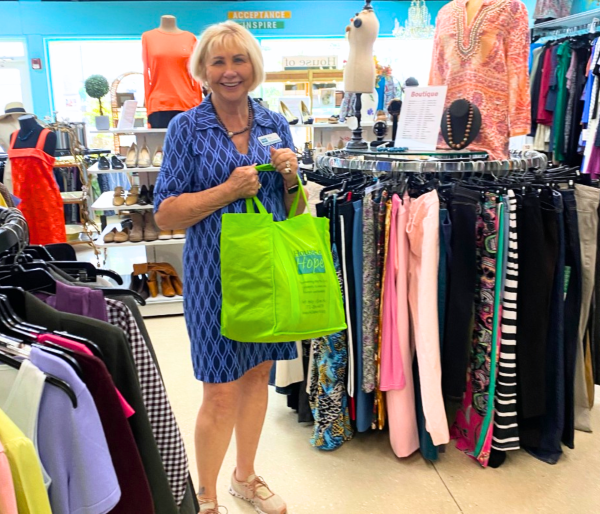
Currently, House of Hope is reaching nearly 12,000 people each month with direct services, and more than 18,000 people through our food bank partners. More than 30,000 of our neighbors that need us most have access to food and other basic needs, enrichment programs, nutrition education and more. To learn more about how you may access or support our programs and services, including our thrift stores, please visit us at www.hohmartin.org. Thank you for helping to grow hope in our community.
Rob Ranieri’s opinions are his own and may not reflect Friends & Neighbors viewpoint.
In about 10 years’ time, the Boys & Girls Clubs of Martin County (BGCMC) has exponentially enhanced the quality of our services, significantly expanded the number of children we serve, and consistently achieved improved outcomes for our members in academics, school attendance, overall behavior, graduation levels and workforce preparation.
This is due overwhelmingly to the generosity of our community, the dedication of our staff and the skill of our grants team in attaining—and maintaining—applicable state and federal funding.
One such funding source is 21st Century Community Learning Centers (21st CCLC). Federally sourced and passed through the states, 21st CCLC funds are an excellent example of how to target grant assistance to those most in need, ensure local oversight and uphold accountability measures.
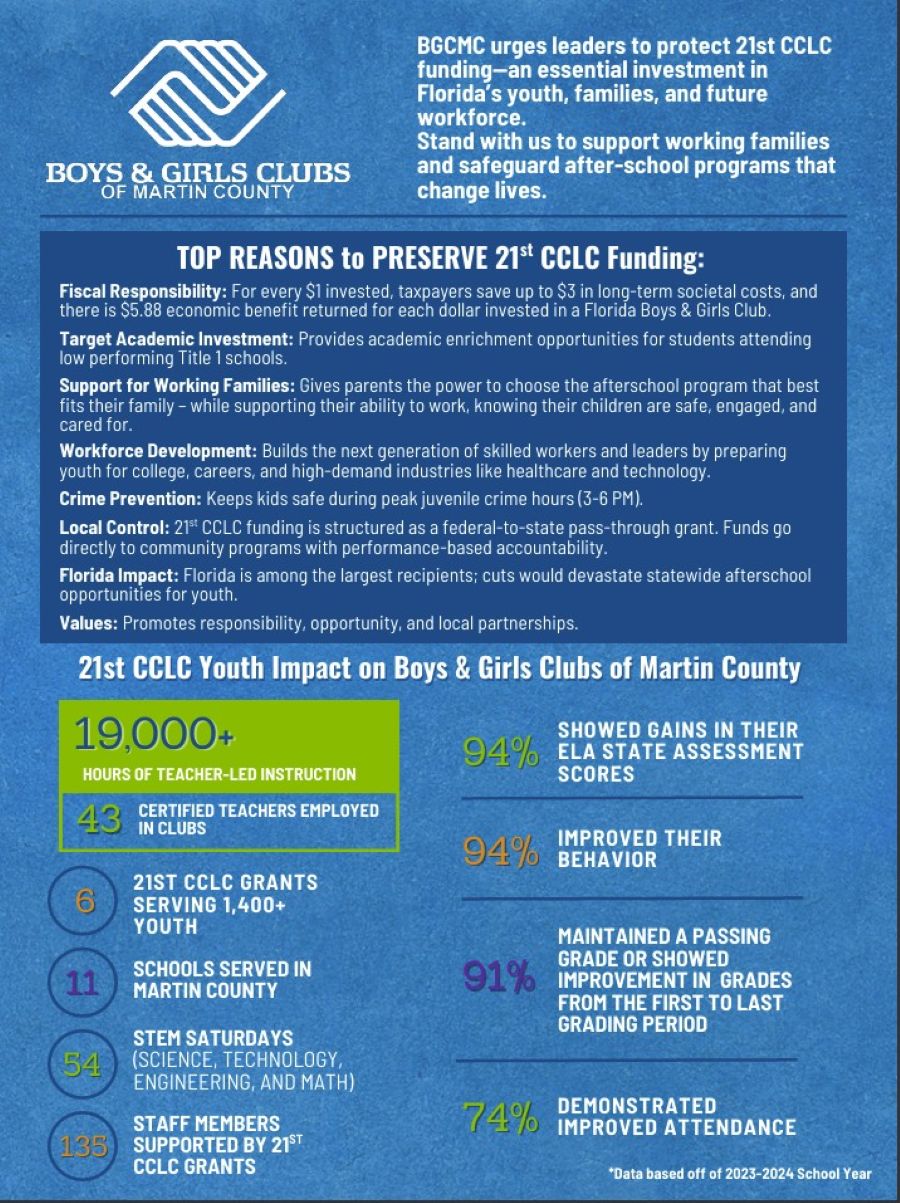
Administered with local oversight, 21st CCLC, broadly speaking:
- Empowers families to choose the afterschool program that’s right for their child, enabling BGCMC to provide nearly 700 children daily (and annually nearly 7,000 more through our outreach) with healthy meals and snacks, certified academic support, enrichment programs, field trips, workforce trainings and more—at no cost to the family.
- Improves learning by funding math, science and literacy teachings and academic enrichment opportunities—after school and over the summer—
for students at lower-preforming Title 1 schools.
- Builds the future workforce through programs in conjunction with industry experts that prepare young people for in-demand professions such as HVAC, marine mechanics, drone piloting, construction, robotics, and computer coding—to name just a few.
Locally, the numbers tell the story. Over 2023-2024, 21st CCLC helped BGCMC:
- Employ 43 certified teachers
- Provide 19,000 hours of instruction uniquely tailored to the students
- Serve 11 Martin County schools
- Teach more than 1,400 young people, of which 74 percent raised their attendance rates, 91 percent showed improvement in their grades, and 94 percent increased their English Language Arts scores on state assessments
- Support 135 positions
- More than 2,200 children all told benefit directly from the fund.
Thank you for assisting us in delivering hope and help to our community’s most vulnerable children and families.
Keith Fletcher's opinions are his own and may not reflect Friends & Neighbors viewpoint.
Stuart’s Property Rights Crisis: Ignorance, Arrogance, and a Manufactured Mandate
They came into office acting like the rules didn’t apply to them. Opposition was silenced. Experts were ignored. State and local laws were brushed aside. The new City Commission majority - Collins, Giobbi, and Reed - believed stopping growth was as easy as stripping away property rights. With three votes, they wielded unchecked control, convinced no one would be able to push back and that no one was watching.
They were wrong. And the result was the strongest rebuke from the State of Florida in Stuart’s history!

The overreach started immediately. Just days after taking office in August 2024, and without public input or any real planning need, Commissioners Collins, Giobbi, and Reed froze all development across the city.
For the next seven months, representative government vanished. Gone were professional planning principles and legal process - replaced by Facebook policymaking, fake outrage, and decisions driven by likes and hashtags rather than facts and community engagement.
Let’s be clear: this isn’t an exaggeration.
City staff, legal experts, and residents warned the commission that what they were doing was reckless. They didn’t care. Instead, the commission majority steamrolled ahead, gutting existing property rights - residential, commercial, and multifamily alike. They ignored Florida Statutes. They ignored the Florida Constitution. They even ignored the U.S. Constitution.
This wasn’t policymaking. It was a power grab under the guise of “no growth.”
And the casualties? Smart growth. Local businesses. Community diversity. Economic stability. Affordability. Property values. Water quality. And every Stuart resident who thought they had a say in what happens on their own property and in their own community.
Nowhere was the damage clearer than in East Stuart. Under the new rules, nothing could move forward without going through a lengthy and costly public approval process. Not a permit. Not a small project. Not even opening a barbershop within an existing commercial storefront. Nothing. And residents were told, condescendingly, that it was all “for their own protection.” As if they couldn’t decide for themselves what’s best for their neighborhood. Facebook cheered. Reality suffered.
Here’s the truth: protections were already in place. The city’s code wasn’t perfect, but it worked. And if it needed adjustment, it should have been addressed with the community’s input. What happened wasn’t about fixing policy. It was about control.
The “Overreach Trio” blamed the city’s code for traffic and overdevelopment, ignoring the fact that most of Stuart’s traffic comes from uncontrolled suburban sprawl in the county to the north. There’s been no effort to study or manage that. And when overbuilding occurred within city limits, it was due to exceptions granted by past commissions - not the code itself. All they had to do was enforce the rules already on the books.
Even worse? Commissioner Reed pushed for increased parking requirements in Stuart, just months after personally securing a parking requirement reduction for his own mother’s business. So, the rules should apply to the rest of us but not to him?
City commissioners also declared that East Stuart had “historically” been a single-family neighborhood and proposed forcing it into exclusive, large-lot single-family zoning. That meant no retail, no businesses, no cottages, no mixed-use, no affordable housing. In other words, no future. And their excuse? That limiting the neighborhood’s potential would somehow “help” its residents.
Expert advice wasn’t just ignored. It was treated like a threat.
Fortunately, the State of Florida noticed.

In a rare and decisive move, the state stepped in, forcing the city to roll back the worst of the damage and imposed a legal freeze on any new efforts to reduce property rights until at least October 2027. It’s worth noting that of the 160 members serving in the Florida House of Representatives and the Florida Senate, only one person voted against it. You couldn’t get that kind of bipartisan agreement if you asked them to vote on whether the sky was blue!
The law matters. Stuart’s leaders should know better.
If the commission genuinely wants to address growth, it can. But it must follow the law. It must involve the community. And it must respect Stuart’s history and heritage - a legacy built by residents, volunteers, and past leaders who worked together to earn national recognition:
- Best Coastal Small Town (USA Today)
- Happiest Seaside Town in America (Coastal Living, 2016)
- Best Small Town (Smithsonian Magazine)
- and many more.
Those awards weren’t handed out for gimmicks or political grandstanding. They were earned - by doing the hard work of planning and community-building, the right way.
Stuart isn’t a sandbox for political experiments. It’s a living, breathing community of people who care. People who won’t sit quietly while their rights are erased and the city is diminished. People who understand that government by social media is no substitute for real governance.
As for the commission majority’s cries of unfair treatment: the only thing the state is doing is enforcing the law. Contrary to the city commission majority’s spin, the state isn’t blocking growth. It’s preventing illegal, unconstitutional local overreach. It’s unfortunate the state had to step in and protect City of Stuart residents and business owners from their own city commissioners – but that’s exactly what was needed.
What can YOU do? Pay attention. Get involved. Let your voice be heard before more damage is done.
Send an email to City of Stuart Commissioners at commissioners@ci.stuart.fl.us.
Attend an upcoming meeting. Click here for the City of Stuart's meeting calendar.
Background on Florida Senate Bill 180
Florida's 2025 legislative session saw the passage of House Bill 1535 (HB 1535) and its companion bill Senate Bill 180 (SB 180), comprehensive bills addressing emergency management. This legislation aims to improve the state's ability to respond to and recover from natural emergencies, particularly hurricanes.

Within Senate Bill 180 (SB 180), and as it specifically relates to Martin County and the City of Stuart, the bill freezes new efforts by municipalities to reduce property rights until October 2027. It prohibits local governments from enacting certain regulations:
Issuing a moratorium on construction, reconstruction, or redevelopment of any property damaged by hurricanes.
Adding more restrictive or burdensome amendments to their comprehensive plan or land development code.
Proposing or adopting more restrictive or burdensome procedures concerning the review, approval, or issuance of a site plan, development permit, or development orders.
Crucially, SB 180 is retroactive to August 1, 2024, and applies until October 1, 2027, with the possibility of extension if a hurricane hits. It also empowers residents and businesses to take civil action against local governments that fail to comply.
To learn more about SB180 click here to visit the Florida senate website: https://www.flsenate.gov/Session/Bill/2025/180
Rick Hartman's opinions are his own and may not reflect Friends & Neighbors viewpoint.
Stuart is Off the Rails
In Martin County, some things disappear slowly. Others are removed all at once.
Stuart’s train station disappeared both ways. It was gone by the late 1960s, a casualty of rail decline and municipal drift. But its real removal began earlier—when passenger trains stopped meaning something and highways took the lead. When civic energy shifted from structure to sprawl.
We didn’t fight to keep the depot. We believed we were done with trains.
Until we weren’t.
A Small Station That Made Us Bigger

The original Florida East Coast Railway depot sat just off Flagler Avenue—close enough to the river to matter, and close enough to downtown to define it. Before bridges and bypasses, the train brought workers, visitors, freight. Pineapple crates. Mail bags. Soldiers. Tourists.
Early Stuart depended on that rhythm. It helped us matter.
Then, it vanished. Not relocated. Not repurposed. Gone.
There’s no plaque. No photo in a waiting room. Most residents couldn’t tell you when it disappeared. But they’ll tell you what came next: parking lots, wider roads, and the long quieting of downtown’s pulse.
A Second Chance, Almost
In 2024, Stuart was offered something rare—a chance to bring passenger rail back. Brightline selected us for its Treasure Coast station. The site? Just blocks from where the original depot once stood.
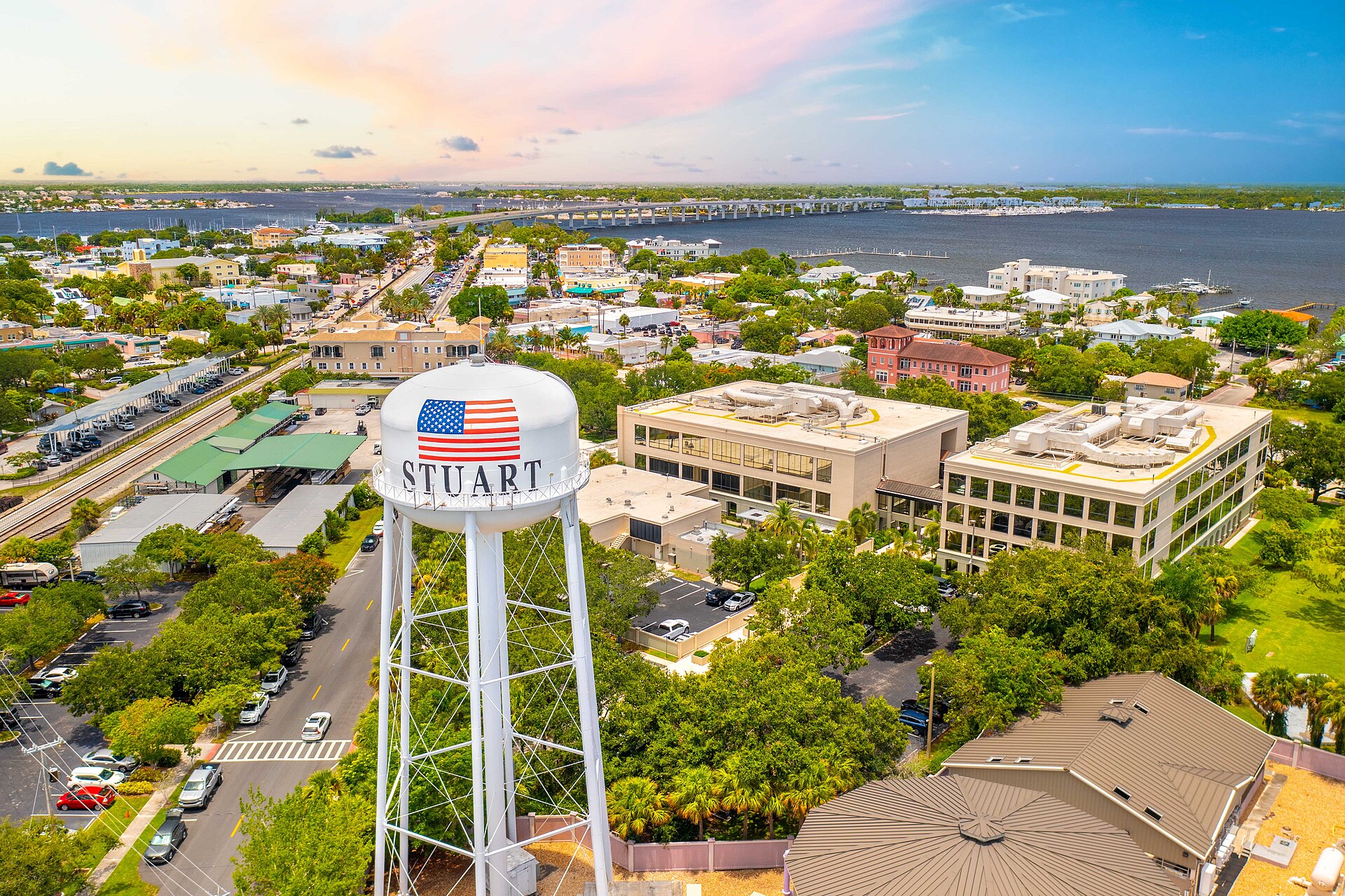
The opportunity was real. So was the resistance.
Noise. Traffic. Change.
The city commission voted 3–2 to reject the agreement. A station that had once defined Stuart was almost brought back—only to be turned away again, this time by the city itself.
Only later did Martin County step in to pick up the effort. A potential station is back on the table, but the hesitation still echoes.
We weren’t just weighing infrastructure. We were wrestling with memory—and with whether we still know how to carry it forward.
What It Still Means
Other towns kept their stations and built around them. Stuart tore ours down. We replaced rhythm with roads, connection with cars, and assumed there was no going back.
But trains don’t just move people. They connect places. And when they return, they test us—asking whether we still believe in continuity, or just convenience.
We were offered a rare chance to reconnect a town to its past.
We nearly said no, twice.
Bill West’s opinions are his own and may not reflect Friends & Neighbors viewpoint.
The Treasure Coast Unveiled: A Journey through Martin & St. Lucie Counties
Echoes of Architectural Heritage
The Treasure Coast offers architectural gems that quietly narrate its early‑20th‑century origins. On Hutchinson Island, the House of Refuge at Gilbert’s Bar (circa 1876) stands as the state’s only remaining U.S. Life‑Saving Station - its coquina‑stone structure and lookout tower a testament to historic coastal resilience.
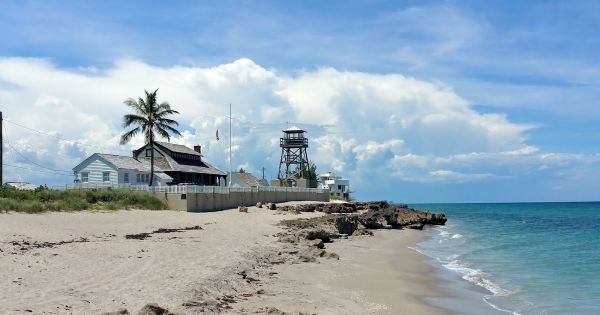
Downtown Stuart’s streetscape features well‑preserved Mediterranean Revival and Streamline Moderne facades - an echo of Florida’s 1920s “land‑boom,” with tiled roofs, stucco walls, and pastel hues worthy of architectural rediscovery.
Uncovering Lesser‑Known Historical Sites
Beyond the beach, the region holds deeper stories. The House of Refuge doubles as maritime and military heritage - later converted to a Coast Guard station, and today, a museum showcasing shipwreck logs and 19th‑century rescue gear.
Fort Pierce’s Zora Neale Hurston Dust Tracks Heritage Trail celebrates the African‑American literary legacy, while local Native American shell mounds whisper millennia‑old connections. Craft‑enthusiast A.E. Backus’ Museum and nearby discovery centers anchor the legacy of early environmental and cultural pioneers.
Coastal Communities with Distinct Flavors
- Stuart: Known as the “Sailfish Capital,” it’s compact, historic, and riverside‑charming - perfect for leisurely strolls through tree‑lined avenues and boutique shops
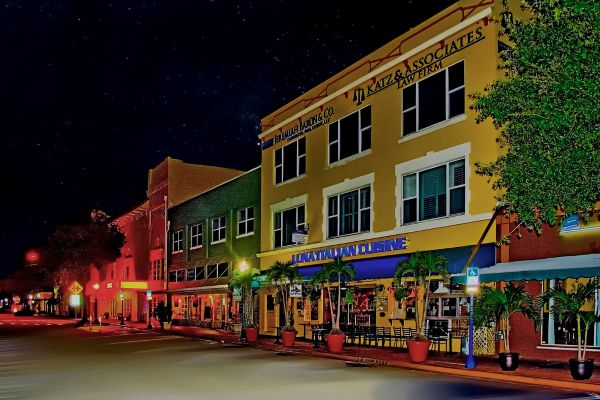
- Port St. Lucie: The county’s fastest‑growing hub, mixing master‑planned suburban innovation with walkable town squares
- Jensen Beach: Laid‑back with a creative soul - from local breweries to weekend art fairs
- Fort Pierce: Gritty and authentic, its working waterfront speaks of shrimp boats and hidden murals
Art, Food & Culture
The cultural pulse is rising - from art crawls in historic Stuart to performances at Fort Pierce’s Sunrise Theatre. Cuisine ranges from casual fish camp eats to elevated Riverwalk dining, fueled by fresh‑catch seafood and regional farmers. Hidden gems include waterfront cafes, pop‑up food trucks in the arts district, and Caribbean‑influenced bakeries.
Nature, Resilience & Ecotourism
Kayak through the Indian River Lagoon or explore dune trails on Hutchinson Island for glimpses of manatees, herons, and mangroves. Community efforts like oyster reef rebuilds and mangrove restoration illustrate grassroots resilience in response to rising seas.
The Treasure Coast quietly champions conservation as a native value - charting a future that safeguards its landscapes and cultural tapestry.
Andy Noble’s opinions are his own and may not reflect Friends & Neighbors viewpoint.
I just returned from a trip to Canada and Alaska. The trip was amazing and the weather was beautiful. I saw eagles, bears, otters and whales. I loved every moment however, I prefer warm and humid weather with dolphins, manatees and pelicans. Florida is my home and the home of my forefathers - I am truly a native and doubt I will ever leave, voluntarily.

The Florida Legislature and the Governor passed a variety of bills that will help the Florida homeowner, property owner and first time Florida buyer. Businesses were helped by a tax reduction. I applaud our elected officials, advocates and watchdogs that helped pass significant legislation to help all of us during the past 100 plus days in Tallahassee.
An allocation of $280 million dollars was made available to the “ My Safe Florida Home” fund. These funds are intended to help Florida homeowners, living in single family homes built before 2008, pay for necessary home harding repairs. The home must be a homesteaded property and there are income restrictions. See if you qualify for these grants by visiting their website, https://mysafeflhome.com/.
A popular program that was allocated $50 million dollars is the Hometown Heroes program. This program offers down payment assistance to many first responders, teachers, nurses and other essential workers in our state. For details about the Hometown Heroes Program, please visit the Florida Housing website: https://www.floridahousing.org/live-local-act/hometown-heroes-program.
Affordable housing assistance programs were funded to the tune of $385 million dollars. The SHIP and SAIL programs provide opportunities for individuals to receive down payment assistance, rent assistance, construction of affordable housing money and additional many programs that help bring affordable housing to the market. Low income families can attain permanent housing using some of these great programs.
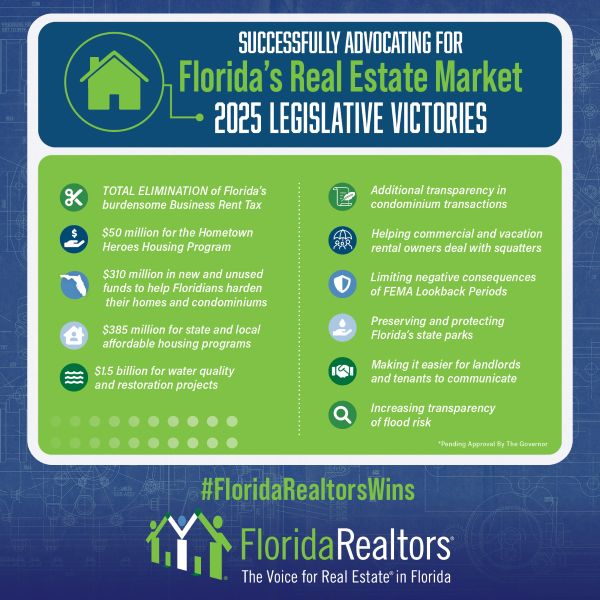
Florida has been one of the few states in the nation to charge a sales tax on commercial rental properties. The additional fee could mean the difference between relocating a business to Florida or going to another state. Floridians were at a competitive disadvantage in many cases. The legislature and the Governor eliminated the rent tax completely. It is a major win for businesses and economic developers.
There are many additional bills and laws that were enacted to benefit Florida property owners including squatter laws, condo board transparency, landlord tenant communication and many more.
Remember - please use a local Realtor when you are buying or selling a home. Refer your family and friends to a local professional.
John Gonzalez’s opinions are his own and may not reflect Friends & Neighbors viewpoint.
Summertime
As a student and then an educator for 34 years, summers were my favorite time of year because I didn’t have to go to school. Now that I am retired, I love every season. We used to have “season” in the winter but recently I have noticed that it has changed. More of our “snowbirds” have permanently landed in Martin County.

However, since our students are out of school many families take the time to travel and visit family. It is a slower time of year for many of our local businesses, so the Palm City Chamber follows suit. There are many fun and exciting activities and functions on the horizon that you should be aware of.
 United States Congressman Brian Mast is doing two congressional updates for our community. One is being held in Plam Beach, and the other is being hosted by the Palm City Chamber of Commerce. The event will be held on Monday, August 4th, at New Hope Fellowship on Citrus Blvd. It will be a luncheon from 11:30-1:00PM. Congressman Mast will be speaking from 12:00-1:00PM about the key issues shaping our nation. This luncheon sponsored by Ashley Capital is open to the public and you may register at www.palmcitychamber.com
The 6th Annual Holiday Village will be at the Patio in Palm City Place on Mapp Road on Wednesday, December 3rd. The Palm City Chamber is looking for vendors for this event. If you are interested, please contact Christiana at christiana@palmcitychamber.com or call 772-286-8121. Be sure to only deal directly with the Palm City Chamber as there have been some scammers trying to take advantage of our vendors.
The Palm City Chamber of Commerce has several Business After Hours networking events in July. On July 24th Architectural Plantation Shutters welcomes residents at 3475 SW Palm City School Avenue. Caring Children Clothing Children is a local non-profit organization located at 7985 SW Jack James Drive, Stuart, that supplies clothing and tutoring to our students. They are having a reception and clothing collection on July 29th. If you don’t have children’s clothing to donate, they accept new underwear and socks for their clients.

 The Festival of Giving, formerly Tykes and Teens Festival of Trees, is being held by the Children’s Museum of the Treasure Coast November 11th-22nd. There will be a Christmas in July Kickoff on Friday, July 25th at Frazier Creek Brewing and Distilling Co. on Federal Highway in Stuart.
Happy Summer!!
Missi Campbell’s opinions are her own and may not reflect Friends & Neighbors viewpoint.
Medical Attention After an Accident: More Important Than You Think
You walk away from an accident thinking you’re fine—maybe just a little sore or rattled. But a few days later, your neck stiffens, headaches start, or that mild soreness turns into pain that doesn’t go away. It’s more common than you think, and waiting too long to see a doctor can make things worse, both for your health and your insurance claim.
Why You Shouldn’t Wait to See a Doctor
Right after an accident, your body is flooded with adrenaline, which can mask pain and symptoms for hours or even days. That’s why some injuries don’t show up right away. Common post-accident injuries include:
- Neck and back pain
- Concussions
- Soft tissue injuries
- Internal bleeding
If not diagnosed and treated early, these injuries can become more serious over time, leading to chronic pain or long-term complications.
Delays Can Hurt Your Case
Seeking prompt medical care protects your health, but it also strengthens your legal and insurance case. Medical records create a clear link between your injuries and the accident. If there’s a delay, insurance companies may argue your injuries weren’t related to the crash or weren’t serious enough to require immediate treatment. That can lead to reduced compensation or even a denied claim.
We’ve seen cases where someone waited weeks to get medical help, only to struggle later proving their injuries were caused by the accident. Don’t let this happen to you.
Know Florida’s 14-Day Rule
Florida law gives you just 14 days from the date of an accident to see a medical provider in order to qualify for Personal Injury Protection (PIP) benefits. These benefits help cover medical expenses, regardless of who was at fault.
If you don’t get medical attention within this window, you risk losing access to that coverage. Plus, any delay creates gaps in your treatment history—something insurance companies use to challenge or reduce claims.

Steps to Take After an Accident
To protect both your health and your rights, follow these steps:
- Get checked out by a medical professional right away even if you feel fine.
- Make sure to visit a doctor within 14 days to preserve your PIP benefits.
- Be honest and thorough about any symptoms, no matter how minor.
- Keep detailed records of all doctor visits and treatments.
- Follow all medical advice and attend any recommended follow-ups.
Take Action Sooner, Not Later
If you’ve been in an accident, don’t assume you’re in the clear just because you’re not in pain right away. Early medical care helps catch hidden injuries and protects your ability to recover damages. It’s a small step that can make a big difference.
Gene Zweben’s opinions are his own and may not reflect Friends & Neighbors viewpoint.
Why Did Martin County Turn Down $375,000 for Our Schools?
Earlier this summer, the Martin County School Board turned down $375,000 — money that could have been used for school counselors, student mental health services, or anything to help kids focus in the classroom. UNRESTRICTED dollars. The funds were part of a larger legal effort holding social media companies like Meta, TikTok, and Snapchat accountable for knowingly creating addictive platforms that harm children’s mental health and disrupt learning.
Across the country, school districts of all types — rural and urban, conservative and progressive — have joined together to fight back. The issue? Social media apps that use manipulative design features to keep kids scrolling endlessly. Platforms that bypass parental controls, target young users, and contribute to rising rates of anxiety, depression, and distraction.

Martin County is not immune. We’ve seen firsthand how social media affects students. Teachers spend more time dealing with behavioral issues, schools are hiring more mental health staff, and kids are struggling with self-esteem and attention. We ALL see it.
That $375,000 wasn’t a gift — it was a partial reimbursement for what we’ve already spent trying to fix a problem someone else created. We’ve already invested so much money and time trying to manage the social media addiction of our students.
But the majority of the board doesn’t want to join the lawsuit or accept the settlement.
Some members of the board feared there were “strings attached” or that it was unclear what accepting the money would mean. But the legal agreement makes it clear: accepting the abatement funds doesn’t stop us from continuing in the lawsuit. The attorneys only get paid from whatever money they recover — there’s no risk to the district.
But the argument they seemed to emphasize was they don’t like a litigious society or doing “money-grabs.” They didn’t see the value in joining the lawsuit if nothing would change.
What a frustrating argument to hear. Why are social media platforms making it addictive? Advertising MONEY. What will force them to stop with the addictive properties? Taking away their MONEY. This moral high-ground, “I don’t want to take money just because it’s there,” months after we almost lost our SROs, is incredibly selfish.
This wasn’t just about the money. It was about leadership — and standing up for our students. The board still has time to revisit this. Let’s hope they do the right thing.
Sydney Thomas' opinions are her own and may not reflect Friends & Neighbors viewpoint.
It is July 12, and the Fourth of July has come and gone, which is hard to believe.
The summertime surf fishing has been as hot as our temperatures with big whiting, croaker, and catch and release snook being the headliners. The Hutchinson Island fish fries are being enjoyed up and down Martin County by lots of friends and surf anglers.
The locations change from week to week but Glasscock, Beachwalk Pasley, Tiger Shores, and Stuart beach accesses have all produced fish this month.
Bloodworm Fishbites in either the red or chartreuse colors are the hot baits, especially when you tip your rig with a small piece of shrimp. The whiting and croaker seem to switch locations from week to week, as one day you will catch nothing but croaker at one spot and when you come back the next day it will be nothing but whiting.
The size of these tasty fish has been really nice this year as the big ones seem to bite every day. Remember, in most cases you pitch your bait, do not cast it, as these guys tend to stay in that first trough 10 to 15 yards from the surf line. Light action 7-foot spinning rods teamed with 3000 or 4000 sized spinning reels are all you need to catch these fish.
They pull hard and taste great so get out and have some fun. As far as the catch and release snook fishing is concerned, find the croakers and or pilchards, and you will find the snook. Use a 500 or 6000 sized rod and reel combo because there are some big snook patrolling our beaches. I always emphasize to get these big girls in as quickly as you can, take a picture, and do a quick release.
They are in their spawning cycle so get them back in the water as quickly as possible. The occasional big jack crevalle or tarpon will be showing as July moves on so pay attention to your lure or live bait as these monsters will be in the feed mode also. Live lining a live croaker will bring you the most bites and the time of day has not made much of a difference because I have had days when they bite early, middle of the day, and the evening.
Stay hydrated and bring a cooler with ice to put your whiting and croaker in.
Thunderstorms are showing in their normal afternoon pattern so the first thunderclap or lightning bolt that you hear or see… leave the beach immediately.
Stay safe, good luck and catch em up.

Paul Sperco’s opinions are his own and may not reflect Friends & Neighbors viewpoint.
Seniors on the High Wire Need a Safety Net!
Some seniors in our community are unfortunately forced to live life as though they’re on a high wire, balancing health issues with financial stresses, fighting loneliness and fearful of needing to leave their home.
The Council of Aging Martin County spreads out a safety net of programs to help these seniors live the dignified, meaningful life that they have earned and deserve.
First, some statistics about why a safety net is essential. Seniors who can no longer live in their own homes face overwhelming health care costs. The median annual cost for a private room in a skilled nursing center in Florida is now at $100,375. For a semi-private room, it’s $89,297. In an assisted living facility, that cost is still about $48,000 a year.
Medicare covers only 19% of all long term care spending. It’s the Medicaid program which covers the bulk of long term care costs for low-income seniors, and even this program doesn’t meet all of the costs.
It’s therefore good public policy to have a strong safety net to keep seniors in their own homes as long as possible, with the support they need. Taxpayers, who fund the Medicaid program, save money, and seniors maintain their sense of independence.
Even more importantly, it’s the right thing to do for our seniors.
The Council on Aging Martin County is the Lead Agency for Martin County as designated by the Area Agency on Aging. The AAA through the Florida Department of Elder Affairs draws down federal and state funds for these four key safety net programs, administered through our organization as the lead agency:
- Community Care for the Elderly grant to help functionally impaired older adults live in the least restrictive, most cost effective environment suitable to their needs.
- Home Care for the Elderly to support caregivers of adults 60 years old and older in family-type living arrangements within private homes.
- Alzheimer’s Disease Initiative to meet the changing needs of non-Medicaid individuals with Alzheimer’s and their families. The program includes medical supplies, respite for caregivers, and Memory Disorder Clinics.
- Local Service Programs to help expand long-term care alternatives that support non-Medicaid elders in maintaining a favorable quality of life in their homes. This includes congregate or home-delivered meals, which are lifelines for at-risk seniors.
Thanks to matching funds from Martin County’s “grant in aid” program, these four funding sources alone bring $2 million a year into our community to help us keep seniors in their homes as long as it is safe and to afford them a quality of life we would all like for our elder family members.

The Council on Aging can only help, however, if we find seniors in need, or they find us. Our Elder Care Mobile Outreach bus now goes into neighborhoods where our Care Navigator can help seniors in need find vital resources. At our home at the Kane Center, we also have Care Navigators who help seniors and their families make their way through the range of available services and link them to the services that will best help them.
We urge you:
- Reach out to the Council on Aging (772-223-7800) if you are a senior in need, or
- Refer a family member, a friend or a neighbor, and
- Advocate for these programs and our community efforts to provide a safety net for vulnerable seniors.
Karen Ripper's opinions are her own and may not reflect Friends & Neighbors viewpoint.
The Power of Normalcy in Child Welfare
For many of us, “normal” is something we take for granted—family dinners, school routines, birthday parties and the comfort of a consistent bedtime. But for children in foster care, normalcy can feel like a distant dream. These children often come from unstable and traumatic environments. They’ve experienced things no child should, and in many cases, they’ve had to grow up far too fast.
At the Tilton Family Children’s Shelter, we give kids permission to be just that—kids. It’s at the heart of what we do—creating a safe, stable environment where children experience the everyday moments that help them feel seen, valued and cared for. We call this normalcy, and for children in foster care, it’s a powerful step toward healing.

Normalcy means helping children feel like they belong. It’s being able to go to school each day and have help with homework when they return. It’s having access to behavioral health services that help them cope with trauma and build resilience. It’s enjoying after-school activities like sports, art or clubs—things that spark joy, creativity and self-esteem.
At Hibiscus Shelter, we provide these opportunities because we know how important they are. The availability of counselors, academic support, structured routines, caring staff and volunteers who listen and encourage, creates a sense of normal that many children have never known. Like celebrating a birthday with cake and a party, learning how to play a musical instrument or having a quiet space to read before bed. These moments aren’t extravagant—but they are everything to a child healing from trauma.
Normalcy means giving children a voice in their own lives—offering choices, honoring their interests and encouraging their dreams. It’s helping them see that their future can be bright, safe and filled with possibility.
Every child deserves that sense of stability and belonging. At Hibiscus, we’re committed to providing it—one day, one smile, one moment at a time. Because when children experience normalcy, they begin to believe in something even greater--hope.
For more information about Hibiscus and how you can get involved to help children, please visit us at HibiscusChildrensCenter.org.
Matt Markley's opinions are his own and may not reflect Friends & Neighbors viewpoint.
ARE YOU READY
Your Treasure Coast Community Singers are getting ready to kick off their 23rd season! The 2025-2026 concert season starts with a Meet and Greet on August 4th at Trinity United Methodist Church, 2221 NE Savannah Rd., Jensen Beach at 6:00pm. If you are thinking about joining our family for the upcoming season, please attend to meet the membership and hear all the great things we are planning. Registration and rehearsals begin the following Monday, August 11th at Trinity United Methodist Church.
We have a full season of outstanding music for you. Mark your calendars and save these dates. You’ll want to be sure to attend them all.
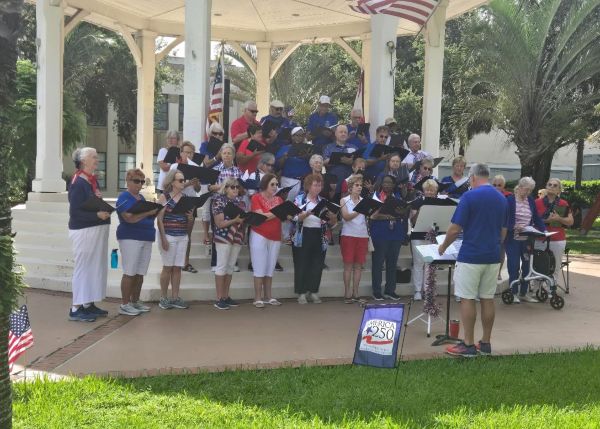
October 4th and 5th – A Tapestry of Autumn
November 15th and 16th – Mendelssohn’s Hymn of Praise
December 6th and 7th – Carols and Candles
March 14th and 15th – Disney Thru the Decades
April 11th and 12th – Chronicles of the Blue and Gray
May 16th and 17th – Birth of Our Nation
For more information, please go to www.tccsingers.org. We are very excited to share this season with you. Hope to see you there.
TCCS is sponsored by The Arts Council of Martin County, St. Lucie Cultural Alliance, Women Supporting the Arts, and the National Endowment for the Arts. TCCS is Gold Guide Star rated. The organization is a 501(c)3, non-profit group.


BIG BROTHERS BIG SISTERS ‘BOWL FOR KIDS’ SAKE RAISED AWARENESS AND SPREAD THEIR MISSION IN PALM BEACH COUNTY
West Palm Beach, Fla. (Friday, June 26, 2025)—Big Brothers Big Sisters of Palm Beach and Martin Counties held their annual bowling fundraiser, Bowl for Kids’ Sake, on Friday, June 6, at Greenacres Bowl in West Palm Beach.
The not-for-profit brought the community together to raise awareness and donations while having fun. With offices in Palm Beach and Marin counties, this Big Brothers Big Sisters chapter meets the community's needs by providing one-to-one mentoring and empowering every kid to graduate with a plan for their future.
Bowl for Kids’ Sake is a fundraiser in which teams create fun team names, dress in a theme or color, and set out to raise money. Some won prizes for their efforts. All participants have fun at the bowling party to celebrate. There are over 24 bowling teams and over 120 bowlers from the local business community and the public.
Bowl for Kids’ Sake is Big Brothers Big Sisters’ signature fundraiser. Every year, half a million people across America come together to have fun and raise money to support Big Brothers Big Sisters. It is a fun way for individuals and companies to have an impact on our community.
“Bowl for Kids’ Sake is more than just a fundraiser—it’s a celebration of community coming together to invest in our youth,” said Yvette Flores Acevedo, CEO of Big Brothers Big Sisters of Palm Beach and Martin Counties. We’re grateful for the enthusiasm and generosity of our bowlers, teams, and sponsors who help us provide life-changing mentoring relationships that empower local kids to succeed,” says Yvette Acevedo, CEO.
Winners include Top Fundraiser: Andrew Leace from “Leace Strikes No Spares”, Top Fundraising Team: Gutter Nonsense, Best Team Name: Gutter Nonsense, Most Spirited Team: Team UES.
Event sponsors include Strike Sponsor The Palm Beach Post – LocaliQ, Split Sponsors Florida Power & Light Company, UES, Haynes Scaffolding & Supply Inc., Jacob & Greenfield PLLC, Lytal, Reiter, Smith, Ivey & Fronrath, NetOne Technologies, Inc., After Hours Pediatrics, and FCU - Flagler Credit Union. Pin Sponsors Innovative Telecom Solutions, Duffy's Sports Grill, Kelley Kronenberg, Victory Counseling and Therapy LLC, Pavon Realty Group, LLC, Seacoast Bank, Cleveland Clinic, Thrivent, and the Mastroianni Family Foundation.
Big Brothers Big Sisters of Palm Beach and Martin Counties has a waiting list for boys needing a big brother. Their recruitment campaign, It Takes Little to be BIG! is ongoing to enlist adult mentors. Parents, guardians, and grandparents should also be aware of the programs available to their children and grandchildren through BBBS. To learn more, visit mentorbig.org.
About Big Brothers Big Sisters of Palm Beach and Martin Counties:
BBBS provides children facing adversity aged 6-17 with volunteer mentors who serve as positive role models. Since 1986, the organization has provided mentors to children in Martin County and, since July 2010, in Palm Beach County. Big Brothers Big Sisters of Palm Beach and Martin Counties was recognized as a Big Brothers Big Sisters of America Growth Award Winner for program excellence in 2023. Out of more than 230 Big Brothers Big Sisters agencies nationwide, Big Brothers Big Sisters of Palm Beach and Martin Counties is one of 100 organizations to receive this top honor. Big Brothers Big Sisters of America (BSA) recognized the Martin County organization in 2007 as one of the thirty-five best-performing agencies nationwide. Visit www.mentorbig.org to learn more.
Angela Hoffman of the Stuart/Martin County Chamber Graduates from Institute for Organization Management
A Leadership Training Program Produced by the U.S. Chamber of Commerce
WASHINGTON, D.C.— Institute for Organization Management, the professional development program of the U.S. Chamber of Commerce, is pleased to announce that Angela Hoffman, IOM, vice president, of the Stuart/Martin County Chamber of Commerce, has graduated from the program and has received the recognition of IOM. Awarded to all graduates of the Institute program, the IOM Graduate Recognition signifies the individual’s completion of 96 credit hours of course instruction in non-profit management. In addition, participants can earn credit hours towards the Certified Chamber Executive (CCE) or Certified Association Executive (CAE) certifications.
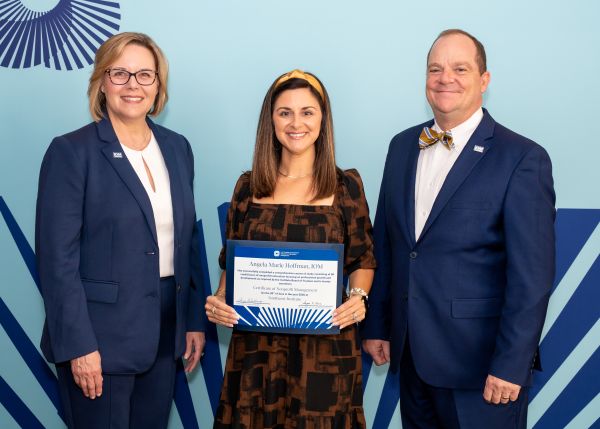
“Institute graduates are recognized across the country as leaders in their industries and organizations,” said Raymond P. Towle, IOM, CAE, the U.S. Chamber’s vice president of Institute for Organization Management. “These individuals have the knowledge, skills, and dedication necessary to achieve professional and organizational success in the dynamic association and chamber industries.”
Since its commencement in 1921, the Institute program has been educating tens of thousands of association, chamber, and other nonprofit leaders on how to build stronger organizations, better serve their members and become strong business advocates. Institute’s curriculum consists of four week-long sessions at four different university locations throughout the country. Through a combination of required courses and electives in areas such as leadership, advocacy, marketing, finance, and membership, Institute participants are able to enhance their own organizational management skills and add new fuel to their organizations, making them run more efficiently and effectively.
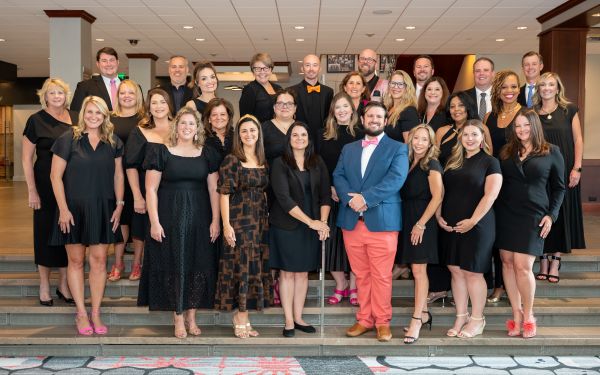
Institute for Organization Management is the professional development program of the U.S. Chamber of Commerce. It is the premier nonprofit professional development program for association and chamber professionals, fostering individual growth through interactive learning and networking opportunities.
The U.S. Chamber of Commerce is the world’s largest business organization representing companies of all sizes across every sector of the economy. Our members range from the small businesses and local chambers of commerce that line the Main Streets of America to leading industry associations and large corporations.
About the Stuart/Martin County Chamber of Commerce:
The Stuart/Martin County Chamber of Commerce is the voice of business in the community. Playing a significant role in the economic climate, the Chamber’s purpose is to inform, unite and promote the business. The Stuart/Martin Chamber acts as the front door to the community offering maps, welcome guides, visitor information and a community event calendar. For business members, the Chamber provides opportunities for leadership, networking, advertising, and essential advocacy locally, in Tallahassee and in D.C.


SafeSpace Awarded $155,000 in Critical Funding to Shelter and Protect Survivors of Domestic Violence
Stuart, Fla. – As part of a growing wave of local support, SafeSpace has been awarded two grants totaling $155,000 from Impact100 Martin and United Way of Martin County to enhance its emergency shelter and expand critical services for survivors of domestic violence. The funding will help strengthen safety, security, and comprehensive support at the Treasure Coast’s only certified domestic violence center.
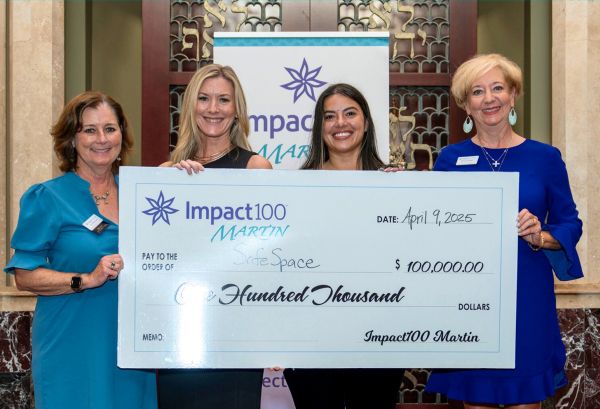 Impact100 - SafeSpace accepts a $100,000 grant from Impact100 Martin for security and safety upgrades at the Martin County emergency shelter. Pictured left to right: Sue Whittington, Jennifer Fox, Melanie Afanador, and Maureen Cotter.
Impact100 Martin awarded SafeSpace a $100,000 grant to support the installation of upgraded security cameras, monitors, and fencing, as well as enhancements to the shelter’s kitchen. These improvements will significantly increase the safety, comfort, and independence of survivors and their children who temporarily reside at the shelter.
“Survivors of domestic violence are often stalked or pursued by their abusers,” explained Jennifer Fox, CEO of SafeSpace. “This transformational investment allows us to better protect the women and children we serve, creating a space where they can feel safe and begin to heal.”
SafeSpace also received a $55,000 grant from United Way of Martin County to support comprehensive shelter programming that helps survivors break free from the cycle of abuse. The funding ensures survivors and their children have access to critical resources including crisis counseling, case management, safety planning, legal advocacy, and other support services aimed at long-term self-sufficiency.
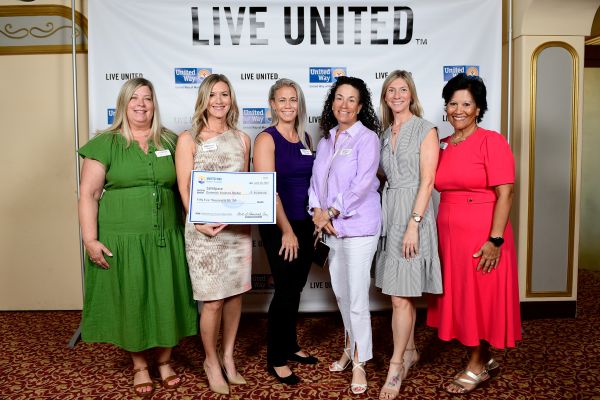 UWMC-SafeSpace receives a $55,000 grant from United Way of Martin County to support comprehensive programming for survivors of domestic violence and their children. Pictured left to right: Amy Bottegal, Jennifer Fox, Aimee Cooper, Jessica Malasek, Christine Cooper and Carol Houwaart-Diez.
“We’re deeply grateful to both Impact100 Martin and United Way for standing with survivors,” said Fox. “Their generous support directly strengthens our ability to empower women and children in our community to live lives free from violence.”
SafeSpace serves more than 1,000 individuals each year across Indian River, St. Lucie, and Martin counties, offering emergency shelter, outreach services, and prevention education.
For more information about SafeSpace and how to get involved, visit www.safespacefl.org. You can also find SafeSpace on Facebook and Instagram @SafeSpaceFl.
If you or someone you know needs help, call the SafeSpace 24-hour hotline at (772) 288-7023.
About SafeSpace
SafeSpace is the only state-certified domestic violence center serving Florida’s Treasure Coast. Its mission is to empower individuals and communities to achieve safety and freedom from domestic violence. SafeSpace offers a range of trauma-informed services, including a 24-hour crisis hotline, two emergency shelters, child welfare support, legal advocacy through Injunction for Protection attorneys, the InVEST program for high-risk victims of homicide, economic justice and empowerment initiatives, community outreach and advocacy, children’s advocacy, and a youth prevention program.
ARC OF THE TREASURE COAST RECEIVES GRANTSFROM THE UNITED WAY TO FUND ESSENTIAL SERVICES
STUART, FL. – The ARC of the Treasure Coast is pleased to announce it has received more than $80K in grants from the United Way. Children and adults with intellectual and developmental disabilities along the Treasure Coast will benefit from these funds that will be used to support essential services provided by ARC of the Treasure Coast.
Specifically, $17,000 has been allocated for ARC’s ABLE Out of School and RISE (Realizing Independence, Supporting Employment) Summer programs. The money will be used to help provide scholarships to low-income children and families in need of out-of-school care or young adults interested in exploring employment opportunities, while learning important skills to assist them in achieving their employment goals.
Another $45,000 will fund ABLE ADT which provides meaningful day activities to adults with intellectual and developmental disabilities who are either not covered by State Medicaid Waiver Funds or who are on the APD pre-enrollment list. Adults learn daily living skills and contribute to their community through volunteerism, while participating in enriching and fun activities.
And finally, $20,000 will fund Project SEARCH Youth, an internship program for young adults transitioning from high school to employment. The program offers internships in various departments within Cleveland Clinic/Martin Health preparing the interns for eventual employment within the hospital or in the community. Job coaches and teachers educate interns on soft employment skills while guiding each student through real-life training within their selected departments.
The ARC of the Treasure Coast wants to thank the United Way for its continued support.
About ARC of the Treasure Coast: The ARC, (Advocates for the Rights of the Challenged) is a 501(c)(3) not-for-profit organization dedicated to empowering children and adults with I/DD through residential, vocational, educational, behavioral, and other healthcare services. ARC provides support, assistance, and training that enhances the abilities of children and adults with disabilities to thrive each day and achieve their fullest potential.

Join a Special Team Changing Lives Every Month
Hibiscus Sustainer Program
Treasure Coast – Would you like to be part of a dedicated group of supporters who make a meaningful difference in children’s lives each month? By becoming a Hibiscus Children’s Center Sustainer, you can help change the future for vulnerable children in our community. Sustainers provide steady, reliable monthly support that directly impacts the children we serve.
Hibiscus Children’s Center is committed to protecting children, helping them heal from trauma, and equipping them with the coping, problem-solving, and life skills they need to succeed. The Hibiscus Sustainer Program plays a vital role in ensuring these essential services continue month after month.
Like any household with children, we face ongoing expenses and the costs add up quickly. Sustainer support helps us meet those daily needs, while also creating opportunities for children to experience a sense of normalcy. We want them to enjoy the simple joys and milestones other children do — going out to dinner with family, buying a yearbook, celebrating a birthday with extra joy, getting a special haircut for prom or homecoming, and dressing up in a beautiful gown or tuxedo.

We also celebrate educational achievements like making honor roll, offer small allowances, and reward positive behavior and personal growth — because every child deserves to feel valued and empowered.
Ready to join us? Visit hibiscuschildrenscenter.org/becomeasustainer to sign up and start making a monthly impact. For more ways to get involved, please contact us at HibiscusChildrensCenter.org . Thank you for helping change lives and give children a brighter future.
Pup Crawl Returns to downtown Stuart with “Peace, Paws & Pints!” theme
STUART, Fla. — The Humane Society of the Treasure Coast is inviting the public to participate in its 11th annual Pup Crawl, themed “Peace, Paws & Pints!,” from 4:30-10 p.m. on August 2 in downtown Stuart. Check-in begins at 4:30 p.m. at the promenade by Spritz City Bistro. The event will be held rain or shine.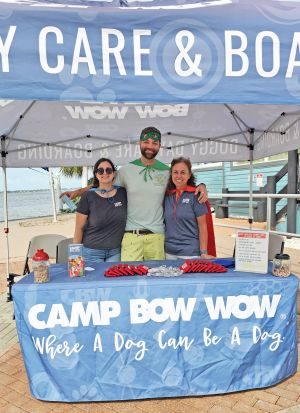
Participants, who must be at least 21 years old, and their pups will gain VIP access to six dog friendly bars in the downtown district and receive one free drink at each stop along the way. Participating bars are Duffy’s Sports Grill, Spritz City Bistro, Hudson’s on the River, Dirty South Bar, Taco Shack and Stack: Burgers-Bourbon.
The cost is $30 per person in advance and $45 per person at the door with all proceeds benefiting the Humane Society of the Treasure Coast. Tickets may be purchased at https://hstc1.org/Post/Pup-Crawl. - Brigid Mclaughlin, Robert Garris and Elena McLaughlin from Camp Bow one of the event sponsors
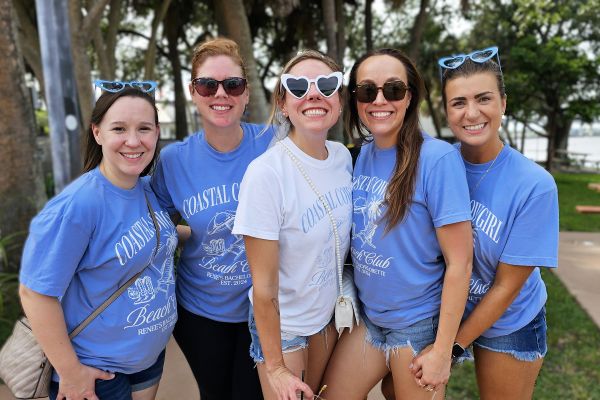 Ashley Soures, Paula Newmaster, Renee Barnett, Kateline Zullich, Morgan Edwards
There will also be a costume contest, 50/50 raffle, prizes and event swag to purchase, including a Pup Crawl Tumbler. Funds raised from the tumbler campaign will go directly to the shelter animals. Purchases may be made at the event or online at https://www.bonfire.com/2026-pup-crawl-tumbler. Orders will ship directly to the purchaser’s house.
The event, which is sponsored by Camp Bow Wow and Paw-Gistics Antler Supply Corp., is dog friendly but all dogs must be kept on a non-retractable leash and the owner must make sure the dog is properly cared for at all times. Pet owners must be aware of the signs of heat exhaustion, aggressive behavior, overstimulation and other problematic areas as pet health and safety are essential. Pets will not be permitted indoors at any of the establishments so participants with dogs are encouraged to have a buddy system.
For more information, contact Community Events Manager Alyssa Bean at 772-600-3215 or Events@hstc1.org. For sponsor inquiries, contact Development Manager Ashton Sorrentino at 772-600-3216 or Development@hstc1.org.
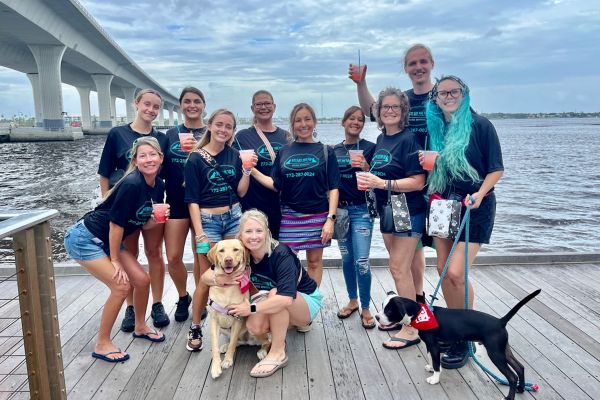 Stuart Sound Animal Hospital employees participating in a previous Pup Crawl
About the Humane Society of the Treasure Coast – The Humane Society of the Treasure Coast (HSTC) is a no-kill animal welfare organization located at 4100 SW Leighton Farm Ave. in Palm City, FL. Since 1955, it has been the leading advocate for animal protection and well-being in the Martin County area. A 501(c)3 private, nonprofit organization, the HSTC is independent and locally operated and relies on donations to support its programs and services. Follow the HSTC on Facebook at https://www.facebook.com/humanesocietyTC and Twitter at https://www.twitter.com/hstc1. For more information, visit https://www.hstc1.org or call 772-223-8822.
I urge those who are reading this newsletter to send an email expressing their opinions on subjects. When a reader sends one, it will be included if I find it relevant and I have adequate space. I may edit the letter because of length and clarity. You don’t have to agree with me to have your letter in Friends & Neighbors. All you must do is send it to TOM CAMPENNI or fill out the form on the website.
Rosie Portera
League of Women Voters Says Florida’s House Bill 1205 Poses a Threat to Democracy
Starting July 1, 2025, Florida’s House Bill 1205 goes into effect. The law proposes a complicated and dangerous solution to a non-problem, to stop “fraud” in the petition-gathering process. Amendments to the Florida State Constitution are proposed either by legislators or by citizens through the initiative petition process.
In response to the recent reproductive rights and marijuana legalization amendments on the 2024 ballot, HB1205, successfully shifts power away from citizen-led initiatives, undermining the participation of Florida citizens in the democratic process. Florida already had a difficult process to propose and pass a state constitutional amendment, requiring nearly 900,000 verified signatures and a 60% super majority to pass. Here’s what that process will look like now:
• Allows petition sponsors just 10 days vs. 30 days to submit gathered signatures and imposes fines (up to $2500) for late submissions or technical errors.
• Individuals collecting signatures must prove U.S. citizenship, Florida residency, and be registered with the state as circulators.
• Any person signing a petition must now provide personal data in the form of a Florida driver’s license, state ID card, or last four digits of their SSN.
• Sponsors of amendment initiatives must post a $1 million bond to the Florida Division of Elections, a requirement that now favors wealthy organizations/donors over grassroots volunteer groups.
The LWV-Martin County relies on the basic tools of democracy - registering voters, educating citizens, and seeking change through the legislative and amendment process - to carry out its mission of educating and empowering voters. By restricting signature gathering, threatening legal action against individuals and small groups, and violating voter privacy, this law is a direct threat to democratic engagement in Martin County and throughout the state.
Make no mistake that supporters of HB 1205 seek to shift Florida’s political future from the voice of the people to the power of state legislators to act without citizen input. This would be the exact opposite role of elected lawmakers who are not supposed to act in isolation but rather are supposed to serve and represent the voices of their constituents.
Call to Action
By restricting signature gathering, threatening legal action against individuals and small groups, and violating voter privacy, this law is a direct threat to democratic engagement in Martin County and throughout the state.
Now that HB 1205 has become the law, communities like Martin County might never see another citizen-initiated amendment. The League of Women Voters of Martin County supports the LWV of Florida’s call for a judicial injunction against HB 1205 in order to preserve Florida’s democratic process.
J. Corey Crowley
The Martin County Difference Needs a New Tool
Martin County’s Comprehensive Plan is one of the most restrictive in Florida—second only to Monroe County and the Florida Keys. It’s not just policy. It’s pride. It’s the backbone of what longtime residents call the Martin County difference.
But let’s be clear: the Comp Plan wasn’t handed down from the heavens. It was forged in conflict by a small group of bold, visionary leaders who looked into the future and decided this county was worth protecting. They fought for a tool that would shape not just development, but the identity of this place. And they won.
Just look around. Drive north to Port St. Lucie or south to Palm Beach County. The difference isn’t the geography—it’s the discipline. Martin County chose restraint. The others didn’t.
But the Old Tools May Not Win New Battles
Times have changed. The affordability crisis we’re facing is real. Home rule is under assault by the state. We’re being forced into a new era—and relying solely on a 40-year-old planning document may not be enough to meet this moment.
Last year, Commissioner Ed Ciampi took a risk. He championed the $4 million purchase of a key property using a patchwork of funding sources. The move passed by the narrowest of margins. It was unpopular in some circles, and it probably cost him votes. But he did it anyway—because he believed it was the right thing for Martin County.
And at the most recent commission meeting, it paid off.
The county sold a portion of that land to the Medalist Group for $3.2 million. Public Works retained another piece to manage Danforth Creek. The result? A win-win deal. The community won. The County won. The taxpayers won. The schools won. Even the buyer won. It was smart. It was bold. And it worked.
A Precedent — and a Warning
This deal cracked open the seal on a new form of government action—one that will alarm some, inspire others, and definitely stir debate. And it should. Any tool this powerful comes with risk. Misused, it could become overreach. It could erode the very principles it seeks to defend.
But here’s the truth: the Comp Plan is no longer enough.
It was built for a different time, to fight a different battle. If we don’t act proactively—if we don’t shape our future with intention—then others will shape it for us. And we will lose what we were trying so hard to protect.
The Time for Comfort is Over
Some still believe the Comp Plan is untouchable—that it alone will shield us. But that’s wishful thinking. Home rule is eroding, fast. Developers are circling. If we don’t adapt, we won’t preserve the Martin County difference—we’ll bury it.
There are still champions among us—Commissioner Heard, for one—who were part of the Comp Plan’s creation. They understand what’s at stake. But we need more. We need a new generation of leaders who are just as committed to protecting this county, not with nostalgia, but with new tools built for new realities.
A Call to Action
I am not afraid of setting a precedent—I am hopeful. I believe in bold, strategic, carefully measured action when it serves the public good. Commissioner Ciampi has shown that it’s possible to act without sacrificing principles. He remembered which county he represents. He remembered what matters.
Now we must do the same.
Because if we don’t take ownership of Martin County’s future, someone else will. And when that happens, the Comp Plan won’t be worth the paper it’s printed on.

When I travelled to Tallahassee as a commissioner to lobby legislators regarding bills that went against Home Rule, I would tell them that one size does not fit all.
 What is good for a large city is not always the best for smaller ones. That argument didn’t win over many legislators. Things have become much worse in the intervening years when it comes to state preemption. However, in the last few years some cities and counties have brought the wrath of the state down on everyone’s head.
Martin County is known far and wide as a place that just says no about almost everything “growth” wise. Stuart did not have that reputation until Boss Collins and his Politburo showed up. Now the city is known far and wide as a place where not only growth, but property rights, go to die.
Along with a few places on the West Coast of the state that were making it hard for long-term homeowners to rebuild after storms, the Florida Legislature became fed up. Especially when voters and taxpayers from those very same areas accosted the legislators begging to have their property rights restored.

The county legislative team summarized a series of bills which pre-empted local government from doing certain things. SB 180 prevents local government from placing a moratorium on construction or redevelopment, a more restrictive or burdensome amendment to their Comp Plans or LDRs, or the non-issuances of site plan approvals.
It applies retroactively to August 2024 and goes until October 2027. This part of the bill expires on June 30th, 2028. I believe this was tucked into the nearly 50-page hurricane relief bill to address the total moratorium and re-write of Stuart’s LDRs by Boss Collins and his Politburo.
The county only has two minor tweaks to the Comp Plan that will be affected. One will be to Rural Lifestyle and one to Independent Urban Services Boundaries…both of which I support but are hardly critical to controlling growth.

Stuart was just out of control and blatantly was doing things that the majority of citizens did not want. The mandate claimed was one of the Facebook universe not everyday voters. If this attitude toward property rights and citizen rights continues, we will see more preemptions.
Those who believe the state went too far by preemption of these local ordinances are wrong. Most states don’t even allow local governments the fig leaf of local control. The Florida Constitution and many court decisions have upheld the state’s right to assert their authority over local governments.
To read what several bills did regarding changes to development regulation go here
If a politician almost loses an election over an issue, they are either highly principled or politically tone deaf.
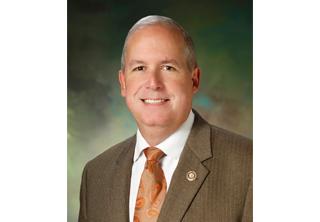 Ed Ciampi, with the actions he took on this property a few years ago, is a great example of the above. It was so much on his mind that he spent a good while explaining the story on how the county ended up acquiring the property at the beginning of this agenda item. Ciampi, never one to let one word take the place of ten, gave a complete history of the county’s involvement. I will try and encapsulate that history in many fewer words.
The development proposed is located in the CRA. As such, it needed to conform with those building criteria. Therefore, the proposed project had multifamily apartments fronting Martin Highway across from several single-family developments, most notably Danforth. The parcel abuts Palm City Elementary and Danforth Creek runs behind some of the property.
 Like so many times before, the Palm City community rebelled against more development. Even development that was being built according to code and zoning and did not need commission approval to move forward. Palm City residents have a history of being against new homes. I understand that at the time they built Danforth, older Palm City residents were against it.
Into the fray entered Commissioner Ciampi, and he convinced the commission to have the county buy the property for a little over $4 million which was about $2 million more than the then developers had bought it for. However, the owners did have development costs to consider. In any event, Ciampi prevented the multi-family buildings from rising.
The county ended up buying from the county 1.2 acres of property along Danforth Creek to allow access to the drainage and water systems in Palm City and Palm City Farms. The price was $800,000 which was paid out of the stormwater and road maintenance fund.
The one and only bid to buy the remainder of the 6-acre property came from Medalist Builders. The price was $3.2 million, and the closing will be in 120 days. Their submitted proposal can be found here
Ciampi’s argument is that he did what his constituents wanted without ultimate harm to the county. But Martin County did not exactly receive all the money it spent. Not to mention the cost of staff time, the cost of money expended itself and lost tax revenue. Those were costs incurred to satisfy Palm City residents.
The real crux of the matter is whether it is the government’s responsibility to interfere with the markets? The plan to build the apartments was following the county code. They were not asking for anything special. Ciampi convinced the commission that it was alright to manipulate the outcome because a few (or even many) residents did not like what was proposed. That is what almost cost him his election. Voters throughout the county felt as if there was manipulation.

There was nothing nefarious or underhanded. No one received an envelope under the table. Neither Ciampi nor anyone else steered the parcel to Medalist in some grand conspiracy.
What transpired with the county buying the property was the use of tax dollars to stop a legitimate development from going forward. Where this parcel is located should never have been in the CRA. Ciampi is right about that.
One time commissioner DiTerlizzi helped a friend build a supermarket almost two decades ago. To do so, he had the CRA boundaries changed. And again, I don’t believe that anything nefarious was going on. It was one “Good Ole Boy” helping another. That is what results in bad government and a series of bad outcomes 20 years later.
The vote to accept the Medalist bid was 3-1 with Hetherington opposed and Vargas absent.
There is an old Les Paul and Mary Ford tune named “How High the Moon.”
 As I was listening to the commission debate about the necessary height of an opaque fence to shield outside storage of materials at Gateway Commerce Center from view, I couldn’t help but begin singing that tune.
The place is for warehouse use. The reason this came up was because a couple of tenants wanted to store materials within their loading bays. The bays are at the back of the buildings and far from anyone’s sight.
The PUD is located on Kanner Highway off 96th Street. It is well shielded from the road by plantings and the bay areas are not seen from any road. But you would think the commissioners were Medieval monks debating how many angels can be found on the head of a pin.
A complicating factor to them was one company will have a crane of indeterminant height located there. With this complicating factor, the height became an issue. What is a commissioner to do but ponder the meaning of height restrictions?
One finally came up with a commonsense motion. Blake Capps said everything needs to be screened regardless of height, but the stored items can’t be taller than the building itself. Since all of this takes place in the rear in their loading bays, no one else will see it. It was such a good idea that it passed 4-0 with Vargas absent.
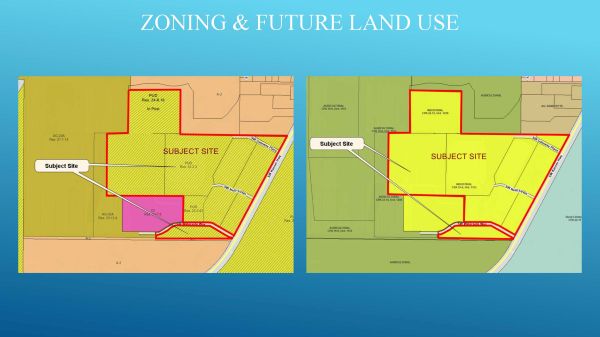
A bigger question is why the commission needed to spend so much time on something that in other places would have never ever been before them. It is important that serious development decisions come before the commission. Yet the LDRs should reflect the commonsense approach that Capps had in his motion. It should not take an hour or so of time to opine on something like this and make it more complicated than it needs to be.
If you believe you want to stop everything from occurring, then you write codes that require commission action. That is what Martin County has. The business owner spent thousands of dollars on experts and time to bring this forth. It shouldn’t be necessary.
 As Mary Ford’s harmonious and rich voice faded in my ear, I began hearing another classic, Irving Berlin’s “How Deep Is the Ocean” with Billie Holiday’s phrasing. When I watch BOCC meetings I often want to know why the commissioners want to be involved in minute details and yet are so afraid to formulate policy. I guess imponderable questions are easier to tackle than outright general solutions.

There is a lot about Chris Collins that is bad.
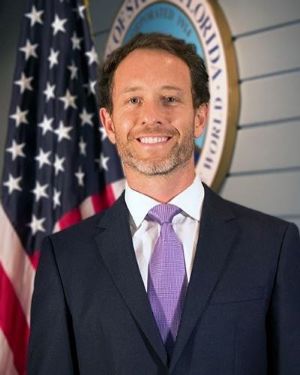 Perhaps his worst trait is how hypocritical he is. Regardless of what stand he takes today, be prepared for him to have an opposite one tomorrow. That may work in Tallahassee or Washington on a macro level, but it doesn’t in local government where all policy decisions are micro.
At the last commission meeting, you saw Chris the DOGE Man. Government needs to be lean and mean. We need to lay off people…he said that with a smirk on his face. There is fat that must be trimmed away. And he wants to see a reduction in the millage rate of .25 mills. That would equate to the median taxpayer saving $8 a month. That is about what a beer in a restaurant costs today for dinner. It doesn’t even cover the cost of a mediocre glass of wine.
 To implement Chris’ savings of $8 a month on his tax bill, about a million dollars needs to be cut. He rules out cuts to Police, Fire/Rescue, and Utilities. Police and Fire are already more than the Ad Valorum collections. Most of the budget for those services is funded by other means. Utilities are almost all paid for from fees charged for those services.
 His desire would leave parks, recreation, and things like the I.T. department subject to elimination or at best a good head chopping. The employees who make the least will either be terminated in Collins’ DOGE scenario or must do two employees’ jobs. The people who fill the potholes and dig the ditches are the ones sacrificed for Chris’ $8 beer.
As Chris said, he is a good Republican…one who hates government and all that it does. Nowhere in any cuts did he suggest that his own salary and benefits should be reduced. Chris is a big-hearted person who probably would leave a guy starving if it required him to ante up a buck. I bet he even takes his automatic pay increase.
 The largest expenditure that Collins added to the city budget is the addition of an environmental attorney at $300,000. What Environmental Attorney Ruth Holmes will do is anyone’s guess. I suspect there isn’t much. Yet Chris can check a box. He is an environmentalist.
As Collins’ DOGE cuts the people tending to the parks, he is making sure that his skateboard park keeps happening to the tune of $700,000+ which was not in the budget when he demanded it. Stuart already lost a state grant because he insisted on this park. He made a promise to his buddy who supposedly was going to fund raise to build it. So far, he has raised nothing. Not one centavo…except the taxpayer’s dollar.
 Martin County Parks have three skateboard parks within five miles of Stuart. Stuart taxpayers are also Martin County taxpayers. I guess Chris can check another box and garner some votes.
The real kicker or unintended consequence of cutting the millage rate is that it gives him $8 for a beer but all those big bad multi-family buildings he has railed against get thousands of dollars in tax decreases. Costco and all the apartments he believes are bad for the city are laughing all the way to the bank because he wants to make them not pay their fair share.
Homeowners have exemptions. Businesses, and rental apartments do not. In fact, until Chris came along so he could DOGE, those very projects subsidized most homeowners. Now the very thing he hates has the most to benefit so he can check a box and have a beer.

His tax cut, his people cut, his $300,000 environmental attorney, his skateboard park, and his big giveaway to car dealers, big retailers, and multi-family rentals are all in service of his being able to run for county commission. Like everything else he does to create his make-believe record, he leaves the city worse off. He is checking the boxes in anticipation of moving up the food chain. That and having an $8 beer.

You can see the budget presentation here
In the governor’s budget veto letter, guess what was on page 21 of a total of 26 pages…the Guy Davis appropriation of $500,000 was a no.
If I were the Stuart City Commission, I would be wondering why Tallahassee is picking on me. There is no secret as to why for those of us that have ears to hear and eyes to see. It all boils down to the shenanigans of Boss Collins and his Politburo.

Now when you have 26 pages of line-item vetoes, it is easy to believe that it just wasn’t your turn this year. However, in the past the city’s “asks” would result in Martin County’s senator and house reps going to bat for the city. Especially since, in general, any requests this time as well as the past were modest and in line with expectations.
There is a new dynamic in play now. The Boss has no qualms about criticizing the city’s state officials right from the dais. If you do stuff like that, you better win because the political death you face can be slow and torturous. So, if you were in the state legislature, would you go to bat for the ingrates?

Earlier this session the governor signed a bill regarding hurricanes with a couple of pages sneaked in preventing changes to Stuart’s LDRs. The bill forbids any changes made from last August of 2024 until 2027. The Boss ignored the wants of too many people with friends in high places, and it appears he doesn’t have any himself.
Since taking control of the commission with last August’s election, Collins has alienated too many people. So many that long time friends of the city have quietly turned their backs. And his continued pronouncements from the dais just keep Stuart from moving forward. Like many before in politics, he has completely misjudged his influence.

Collins has his sights set on a county commission seat. If he ever were to be elected to the BOCC, the county would suffer a very bad fate. In Florida counties are where the local government action is.
Stuart is very small both geographically and demographically. With all the Boss’ rhetoric and fear about the city’s breakneck development, it is no longer growing. There is just no more vacant land to have new massive projects. His fevered fear of East Stuart turning into Abacoa could only be conjured up in the mind of someone who knows nothing about development.
Boss Collins has cost the city money, resources, and reputation. Every moment he stays in office adds to the city’s scorn by others. Time for Stuart to move on and leave this sad and I hope brief chapter behind.
The Costco property was almost 50 acres. We are seeing them build on most of it. There is a park-like lake setting located there. All in all, it is exactly as advertised so far.
What wasn’t part of the development was a five-acre outparcel that remains undeveloped. The only reason it wasn’t included for development was the current owners want too much money for the parcel. However, sometimes the public sector can pay more than the private one because they have different time horizons.
At some point the seller will sell this land, and it will become an Outback Steak House or Olive Garden. The City of Stuart has the means with the proceeds of the new half-cent sales tax to take it off the market even by paying a little too much.
We don’t need another park with benches and swing sets, but the city can preserve a little Florida native area of fauna and flora in the middle of more and more concrete roads and buildings. Too many people want to take away the rights of others but refuse to spend necessary tax dollars to secure open space.
Boss Collins and the gang want to use socialist and communist tactics to remove the property rights of others claiming it is for the common good. This is their chance to put our money where their mouths are by buying a parcel of green and perpetuate native Florida forever.

Next January, a civil trial will occur in a class action lawsuit between school districts nationwide and social media companies. The Martin County School District is acting as if participating as one of the members of the suit would be a moral failure.
A few years ago, there was another such suit against Juul by the nation’s school boards. When asked to be part of that court filing, the Martin County School Board declined. The roughly $2 billion class-action settlement would have paid Martin County about $375,000 after deducting for expenses.

Forty-five of 67 Florida districts are already class-action litigants including Palm Beach County in the social media suit. For most Florida districts, it doesn’t seem to be a very hard decision. If you believe that our children are being harmed because of the algorithms that are employed by these companies, how else do you address those problems except through civil litigation?
Both Marcia Powers and Li Roberts who were dead set against joining the Juul suit are as vehemently opposed to this one. A big part of their objections is based on personal responsibility and what would you do with the payout if successful. They want to know whether vaping is still a big problem with kids.
I am going to go out on a limb here and say probably nothing has changed as to the number of students still vaping. Guess what…a subset of kids are still smoking cigarettes, drinking alcohol, and using drugs. Does that mean we don’t hold the purveyors of those products accountable? And one of the ways to do that is through civil legal action.
Powers and Roberts want to equate what programs you can have with the money received before joining. The lawsuit is not about starting and paying for programs but rather inflicting a penalty on bad behavior. Perhaps what the Juul settlement tells us is that the amount of money awarded and accepted was not enough to stop the marketing of their product to young kids.
The board should have programs to teach how to limit social media use regardless of prevailing in a lawsuit. The district went a big step forward with the banning of cell phone use during the school day. Now the board needs to be part of a class-action suit that is going after the companies responsible for a world they created with addictions just as bad as vaping if not worse.
When someone is hurt during the commission of a crime, when society knows who the perpetrator is, they are prosecuted. The criminal prosecution in no way limits the victims’ right to civilly sue for damages they sustained. This is no different.
The programs the district creates to help students should be done regardless of the lawsuit. If Roberts, Powers, and other school board members believe that social media’s effects are harmful, then not pursuing civil retribution would be like not arresting shoplifters since the monetary thefts are so small. This has nothing to do with personal responsibility, whether the companies change their algorithms or not, and frankly whether the kids use social media less.
It is about doing what is right for the taxpayer, the parents, and the children. And if necessary, doing it repeatedly until the harm stops.
Martin County has become an “A” District. That is a nice accomplishment, and the board, superintendent, and staff should congratulate themselves.
 The district joins 27 other Florida districts with an “A” grade. 31 districts are rated “B” and 8 received a “C.” No district was rated “D” or “F”. The last time we were rated “A” was in 2018.
Our closest neighbors and competitors for attracting businesses and jobs; Miami-Dade, Broward, Palm Beach, St. Lucie, and Indian River, were all “A”. Okeechobee had a “C” rating. Gadsen in the panhandle is the lowest scoring while Nassau and St. John are tied and are the highest.
Depending on how you count changes to the methodology of obtaining a score, Tallahassee has instituted five such changes in the past decade. It will continue to refine its scoring methodology next year. So then what does it all mean?

In K-12 education, Florida is ranked anywhere from 9th to 41st nationally depending on the organization doing the ranking. But our kids will not only compete for jobs and financial security against other Americans but against the people of the entire world.
One of the most reviewed studies was one where 470,000 fifteen-year-old students were administered tests in math, science, and reading similar to the ACT or SAT exams. China received the highest score, followed by South Korea, Finland, Hong Kong, Singapore, Canada, New Zealand, Japan, Australia, and the Netherlands.
Martin County should be praised for once again being an “A” district. Unfortunately, it is in the State of Florida which is mediocre at best in the United States which is far behind our global competitors. An “A” is in the eye of the beholder.
The school board, in an unexpected move, decided they needed more questions answered on how parts of the sheriff’s new contract will be implemented.
Member Russell made a motion to approve the contract, and Marsha Powers seconded it for discussion. Powers wanted to know how SRO hours would be recorded, especially overtime hours. Since they are now paying for overtime, she would like the principals to approve. That is especially true when extra deputies are brought in for events like football games.
Last year six positions were left unfilled. So how do things like that affect staffing. According to the board discussion, the school district pays deputies for 12 months per year even though they only work 10. That would mean they are available for other duties. How are those two months accounted for?
Board Member Roberts said the old contract continues even past the expiration date of June 30th. Sheriff Budensiek does not share that opinion. He does believe that things will be worked out prior to the new school year.
There is also a question about who supplies the crossing guards. It is Powers’ position that they are the responsibility of the entity that controls the roads. The contract already calls for the sheriff to provide them at a cost of $880,000.
What really seems to be the sticking point is who controls the deputies in schools and at after school events. Even though they are employees of the sheriff, the board wants control over how they are used. I don’t know whether or to what extent that will happen. There are several other options the board may explore in the future.
However, the board expects to have the wrinkles ironed out by the end of the month.
Isn’t it a shame that this now is part of our education system…the tremendous cost going to protection and not education. I guess that is just American education in 2025.
Michael Maine is the second appointed school district superintendent in Martin County.
I don’t think you will find many people who don’t believe he is anything but a professional and good leader. Even saying that, it always surprises me how every board member’s review of their manager at the district and in government are superlatives upon superlatives.
Managers’ performances should be reviewed periodically. But here, as is usual, Mr. Maine is close to walking on water. There were a few suggestions about how he could improve but overall, the accolades are impressive.
As we have seen students’ grades being inflated, there is now a tendency to also do so for job performance. That is not to take anything away from Maine. He has been a great leader who has not been afraid to make tough decisions. That was something that the board believed also.
There is a push by board members to extend his contract for another three years even though he has two more years to run on his existing one. I agree with Moriarity…it is too early to do so. Roberts believes if it is done every year, you always will have the superintendent locked in.
Powers suggested that taking such action prevents a different board from choosing their own path. I don’t know whether Maine would want to lock himself in by negotiating a contract now instead of waiting. After next year, if Maine and the Board feel that they want to continue for another three years, such an extension would make more sense to me at that time and I think most Martin County residents.
You can see the evaluations here

This month’s meeting was much better conducted than June’s was.
 I would like to think this publication had something to do with it after reporting on the issue. That may have been the worst run and managed meeting I have ever attended. This meeting was much better, and I think they succeeded in giving everyone a chance to speak with minimum interruption. No attorney or consultant was in attendance.
That doesn’t mean this was perfect. There is still some work to do for President Docherty to grasp procedural requirements. For example, member Heller introduced what he called a “motion to table.” A motion to table means it stops debate. A second is called for and then an immediate vote. If passed, then the item ceases to be considered unless one of the people that voted in the affirmative asks for it to be considered again at either this meeting or the next meeting.
However, Heller’s motion was not meant to table but rather to postpone to a future date. That does allow for debate and public comment. The chair should have made that clear. The attorney, who is usually the parliamentarian, did do so after a time.
The most room for needed improvement is with public comment. Though Docherty did follow the rules outlined on the agenda, he did not limit a person’s comment to one time and one time only for each motion or item. One audience member spoke three times on the same motion and item.
While it is better than people screaming out, it still is far from proper procedure. Any member of the public can speak for three minutes but only once on any item. Otherwise, once again it falls into the category of a debate even if it is a civilized one. And public comment is heard all at once, not every time someone wants to say something.
 Council members still need to do some work on procedure. Vice-President Kelly engages with the public by answering and asking questions as if she wanted to debate. This is the Boss Collins’ approach, and while Kelly is much more polite, it is still inappropriate. Debate between council members can continue for as long as the chair feels appropriate, but it is never appropriate with the public.
Member Galante was a different and better-behaved person at this meeting. When she speaks about something now, more people will listen. So was the behavior of Members Ciaschi and Heller.
Indiantown and Stuart have the clerk handle the permission to speak cards. They call the people up and control the time. That would be a good suggestion for Ocean Breeze to follow.
Most of us have a tendency not to be very precise when speaking. Imprecision usually doesn’t matter very much. In government it can lead to an awful lot of confusion. That is what happened to the idea of a charter review committee.
 The Ocean Breeze charter is probably 60 years old. It can use some updating. However, Council Member Ciaschi’s idea of a town charter review is not what he really means. What he appears he is speaking about is having a committee look at the purpose and vision for the town’s future.
I suppose when he spoke with Dan Hudson, the town consultant, Dan gave him a ballpark price of $10,000 to change the charter. It is not an unreasonable price. However, before any changes to the charter are made, Ocean Breeze needs to have a discussion on the vision for Ocean Breeze’s future. I think both Ciaschi and Vice President Sandy Kelley agree with that, but they are not speaking the same language.
 Kelley, a Sea Walk resident, wants to unincorporate from the town. She believes that her development should secede. This not being 1861 and Sea Walk not being Charlston S.C., that is not how town un-incorporation works.
Kelley and her fellow rebels are right about why should they spend to change the charter if they are not going to be around. Ciaschi, a resort resident, wants to keep the union alive but compiling a vision for the future is not a charter revision either. In fact, there is no need for a special committee at all.
What this town needs is to hire a facilitator and hold public workshops to discuss its purpose, mainly should there be a town. Some like Mayor Ostrand believes a town exists and needs to exist because it exists. That is not a reason for Ocean Breeze to continue.
There are benefits to having a municipality. They make their own growth decisions. A town can have their own codes and provide extra services such as a police department or park department.
I am with Kelley and Heller; I don’t see a purpose for Ocean Breeze to continue. They have no roads, parks or utilities. There are no police or fire departments. Taxes are collected to pay for mandated government because one exists.
 While Kelley may believe that Sea Walk can just secede from the town, Karen Ostrand set her straight with the broad steps it would take to do so. There is no secession but there could be un-incorporation by a vote of all residents of the town. There are other issues that must be decided but the gist is winning the vote.
Before divorce court convenes, how about the town try the idea of having a few visioning sessions with a facilitator leading the discussion. It shouldn’t cost anywhere near $10,000, which seems to be a big sticking point with some. Look at it as marriage counselling for municipalities.
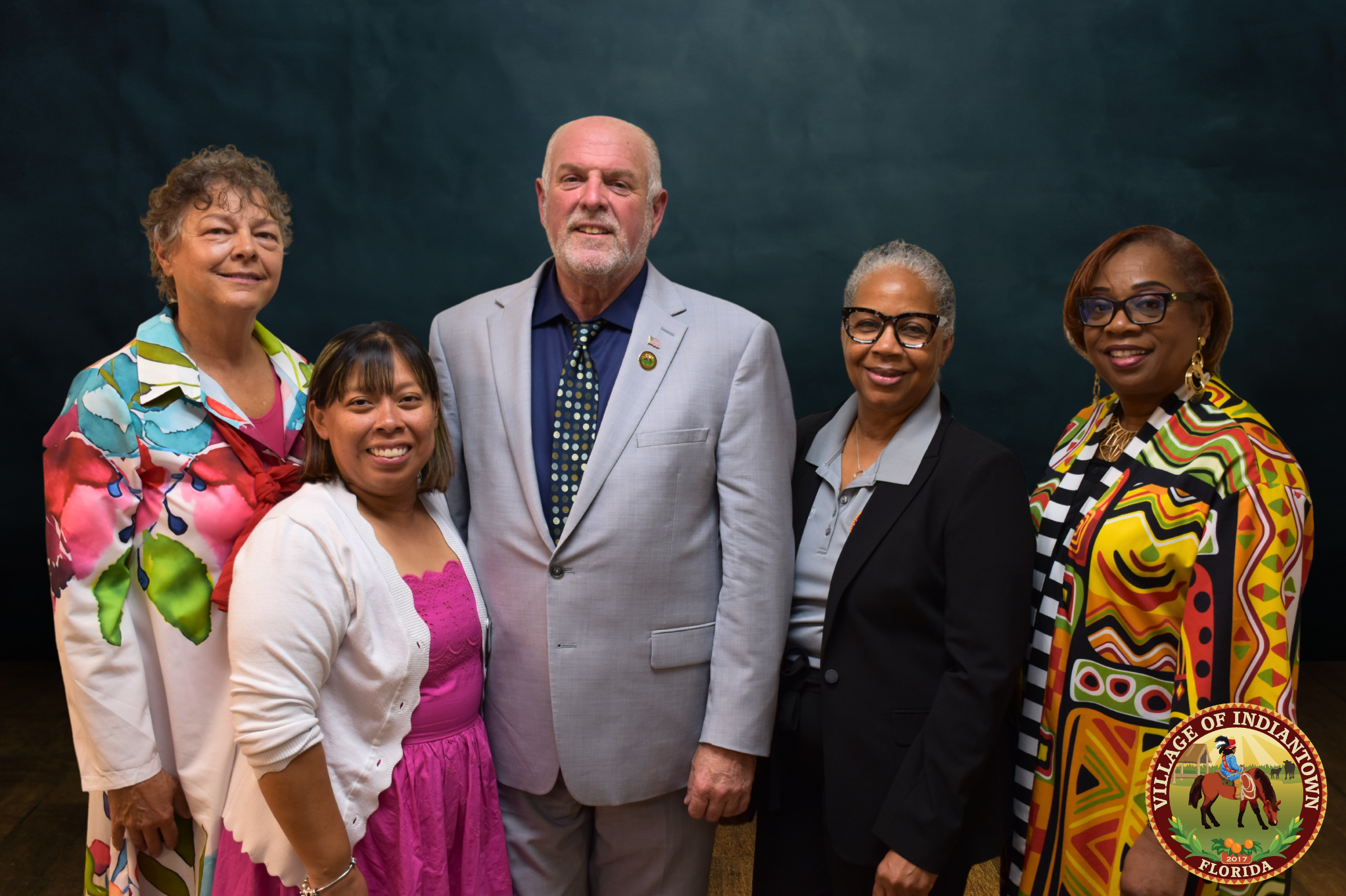
The Village of Indiantown is having a referendum initiative to decide whether Indiantown will mirror Martin County and offer tax incentives for businesses located within the village. The vote will be done only by mail.
Why a mail ballot? It was the quickest way to place the question before the voters. There are a few problems with mail-in only elections. The lack of participation by the voters is the main issue. Indiantown has never had the greatest participation even with a regular in-person election.

Speaking strictly for myself and having nothing to do with Indiantown, I philosophically don’t believe in trying to lure business to a community with the use of incentives. Many studies have proven that once the incentives expire, the businesses may not hang around very long. So, what are the advantages? Indiantown may be in a unique position to come out a winner.
The economic incentive studies that have been done are more in line with big cities and big industries. Indiantown doesn’t have either. It is not like the Miami Marlins that received big tax breaks and incentives for their new park. Nor is it like the brouhaha that accompanied the luring of the national Amazon headquarters that occurred a few years ago.
In Indiantown’s case, there may be a data center that could come into play. Why would they locate in a place like Indiantown where there are no qualified employees for that enterprise or even enough water to make it feasible to build something like that within the boundaries of the village? It must be because they see something most of us do not. Lower taxes may be the thing that seals the deal.
I don’t know whether the council members understand the nature of how different types of development interact with each other. There are 3000 new homes being built or are on the drawing boards. The people who will buy them will come from largely outside of Indiantown. What will make a family living in Terra Lago become part of the greater Indiantown community? If mom and dad drive every morning to Port St. Lucie or Palm Beach Gardens for work, that is where they will spend much of their time.

Their kids will be in day care close to where they work. Even when it comes to where the kids go to school, many will bypass the local public schools in favor of better performing private ones. Presently Indiantown has no retail, restaurants, or food markets that these new residents will shop at.
A well-rounded place will give employment opportunities to all their citizens. Blue- and white-collar jobs. Ideally few will need to leave the village. That will make for better schools and retail establishments. A place for all residents to reach their potential. It can’t just be a place to buy the cheapest homes in the area.
Any businesses setting up in Indiantown are not moving into 2nd generation facilities. They will construct new plants where nothing was built before. Land that paid no taxes will suddenly pay taxes. And that is not to mention the personal property tax that will be due.

You hear council members saying things like we need to catch up on the development that is occurring. Industrial has nothing to do with residential. They are two different products that should complement each other. In other words, they do not compete.
Like council members, some residents don’t get what Indiantown’s development is all about. At the last council meeting, a resident stated that she wouldn’t mind paying more if it went toward infrastructure, but residents shouldn’t have to pay more so that developers pay less. Does she mean by that statement that the new homeowners at Terra Lago shouldn’t receive a subsidy by paying less in real estate taxes? If that is what she meant, then I would agree.
I would imagine, though, that she conflated what residential development pays in taxes and what an incentive would do for business. No business has homestead exemptions or the myriad of other tax breaks that accompany residential real estate. Comparing the two is like the proverbial apples and oranges.
If I had a vote on the referendum, I don’t know how I would cast my ballot. Philosophically I am against government giving breaks to business. But if there were any time when it would be needed, it is in the Village of Indiantown now.
Too many of us call ourselves Conservatives when we don’t have the slightest idea what that term means.
Some political thinkers believe it arose in the aftermath of the English Civil War in the 1650s with the restoration of Charles II as monarch in 1660. Thomas Hobbes’ “Behemoth,” published in 1681, was both a history and philosophical treatise on the war and its causes. He concluded that change should be made slowly, and society should conserve the values that came before.
 Hobbes thought of himself as a monarchist. In that world, tradition counts. That is why he did not support what became to be known as the “Glorious Revolution” of 1688 which brought to the throne William of Orange from the Netherlands and his wife Mary who was James II’s daughter. James is who Parliament was overthrowing. With this almost bloodless revolution, the “Divine Right of Kings” was supplanted by what is today’s Parliamentary government being supreme.
Edmund Burke is considered the father of Conservatism. He saw the French Revolution with the chaos and violence that accompanied it and believed that change can happen and be accepted but to repress change is dangerous. As a member of Parliament,  Burke was against the treatment of the colonies by the English government. He believed that to be conservative meant that society had to have morality and needed the guiding hand of religious belief.
That was the underpinning of the English Tory Party which evolved into the Conservatives of the 19th century. To be a Conservative meant to make your decisions using reason, logic, science, and morality.  You should not be anxious to break precedent. That is why William Blackstone’s “Commentaries” considered the bible of judicial precedent, is a contributor to the Conservative doctrine, and the foundation of English law.
Conservativism has had a problem with people calling themselves Conservative but espousing reactionary, racist, and illiberal doctrine. A true Conservative is not someone who wants to restrict the liberty of others but embrace their liberty while everyone else does the same. They seek to broaden the debate and do not demonize their opponents.
I don’t believe today’s Republican Party is a conservative party. Frankly it is reactionary, inconsistent, and narrow in its tolerance of other’s views. The continued climbing of the national debt is irresponsible and the antithesis of a conservative doctrine.
Being a Conservative is not being anti-government. Republicans currently control both the executive and legislative branches and govern as supposed outsiders and call it conservative. That is just plain ridiculous.
Conservatives are not anti-tax. They are in favor of a government that pays its bills. While Conservatives believe in limited government, they don’t believe you can pretend that you are conservative and leave a debt for our children and grandchildren.
 The French monarchy under Louis XVI was guided by, and if you follow Burke’s logic, anything but the status quo. Because there was no relief valve for hearing the people, society fell violently apart, and a blood bath ensued. If the French Estates-General (their Parliament) had the least of democratic principles, then it might have all been avoided.
What we have in today’s America is a reactionary populist government without any guiding principles. Congress should be making sure the people have a voice. Instead, they have abrogated their constitutional responsibilities. They have become very similar to the Chinese Politburo or Russian Duma. A virtual stamp on the president’s contrasting whims.

Don’t use the word Conservative to describe those who rule today’s Washington. That would be an insult to Burke and the millions of his true adherents. Call it what it is the MAGA Movement.
IF YOU ARE NOT A SUBSCRIBER DO SO FOR FREE HERE www.friendsandneighborsofmartincounty.com
GET THE WORD OUT
Friends and Neighbors of Martin County is your eyes and ears so that you know what is going on in Martin County’s municipal and county governments. I attempt to be informative and timely so that you may understand how your tax money is being spent. Though I go to the meetings and report back, I am no substitute for your attending meetings. Your elected officials should know what is on your mind.
Tom Campenni 772-341-7455 (c) Email: thomasfcampenni@gmail.com
Tom’s Articles
From Medium
"A Lifetime of Friendship"
Other Articles:
Florida Phoenix: "Miami-Dade Coiunty mayor seeks oversight pf Evergrades Immigration Detention Center"
Boondogle: "The Cost of State Data Center Handouts Is About To Explode"
Realtor.Com: "Is the Sun Belt in Trouble? Homes Are Taking Longer To Sell in These Once-Popular Markets
The Upshot: "A List of Nearly Everything in the G.O.P. Bill, and How Much It Would Cost or Save"
The New York Times: "President Trump has achieved much of his agenda, leaving the fate of the economy squarely in his hands."
The Capitolist: "Florida Tax Watch Report: Tariffs Set to Drive Up Costs for Consumers and Businesses"
Substack by Paul Krugman: "Trump's Brazil Tariff Is Blatently Illegal"
Washington Post: "Trump can's achieve his economic goals without more immigrants" By Stephen Moore and Richard Vedder
TC Palm: "School grades: All 3 Treasure Coast districts get A's from Florida Department of Education"
Copyright © July 18, 2025 Friends & Neighbors of Martin County, LLC., All rights reserved.