


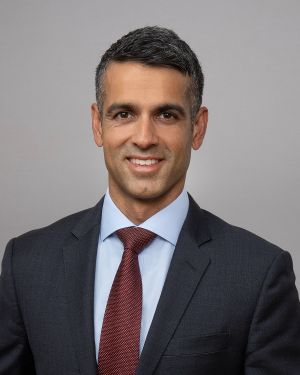
 “Dr. Choudhary has been instrumental in driving quality and clinical excellence at Tradition Hospital,” said Conor P. Delaney, MD, PhD, President of Cleveland Clinic Florida Market. “His leadership has helped elevate patient care, expand our services, and strengthen our mission to provide the highest level of care for our communities. I look forward to seeing the continued success he will bring across our Martin Health hospitals.”
This is our first newsletter in 2026.
There wasn’t much government activity occurring in the first week of the new year. It ramped up a bit this week and will be back in full swing next week.
Because of the holiday season, we will be running back-to-back issues. One today and another next Sunday the 18th. Then back to our regular schedule of twice a month.
2026 is an election year. It will be one full of contention and plenty of dirt being shoveled even locally. Don’t let claims that confuse you.
There will never be candidates that you agree with all the time. There are some that are outright unfit for office. Remember that as we point things out to you.
We have all our great columnists ready to give you their opinions on matters, big and small, political and practical, and always helpful. This digital newspaper could not come out without their hard work. And we can’t forget the other people, mostly volunteers, that help with the behind-the-scenes functions from editing to graphics to how we look on the internet.
Let me know if you want to become involved.
Now sit back and relax, pour yourself another cup of coffee, and dive into Friends & Neighbors.
Have a great Sunday Morning!
People constantly complain about the weather.
I am no exception. In the summer, I can barely tolerate the heat. When you go out even at 5 in the morning, the temperature can be 80 degrees. Yet to many, this is the charm of South Florida.
I must admit that until about the middle of September, I find the heat and humidity are tolerable. Twenty years ago, you knew that in another month or so temperatures would finally break, and the first cool breeze would announce autumn. Now you can’t be so sure about that.
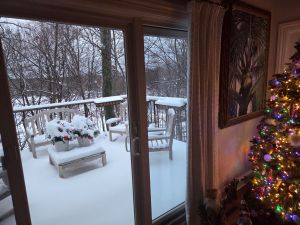 As I write this on December 23rd out my window in Connecticut, I am looking at the snow falling. There is a preserve surrounding our town home, so from the inside at least it is very pretty. We won’t have to shovel or clean the front walk, which is the beauty of town home living. It is someone else’s responsibility.
Before we moved to Florida, we had a home here in Connecticut, and the snow shoveling was a major reason why we decamped to sunnier places. I remember leaving at 5 am to drive to my New York City office. I always hoped the snowplows were out first.
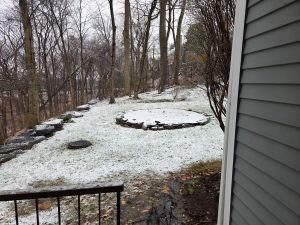 Now that I am retired, I can sit in my house and watch the snow fall and cover the trees and ground in white. Unlike snow when it falls in the city, here it will remain white and not have that nasty turn to black. It is also Christmassy and like a picture post card.
At this time of year, a million people flee to Florida to have a break from the cold snowy weather. And if it wasn’t for the holiday season, maybe I would also want to be at home in Martin County. I can’t think of anywhere else but in Connecticut with family that I want…no need to be a day before Christmas Eve…even with the weather.
 We went to an evening church service on Sunday. We are fortunate that within walking distance we have Congregational, Methodist, Presbyterian, and Episcopal churches. It was at the Episcopal church, and we attended a service entitled “Carols by Candlelight.”
The few times we stayed in Florida in the past 20 plus years during the holidays, I can think of twice where all the kids ended up visiting us. They all have jobs and obligations, and mostly I was just lonely without each of them. I guess that is the nature of the holiday—family. Because of that, even a snowstorm won’t keep us away.
Owning a newspaper, a magazine, or even a television station or network was once viewed as a sacred trust.
 The most important thing for many of these men and women was their integrity. There was no mayor, governor, or president that could get them to pull a story out of fear. They may have kept something under wraps if it were for national security but not because it made the government look bad. Dorothy Schiff Publisher New York Post
It didn’t mean the owners didn’t have their prejudices and points of view. Some were liberal while others were conservative, but they would have hung their heads in shame if any local, state, or national bigwig could frighten them away from telling the story.
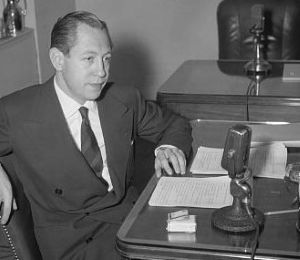 William S Paley Owner of CBS
Freedom of Speech was an absolute. They printed the news without fear or favor as they once said. But no more.
Now newspapers are a shadow of themselves. Few people under the age of 60 bother to read them. Where once there were many news type magazines, now the few that are left are inconsequential and will join the others, ceasing to publish soon.
The broadcast stations are small parts of broadcast networks which in turn are owned by conglomerates. The corporate owners are not going to let a story exposing a wrong stop a merger when it is so much simpler to kill the story and please the president, especially one with exceedingly thin skin.
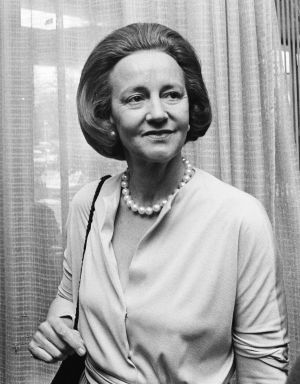 Katherine Graham Publisher of Washington Post
Back in the 1970s some people believed that at one point there would be just a handful of corporations that would own everything. Many of us laughed and thought the government would never let companies grow that large whether as vertical or horizontal entities. Anti-trust laws would prevent that. Too much accumulation of market share was against the law going back to the Rockefeller and Carnegie Trusts of the Gilded Age.
Little did we know we would once again be in another Gilded Age. Not one of manufacturing concentration but one of entertainment and communication. News organizations are a miniscule part of those business behemoths. Is a news story exposing greed, corruption or wrongdoing going to be allowed to get in the way of making money? Hell No!
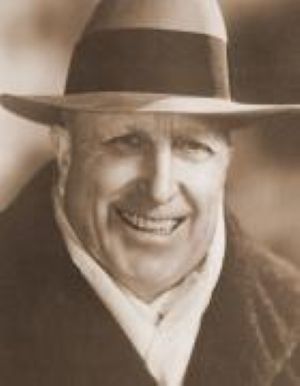 William Randolph Hurst
Everyday a little more integrity is lost. Truth doesn’t matter even in a name, hence “Truth Social.” Where once publishers may have dined with presidents but never allowed them to dictate editorial policy to their news organizations. Now it is routine because a publisher is no longer the owner and trustee of a great asset but an employee and cog in some massive business structure.
Reporters that once had to make sure their stories were accurate now must also make sure that those stories tow the administration line. The loss of freedom to our nation and our people is incalculable. Though our government would like all of us to ultimately be tamed like Winston Smith of “1984” instead we could be the successful rebel exemplified by Guy Montag in “Fahrenheit 451.”
By any metric, Martin County is a high tax county.
Florida Tax Watch has our little old county in 5th place with a per capita tax amount of $3,656.86. For school taxes, we are ninth per capita in the state at $1,337.17. Why does it require so much funding to run county government and the schools?
With roughly 167,000 people, we are tiny compared to surrounding population centers. Our main problem is that we don’t have the economic infrastructure to maintain our champagne tastes. We hate new development and industry, but we want government services that go with a much larger economy.
For too long, we have been told that we can have an urban fire service with all the bells and whistles without the tax base to pay for it. Martin County’s Sheriff’s Department is one of the best in the state. Yet the main reason we have so little crime is that our population is skewed old, middle class, and small.
We like to portray ourselves as one big Mayberry, but our Sheriff’s Department is much more like a big city one than Sheriff Andy Taylor. Our crime fighters are sophisticated and have the best in tactical and crime solving technology. All of which cost money.
 If Martin County residents want the best (and they should have it), they need to realize it comes with a cost. The cost can be spread over our 167,000 residents and very few commercial enterprises or allow the population growth and expand the number of businesses to help offset the costs. There is a balancing act, but part of our expensive government includes great administrators who can figure it out.
If we want to be a rural county, then more of what government does falls on individuals. In most parts of the country, garbage collection is confined to the urban and suburban areas. Others must fend for themselves or privately hire trash collectors.
I once had a farm that was 30 miles from the nearest law enforcement facility. Dialing 911 wouldn’t get you very much. Our hospital was just as far, and the fire/rescue was our neighbors, but we also lived miles apart from each other.
This is not to say that Martin County should operate that way. But residents must come to grips that taxes will increase if the cost of government services goes up. In other words, the government that residents have come to expect, and in some cases demand, will become more expensive.

Commissioners have a responsibility to plainly tell voters what to expect. Promises of everything for everyone will only lead to more disappointment. Not to mention that our state ratings for per capita taxes paid will continue to climb.
I believe one of the main reasons that Tallahassee is taking away local control of issues is because of abuse by local governments.
 Time after time, egged on by a minority of residents, local elected boards are denying the property rights of individuals, their own local ordinances, and state statute. For some reason, vocal individuals believe that town and county commissions can arbitrarily refuse to grant development rights to individuals even though by doing so property owners are being discriminated against.
 If there is an ordinance or state statute on the books granting a permitted use, it is wrong for the local body to vote no…regardless of whether the individual town council members agree with the project or not. They are obliged to follow the zoning code and LDRs. It would be mandatory for a yes vote.
That was recently the case when the owner of two adjacent parcels that had different but compatible zoning asked for the same zoning on both. The Stuart Commission denied the rezoning with excuses that were frankly idiotic. A court decision last month found for the property owner.
 It wasn’t a change in use because both zoning classifications would allow for a hotel which was the intended use on that site. By denying assigning either classification to both parcels would effectively be a governmental taking. Is the City of Stuart ready to buy that property at market price?
Legislators in Tallahassee hear these complaints about usurpation constantly from their local constituents. The only way the state can correct it is by restricting local control over development decisions. In the last several years, we have seen more of the legislature doing just that.
Every bad decision by local government results in calls to restrict and pre-empt what counties and municipalities may do. Local elected officials playing to their supporters instead of adhering to the law makes one more state official think restriction is a good idea. Even more troubling is when the local official is clueless as to what they can and cannot legally do when voting on these requests.
 Loss of local control will only accelerate with the several restrictive property tax measures going through the legislature now. Without the means to pay their bills, local government will be forced to cut back. It would appear to me the economic and land development decisions will be heavily proscribed by the state, leaving public safety in the hands of local government.
Elected officials such as Chris Collins are the reason local governments are more and more restricted. You cannot ignore the laws of the State of Florida and expect to be rewarded.
At the cusp of each new year we feel pressured to make resolutions. Eat better. Do more. Be more. The calendar flips to January 1 and suddenly we’re expected to reinvent ourselves. But anyone who has spent time on a farm knows that real growth doesn’t happen in a moment; it happens over time, with intention, patience, and care.
On the farm, no one plants a seed and expects a harvest the next morning. There’s a pattern to growth: planning, planting, tending, resting, and finally harvesting. Perhaps the new year, instead of adding more resolutions to an already full plate, create patterns that allow the things that matter most to grow sustainably.
Resolutions often fail because they demand perfection. Patterns invite consistency. A resolution says, “I will never miss a workout.” A pattern says, “I will workout regularly and adjust when life gets busy.” One is rigid. The other is realistic. Just like agriculture, patterns account for weather, unexpected challenges, and seasons of rest.
What if we approached family life this way? Instead of resolving to “spend more time together,” we could build simple patterns like weekly family meals without screens, a monthly service project, or intentional conversations during everyday moments like car rides or chores. These small, repeated practices do more to strengthen families than one lofty goal.
The same is true for youth development. Young people don’t grow into confident leaders because of a single workshop or program. They grow because adults consistently show up, give responsibility, and allow room for learning from mistakes. When we replace one-time resolutions with ongoing patterns of mentorship, encouragement, and hands-on learning, we cultivate leadership that lasts.
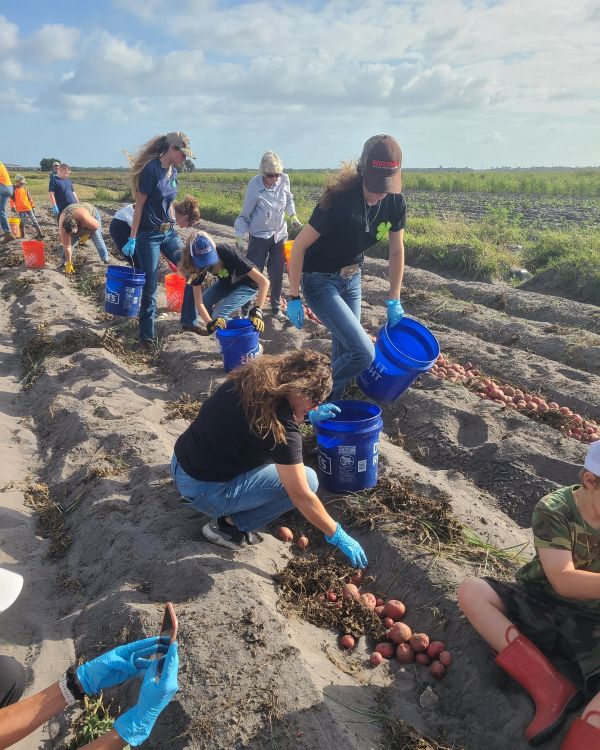
Patterns also matter in our communities. Supporting local agriculture, volunteering, or simply knowing your neighbors doesn’t happen by accident. It happens when we build habits of engagement. Habits like choosing to buy local over convenience, showing up to community events, and inviting others into shared projects. These actions, repeated over time, strengthen the soil of our communities.
As we step into this new year, consider trading resolutions for patterns. Ask yourself a farmer’s question: “What am I intentionally growing?” If the answer is stronger families, more capable youth, or deeper community connections, then the next question becomes: “What daily or weekly practices will support that growth?”
Growth doesn’t require perfection, but it does require attention. When we align our lives with patterns that reflect our values, we give ourselves permission to grow steadily rather than sprint and burn out. This year, instead of chasing quick change, let’s commit to sustainable growth one season, one habit, and one intentional choice at a time.
David Hafner’s opinions are his own and may not reflect Friends & Neighbors viewpoint.
We proudly celebrated the Humane Society of the Treasure Coast’s (HSTC) 70th anniversary this past year, a milestone that reflects decades of compassion, growth, and community support. The achievements of the 2024–2025 fiscal year show that our legacy of lifesaving work is only the beginning of an even brighter future for the animals in our care.
During the past fiscal year, we saw a 6% increase in adoptions compared to the previous year, along with an impressive 94% live release rate, reinforcing our commitment to maintaining no-kill standards. In total, 2,441 animals found loving homes through our programs and partnerships.
Overall, we served 8,352 animals through adoptions, spay and neuter surgeries, obedience training, surrenders, and other essential services. Our spay and neuter programs played a critical role in this impact, with 4,380 successful surgeries completed. By providing these affordable services, we continue to reduce pet overpopulation and improve the overall health and well-being of animals in our community.
Our Trap-Neuter-Vaccinate/Return-to-Field (TNVR) program also made a meaningful difference this year by assisting 666 community cats. These services are offered free of charge in Martin County, allowing us to humanely manage community cat populations while improving their quality of life.
Foster care remained a vital lifeline for animals needing extra support. This year alone, 1,378 pets were placed in foster homes where they received individualized care, healing, and socialization. Our volunteers continue to be the backbone of everything we do, with 451 dedicated individuals contributing an extraordinary 42,747 hours to support our mission.
Our Humane Education programs also thrived thanks to 93 pet therapy volunteers who generously gave 7,670 hours to serve the community. Through programs like Paws to Read, 149 children gained confidence and strengthened their literacy skills by reading to the gentle, non-judgmental ears of our therapy dogs. At the same time, 797 participants strengthened the bond with their pets through our Canine Connection training classes.
When 1,432 stray animals entered our shelter this year, our staff and volunteers worked tirelessly to reunite pets with their families. As a result, we achieved return-to-owner rates of 60% for dogs and 5% for cats, which is well above national averages.
As we look ahead, we are filled with excitement as construction continues at our Palm City shelter. As Martin County’s only no-kill, open-access nonprofit animal shelter, these renovations will enhance the care we provide while improving the experience for our animals, staff, volunteers, and visitors.
If you’d like to get involved or support the Humane Society of the Treasure Coast, we invite you to reach out or stop by. We are deeply grateful to our community and your continued support makes this lifesaving work possible!
Frank Valente's opinions are his own and may not reflect Friends & Neighbors viewpoint.
Over the last few days, conversations about Venezuela and forced regime change have raised serious questions for people of faith. Many are wondering how Christians should think about these events and what guidance Scripture might offer. While the Bible does not provide a detailed political roadmap, it does give us a clear moral and spiritual framework for reflection.
In the Lutheran tradition, we often speak of God working through two kingdoms — the spiritual and the earthly. Through earthly government, God seeks to preserve order, restrain evil, and protect human life. At the same time, no nation or leader stands above God’s judgment. All political power is limited, imperfect, and shaped by human sin. For that reason, Christians approach political questions with humility, caution, and a deep awareness of our own brokenness.
Scripture reminds us where true trust belongs:
“Some trust in chariots and some in horses, but we trust in the name of the Lord our God.” (Psalm 20:7)
At the heart of the Christian life is Jesus’ command to love our neighbor. That command challenges us to look beyond national interests and political calculations and consider how real people are affected by these decisions. The well-being of ordinary Venezuelans — families, children, the elderly, and the poor — must remain central to our moral concern. Their suffering is not theoretical; it is personal, and it matters deeply to God.

There is also reason for caution when actions like these begin to take on the shape of a broader pattern. History shows how easily the use of power can become habitual, how quickly exceptional measures become normal practice. When regime change becomes a recurring tool of foreign policy, the temptation to rely on force rather than patient diplomacy, cooperation, and peacemaking grows stronger. Christians are called to examine such patterns carefully, remembering that repeated uses of power shape not only global politics, but the moral character of the nations that wield it.
Lutheran theology is honest about the human condition. Even the most carefully crafted policies are influenced by fear, pride, and self-interest. Because of this, Scripture consistently calls God’s people toward peace and restraint. As the apostle Paul writes, “If it is possible, so far as it depends on you, live peaceably with all.” (Romans 12:18) Any use of force, if it is to be considered at all, must come only after sincere efforts at diplomacy, cooperation, and peacemaking have been fully pursued.
Finally, our ultimate hope does not rest in governments, alliances, or military strength, but in Christ alone. As citizens, we stay informed and engaged. As Christians, we pray for our leaders, seek peace in a troubled world, and continue to serve our neighbors with compassion and courage — trusting that God’s reign is advanced not by coercion, but by grace.
Chad Fair's opinions are his own and may not reflect Friends & Neighbors viewpoint.
Every now and then I come across an idea that doesn’t just make me think - it makes me feel calmer. Recently it was an article by Arthur C. Brooks in The Atlantic called To Get Happier, Make Yourself Smaller and it suggested something surprising. Maybe happiness doesn’t come from climbing higher, collecting achievements, or constantly trying to stand out. Maybe it comes from gently shrinking our sense of “me, me, me” and reconnecting with what actually matters.
That might sound strange at first. We live in a world that tells us to hustle harder, grab attention, collect likes, and keep proving ourselves. No wonder so many people feel exhausted, overwhelmed, and like they’re always falling short.
But think about the moments when you’ve felt truly peaceful. Looking up at a sky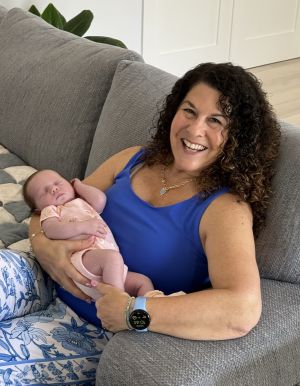 full of stars. Standing at the edge of the ocean with the breeze on your face. Holding a newborn and realizing life goes on long after we’re gone. Those moments don’t make us feel bigger. They make us feel beautifully small, and somehow, that brings relief.
When we stop trying to be the center of the universe, life softens. The pressure lifts. Things become less about performance and more about presence. Less “look at me,” more “how can I help?” A kind word. Checking on a neighbor. Doing something thoughtful without announcing it to the world. Those quiet, unfancy acts often bring the most genuine joy.
And it turns out, science backs this up.
Dr. Laurie Santos, the Yale professor behind the hugely popular class, The Science of Well-Being, studies what truly makes people happy. Spoiler alert: it’s not more stuff, more status, or more applause. It’s gratitude. Connection. Purpose. Perspective. The simple things we sometimes overlook.
This time of year always nudges me to think about what I want more of in my life, and maybe even more importantly, what I can gently set down. In my last column I wrote about skipping the big, dramatic New Year’s resolutions and instead creating a simple little “micro-list” of things that actually make life feel better.
I think this idea belongs on mine.
Not trying to be the loudest voice in the room. Not measuring life by applause or attention. Just choosing to live a little softer, notice the good a little more, laugh when I can, and remember that being part of something bigger than myself is a relief, not a demotion. There is something wonderfully freeing about saying, “I do not have to star in every moment. I can just be grateful to be in the scene.”
If you would like to explore this idea even more, you’re in luck. Dr. Laurie Santos is coming to Stuart on Thursday, February 26 at 7 p.m. as part of the Rappaport Speaker Series at Temple Beit HaYam. Her talk, Calm Amidst the Chaos: The Science of Happiness, makes all this research feel practical, funny, hopeful, and refreshingly doable. Tickets are available at RappaportSpeakerSeries.com.
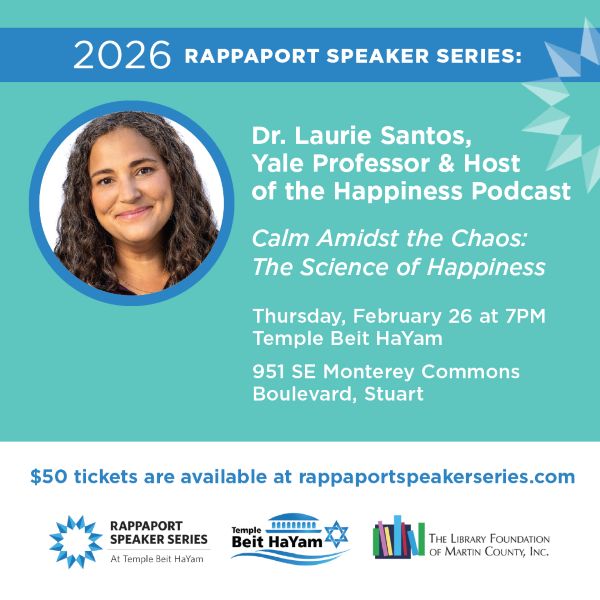
If happiness really does live in those quieter, humbler, beautifully ordinary spaces, then maybe this year we don’t need to chase it so hard. Maybe we just give it a little more room to show up in our lives, right where we are, doing the small things that matter most. One small thing I’ll be doing is attending that Laurie Santos Happiness event. Hope to see you there!
What does happiness look like to you? Let me know at stacy@fireflyforyou.com
Stacy Weller Ranieri's opinions are her own and may not reflect Friends & Neighbors viewpoint.
For the last five years, my work has focused on local economic development and helping successful business owners retire. Much of this work happens inside established local businesses many never see and few know exist in our community.
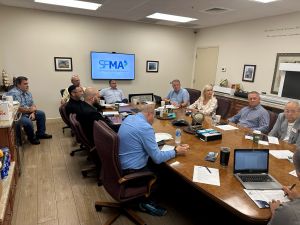 These businesses include manufacturing shops and specialized service firms in industrial parks, along with marine-related operations working along the river, the Okeechobee Waterway, and within those same industrial areas. They sell goods and services beyond Martin County, bringing money in from elsewhere and converting it into local paychecks, local vendor work, and reinvestment. These are contributory businesses. They rarely make headlines, yet they quietly hold our economy together.
When contributory businesses are healthy, the local economy feels steady. People remain employed, local vendors stay busy, and facilities are maintained and improved using local contractors. The wealth these businesses bring in continues to circulate because ownership and decision-making remain close to the work and close to home.
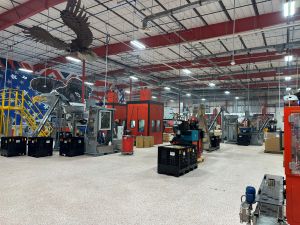 As baby boomers age, many contributory businesses are owned by people approaching a transition window. These businesses are often profitable and well run, with deep roots and long-standing local relationships. Their operations are solid, their teams are capable, and they provide value both to the owners and to the community that has grown around them.
When ownership becomes remote, the effects tend to appear quickly and in familiar ways. Decisions are no longer made here, and the people who once handled issues directly are no longer the ones deciding what happens next. Vendor relationships change, services are reorganized, and what had once been responsive and nearby becomes harder to reach.
This pattern often appears when businesses are sold to out-of-area owners. The operation may continue locally, but decisions, vendor relationships, and control move elsewhere. Over time, experienced employees leave, institutional knowledge thins, and problems take longer to resolve because the people who once made things work are no longer the ones deciding how they should work. Customers notice it first in small ways, vendors notice it when long-standing work disappears, and employees feel it as judgment gives way to policy.
For many business owners, this creates a natural pause. They have spent decades building something that works, employing people they know, and serving customers who rely on them. They understand that a sale changes more than ownership on paper. It changes who decides, how quickly problems get resolved, and whether judgment still matters, even if the business continues operating.
At full employment, economic development is no longer about adding jobs. It is about strengthening the systems that already work, including how money enters the community, how long it stays, and how much of it reaches local paychecks and contributes to lasting wages and wealth.
Bill West’s opinions are his own and may not reflect Friends & Neighbors viewpoint.
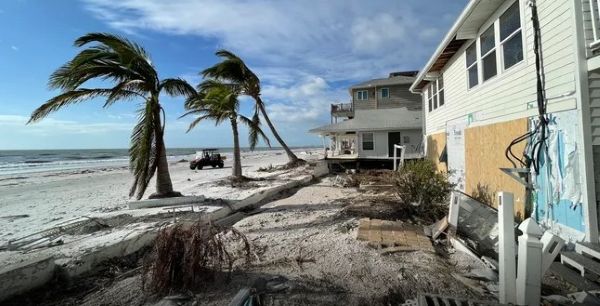
Every year when hurricane season returns, so does the narrative: “Storms are getting worse”, “Florida is becoming unlivable”, “This has never happened before.” But Florida’s own history tells a far more nuanced - and far more important - story.
Florida has always been hurricane-prone. Long before air-conditioning, high-rises, and coastal subdivisions, powerful storms shaped this state. The 1928 Okeechobee Hurricane killed over 2,500 people. The Labor Day Hurricane of 1935 struck the Florida Keys as a Category 5. Donna (1960) carved a destructive path across South Florida. Andrew (1992) levelled Homestead and permanently changed building codes and insurance.
The list goes on: Betsy (1965), Eloise (1975), Frederic and David (1979), Opal (1995), Erin (1995), and the devastating cluster of 2004–2005 – Charley, Frances, Jeanne, Wilma, Katrina, and Rita - all struck or materially affected Florida.
So, hurricanes are not anything new or more dangerous.
What is new is how much Florida has put in harm’s way.
Since 1970, Florida’s population has more than tripled. Coastal development has surged vertically and horizontally. Replacement costs have skyrocketed. Property & Casualty insurance and risk have become deeply intertwined with global reinsurance markets. When storms hit today, they are hitting far more people, far more buildings, and far more value than at any time in history.
For South Florida and the Treasure Coast, this history is personal.
Hurricane Andrew (1992) remains the defining storm for Miami-Dade and Broward. Wilma (2005) swept across the southern peninsula causing widespread wind and infrastructure damage. More recently, Irma (2017) affected virtually the entire state, including Martin County. Matthew (2016) and Dorian (2019) brushed the Treasure Coast with damaging winds and coastal surge. Ian (2022) devastated Southwest Florida but rippled insurance, housing, and economic impacts statewide. Even storms that do not make direct landfall here - like Katrina, Rita, and Gustav - influence insurance markets, premiums, and rebuilding costs that hit local homeowners.
In other words: South Florida and the Treasure Coast live not only with storms, but also with the financial ‘aftershocks’ of these storms.
The real Florida challenge is not that hurricanes suddenly appeared. It is that we have layered massive population growth, dense coastal development, high asset values, and fragile insurance systems onto a naturally storm-exposed geography.
Florida did not become any more dangerous or hurricane-prone.
Florida became more valuable, more concentrated, and more developed - and therefore more expensive to protect. That distinction matters, because it reframes the conversation from fear to responsibility: how we build, where we build, how we insure, and how we plan for a future that Florida’s past has already warned us about.
Major Florida Hurricanes & Tropical Storms (1906–2024)
|
|
|
|
|
2024 Milton (Oct) |
2010 Danielle (Aug) |
1987 Floyd (Oct) |
|
2024 Helene (Sep) |
2008 Gustav (Aug) |
1986 Charley (Aug) |
|
2024 Debby (Aug) |
2007 Noel (Nov) |
1985 Kate (Nov) |
|
2023 Idalia (Aug) |
2005 Wilma (Oct) |
1985 Juan (Oct) |
|
2022 Nicole (Nov) |
2005 Tammy (Oct) |
1985 Elena (Sep) |
|
2022 Ian (Sep) |
2005 Ophelia (Sep) |
1984 Isidore (Sep) |
|
2020 Sally (Sep) |
2005 Rita (Sep) |
1982 Alberto (Jun) |
|
2019 Dorian (Sep) |
2005 Katrina (Aug) |
1979 David (Sep) |
|
2018 Michael (Oct) |
2005 Dennis (Jul) |
1979 Frederic (Sep) |
|
2017 Nate (Oct) |
2004 Frances (Sep) |
1975 Eloise (Sep) |
|
2017 Irma (Sep) |
2004 Ivan (Sep) |
1965 Betsy (Sep) |
|
2016 Matthew (Oct) |
2004 Jeanne (Sep) |
1960 Donna (Sep) |
|
2016 Hermine (Sep) |
2004 Charley (Aug) |
1948 October (Oct) |
|
1999 Irene (Oct) |
2001 Michelle (Nov) |
1945 Great (Sep) |
|
1998 Mitch (Nov) |
1996 Bertha (Jul) |
1944 Cuba-FL (Oct) |
|
1998 Earl (Sep) |
1995 Opal (Oct) |
1935 Labor Day (Sep) |
|
1998 Georges (Sep) |
1995 Erin (Aug) |
1928 Okeechobee (Sep) |
|
1994 Gordon (Nov) |
1992 Andrew (Aug) |
1919 Key West (Sep) |
|
|
|
1910 Cuba (Oct) |
|
|
|
1909 Hurricane (Oct) |
|
|
|
1906 Keys (Oct) |
Andy Noble’s opinions are his own and may not reflect Friends & Neighbors viewpoint.

"Vanity of vanities. All is vanity." Ecclesiastes 1:2
"Who is like the wise man? And who knows the interpretation of a thing? A man’s wisdom makes his face shine, and the boldness of his face is changed." Ecclesiastes 8:1
Since the very beginning, since we were capable of language and introspection, humans have had the self-awareness to ponder the quality of existence and attempt to negotiate the trajectory of life. Yep, we have always been prone to wanting to feel right and function right. Perhaps these innate drives are what most distinguishes us from other animals; we have the concept of time, affording us planned opportunities to improve our chances of survival. Survival has come to mean safety and success in our milieux.
The Book of Ecclesiastes in the Judeo-Christian tradition is a philosophical admonishment to seek a better life overall. This book has been subject to much interpretation and debate. We are accused of focusing on unimportant ephemera. We are challenged to seek greater understanding and knowledge of ourselves, and this is the basic premise of the categories of interaction we call psychotherapy. We have always had need to process our introspections to the end of improving our lives psychologically and functionally.
Throughout human history, shamans, Zen masters, sensei, clergy, and those otherwise enlightened with insights and wisdom have been therapeutic to those who sought wisdom and self-improvement. It is not surprising that with the decline of organized religion, this function has been expanded to include a new class of secular spiritual or psychological guides through our dysfunctions and discontents. Defining psychotherapy has become increasingly difficult though, as every systematized approach to psychotherapy has its own methods useful for particular problems. Consumers often find it difficult to discern exactly what type of psychotherapy they would need. The basic categories available today are the methods that focus on internal life and the methods that focus on external life.
Supportive psychotherapy is usually the first foray into fixing a problem. The therapist listens supportively and offers validation. There is no formalized didactic structure with clear cut goals. No one gets hurt. It offers innocuous human company in a lonely and hostile world. This modality tends to never end and does not use the often-painful corrective exercises used in other modalities.
Interpersonal Psychotherapy (IPT) is a systematized therapy conducted through a protocol which focuses on correcting dysfunction in identified relationships over 12 to 16 weeks. This therapy requires introspection and addressing dysfunctional interpersonal patterns of relationships, which if corrected, allows for greater satisfaction in the identified relationships. The patient is left with the knowledge of what works and what does not in negotiating others. Addressing painful interactions with others will often alleviate depression and anxiety caused by those relationships. IPT is evidence-based.
Cognitive Behavior Therapy (CBT) is a systematized therapy conducted through a protocol which is goal oriented and identifies cognitive distortions and dysfunctional behaviors; correcting distortions allows for developing functional behaviors. CBT is evidence-based. The therapist functions a life-coach, and the skills learned can be codified into a personal notebook for ongoing reference and repeating the pattern of search for distortions and improving behaviors.
Exposure and Response Prevention (ERP) is a specialized type of CBT which treats obsessive compulsive disorder by desensitizing exposure to obsessive triggers and allowing for decoupling from the compulsive behaviors. ERP is evidence-based.
Dialectical Behavior Therapy (DBT) is also based on CBT but is a program of therapy that includes individual and group interventions with a strong didactic component. DBT was developed to treat the affective instability, self-destructive drives, and interpersonal dysfunctions seen in severe borderline personality disorder. The goals of treatment are to control emotions, interpersonal effectiveness, and to attenuate self-destructive impulses through mindfulness training and distress-tolerance skills training. True DBT is not offered in individual psychotherapy practices and requires the resources of social service agencies. DBT is costly to implement and maintain, and so is increasingly uncommon to find, though components of DBT have been incorporated into the skill sets of therapists who do CBT or IPT. DBT is evidence-based.
There are numerous other types of psychotherapy which offer useful skills for human problems. It is important to match the right modality to the identified problem. It is appropriate to ask a therapist about their therapeutic skill set and whether it is a good match. Most therapists master a preferred modality; it is rare to meet a therapist who can conduct therapy with all modalities. It is also appropriate to ask how long therapy should take and to measure progress with discrete goals. Psychotherapy is goal-directed life coaching. There is no shame in Yoda’s teaching, “Much to learn, you still have.”
Dr. Louis Velazquez’s opinions are his own and may not reflect Friends & Neighbors viewpoint.
Yes, it’s 2026! Happy New Year! The end of year Holiday break is my favorite time of year. The Hamster wheel of everyday life slows down a bit and allows me to spend more time with Friends and Family. This year I also spent some time reflecting on what I have learned being more involved in Stuart civic activities. I share this because I think many of you are like me; busy as heck with little time to devote to community affairs but hope that good decisions are made for us by those in leadership roles.
I really enjoyed serving on Stuart’s Community Redevelopment Board (CRB) for 2025. This is probably a little-known entity to most citizens but has major responsibility influencing the future shape of our city. I was delighted to work with likeminded volunteers who all contributed to help make decisions on where and how best to invest millions of tax dollars to improve our community. We didn’t always agree and had great constructive debates to get to a reasonable board recommendation. My experience confirmed to me that many of us in the community are well intentioned and can discuss issues in a rational, respectful manner for the greater good.
In addition to serving in a formal role on the CRB, I also spent time with many community leaders individually on a bit of a listening and learning tour. I learned a lot. All of our elected city commissioners are passionate about their role and desire to help steer Stuart. Anyone watching or listening over the past year will also know that there is considerable friction among the commissioners and lack of agreement on most issues. This is very different than my experience on the CRB. Several long time community leaders indicated to me that the city commission has never previously been this divided and politically driven. Not sure how this plays out; I just hope they all remember that they are serving us.
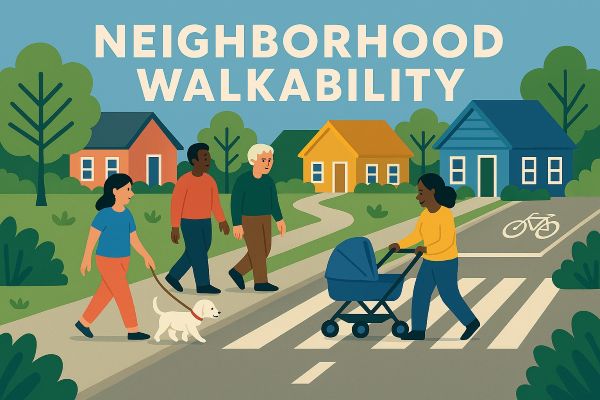
The two most popular topics from my listening tour were increasing greenspace and pedestrian friendly streets as well as health of the river. I run around with a segment of our local fisherman crowd and everyone is beyond excited about how clean the St. Lucie is currently. The water appears clearer and cleaner and we are seeing species which we haven’t seen in decades. Others are more knowledgeable on the details of why, but decisions made over the last many years may be finally paying off. It also helps that we haven’t had significant rain for several weeks….
I couldn’t be more pleased that our local citizenry also supports investments in green space and walkability. The CRB is well aligned with these goals as several big projects include sidewalk improvements, traffic calming, undergrounding utilities, and installing shade trees (my personal favorite). Although I was not selected to continue serving on the CRB in 2026, I will continue to volunteer in various capacities to help guide our future. Stay tuned.
Clay Scherer's opinions are his own and may not reflect Friends & Neighbors viewpoint.
For those of you who may not know, this January marks my 39th year working for United Way. I spent 29½ years in Niagara County, New York, and the past 9½ years here in Martin County. Over those decades, I’ve seen the highs and the lows of the United Way movement.
Recently, I had the opportunity to meet with someone I deeply respect. What they shared with me was eye-opening. They told me they knew United Way had been around for a long time—but they didn’t really know what we do. This truly was an eye opener for me. 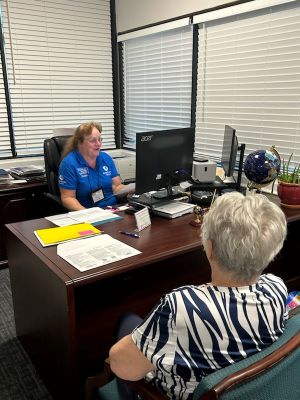
One thing I’ve learned over the years is that United Way does not do a great job of “tooting our own horn.” We are very good at highlighting the incredible partners we invest in, but we rarely pause to take credit for the role we play in creating real, measurable impact in our community.
So, if you’re someone who knows United Way has been around for a long time but isn’t quite sure what we do, please keep reading.
I want to highlight just some of what our organization accomplished in 2025 so you can better understand how United Way serves Martin County:
- Eliminating transportation barriers:
In just three short years, we launched and administered Ride United, a free, door-to-door transportation program for critical needs—doctor appointments, food access, employment, and more. While designed as a temporary solution, for many (especially seniors who have given up driving due to rising insurance and living costs), it is their only solution.
In 2025 alone: 755 unduplicated clients received 5,455 rides. - Free tax preparation:
Through our Volunteer Income Tax Assistance (VITA) program, we completed approximately 400 tax returns for local residents—at no cost. These individuals received the same electronically filed returns they would get at a paid tax service, saving them an average of $250 per return. - Disaster recovery from Hurricane Milton:
We contacted over 3,000 Martin County residents who registered for FEMA assistance following Hurricane Milton and the accompanying tornadoes. From that outreach, we helped dozens of households address unmet needs and bridge financial gaps between FEMA or insurance payments and the true cost of repairs. - Emergency response and preparedness:
We worked closely with the Martin County Emergency Operations Center on disaster response and preparedness. We also coordinated the opening of Cold Weather Shelters for vulnerable residents when temperatures, including wind-chill, dropped below 40 degrees for extended periods. - Emergency financial assistance:
We assisted more than 20 residents with emergency rent, mortgage, utility, or car payments. These individuals—often part of the ALICE population (Asset Limited, Income Constrained, Employed)—live paycheck to paycheck. One unexpected expense can send their lives into crisis.
This is not a handout, but a hand up. Clients participate in case management and must demonstrate that this one-time assistance will help stabilize their situation. Unfortunately, many more could not be helped due to unsustainable income-to-expense ratios, driven largely by rising rents and reduced work hours. - Holiday Project impact
Through our partnership with Toys for Tots, we provided 855 families with toys, books, balls, bikes, stocking stuffers, games, and food for a holiday meal. Because United Way of Martin County is considered a medium campaign, we brought over $23,000 in free toys into our community from the Toys for Tots Foundation.
In addition, nearly 160 local businesses hosted Toys for Tots collection boxes, and Zweben Law Group hosted their annual bike drive—raising critical resources to purchase bikes for local children. If we could grow our campaign to a large campaign, the value of toys received would increase to $43,000—resources brought from outside our community to support local families. That matters.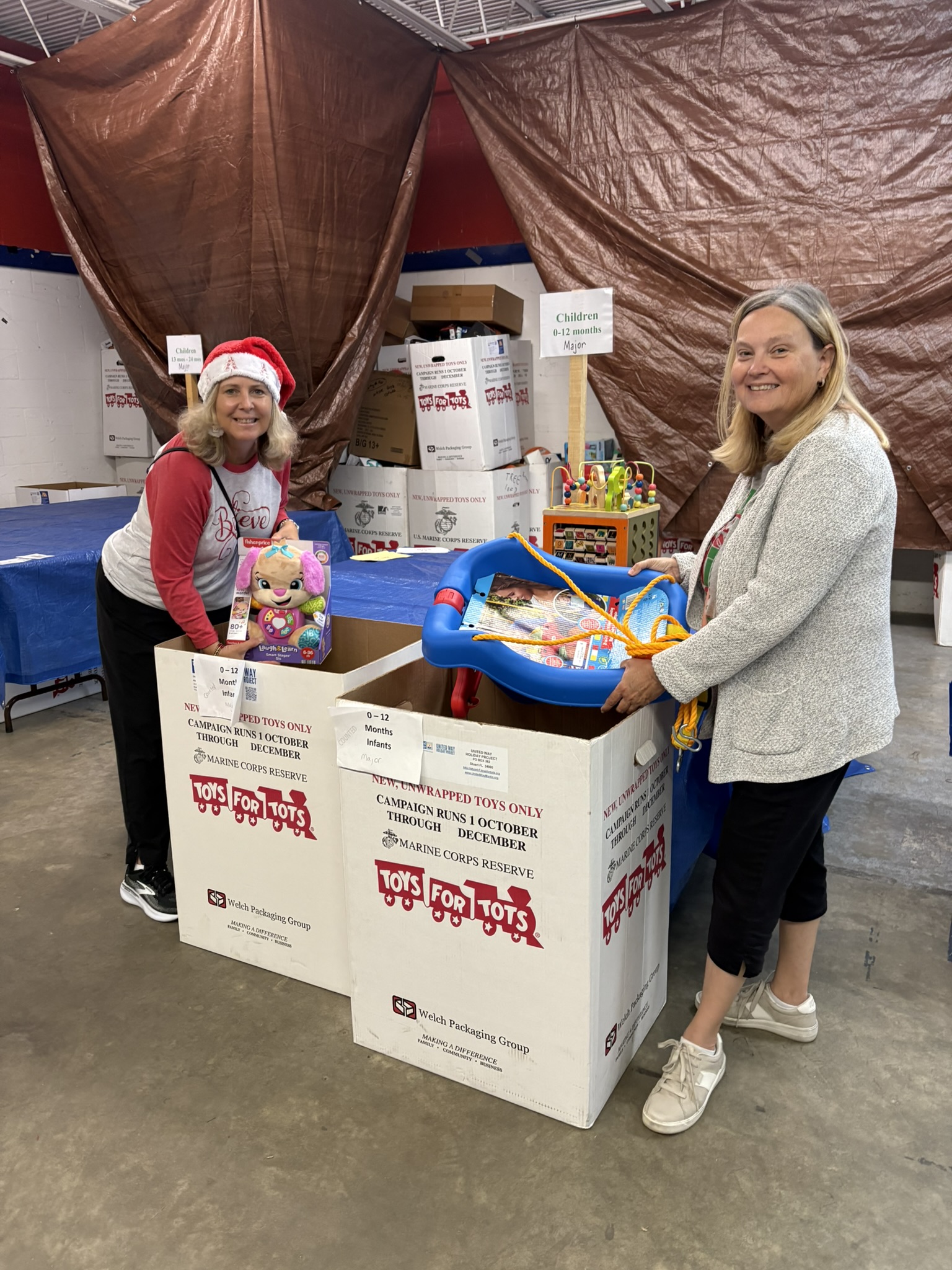
- Community education:
We premiered the documentary “Uncharitable” to help our community better understand what overhead really means for nonprofits—and why investing in strong organizations matters.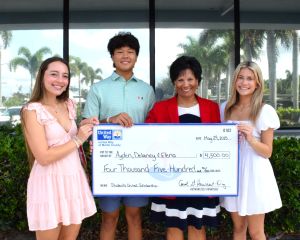
- Rapid response to SNAP reductions:
When SNAP benefits were suspended or reduced, we responded immediately by providing $20,000 to two organizations serving seniors and the broader community to help fill the gap. - Students United: Launched a scholarship program for high school students who have participated in the United Way’s Student United program. The benefactor of this fund started it because of his appreciation to the scholarships that he received that enabled him to be able to attend college. Three students received a scholarship this year to help them with college expenses.
- Investment in local programs:
And, of course, we continued our core work—investing in 44 local programs that directly impact individuals and families throughout Martin County.
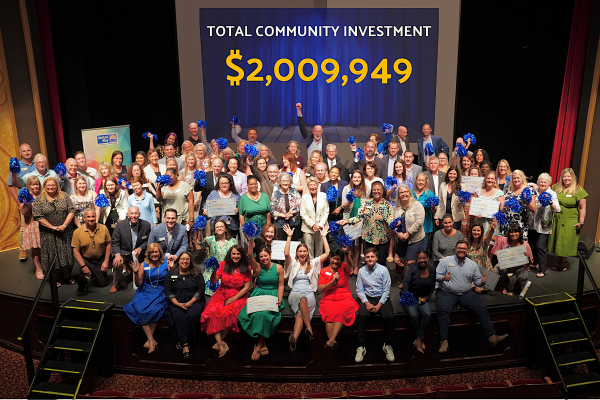
This list represents only highlights, not everything we accomplished—but it gives a clearer picture of the role United Way plays locally. I want to thank my friend for opening my eyes to a simple truth: many people don’t fully understand what United Way does—they just know we “do good.”
As we move into 2026, you’ll see us sharing more stories, more outcomes, and more good news. Here’s to a year focused on education, transparency, and strengthening the understanding of why a strong, healthy, local United Way is so important to our community.
For more information on United Way of Martin County, please visit our website www.unitedwaymartin.org or email me at chdiez@unitedwaymartin.org.
Carol Houwaart-Diez’s opinions are her own and may not reflect Friends & Neighbors viewpoint.
Happy New Year! After what is usually a flurry of activity during the month of December, the new year often brings with it a mixture of optimism for a year ahead and the difficulty of returning to normal routines after all of the fun and festivities of the holiday time.
That transition can sometimes be challenging, particularly for those who are suffering with a mental health challenge, for children or adults returning to school or work routines, or for those for whom the holidays may have brought unexpected life changes.
At Helping People Succeed, we work with all ages and people in all of life’s different types of circumstances, and so today, I share some tips to help you or your loved ones transition into this new year successfully.
First, prioritize emotional regulation before focusing on new year’s resolutions. After the hectic and festive nature of the holiday time, it’s best to try to “reset” rather than try to tackle big, ambitious (and often overwhelming) goals. Allow yourself and those you care for time to settle back into “normal” this month instead of pushing major behavior or life changes.
Second, reset routines gradually; not all at once. Focus on re-setting sleep schedules, meal schedules and choices, and transitions to and from work or school first and as priority. Visual schedules are a great way to help children and those with disabilities feel some predictability and control over their routines. Remember, transition from holiday fun to normal routine takes time, so take it one thing at a time.
Finally, focus on connection and relationship as you ease back into your normal routines. Knowing that transitions can be challenging, there is nothing better than pure and authentic connection with your loved ones to work through it together. Just building in time to the day or evening to just relax together, read together, chat together without the list of “to-do’s” is a great way to ensure connection and relationship stay strong during times of transition.
If you or a loved one needs support with mental health or parenting concerns, never hesitate to refer them to us or to contact us directly at 772-320-0770 or info@hpsfl.org.
I wish each of you a happy and healthy 2026!
Kara Stimpson's opinions are her own and may not reflect Friends & Neighbors viewpoint.
Reflections and resolutions. You really can’t have one without the other and there’s no better time to contemplate both than the end of one year and the beginning of the next.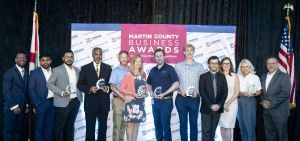
When looking back on 2025 the Business Development Board of Martin County’s core achievements in business retention, attraction and economic climate, I’m so grateful for the leadership and support of my board of directors, staff, colleagues and key partners who helped make it all possible.
Expanding businesses
 We were happy to participate in celebrating the new 44,000-square-foot, state-of-the-art boat facility at Hinckley Yacht Services, a legacy member of the area’s billion-dollar marine industry. We helped Choice Waste of Florida, a concierge waste and recycling management company, establish its corporate headquarters in Stuart. We also secured Catch Boatworks, which innovated its newly released vessel uniquely designed to accommodate in- and offshore fishing, as it opened its new 5,600-square-foot facility right here in Martin County.
 After assisting Power Systems Manufacturing with its decision to move back to Martin County after originally being founded here in the late 1990s, we participated in the recent ribbon cutting of the advanced manufacturing/clean energy company’s new 180,000 square-foot facility at the South Florida Gateway Distribution Center.
Business climate
Building on the efforts of my predecessors, we worked with the county and partners on the creation and passage of the Economic Toolkit, which enables qualified employers in targeted industries (such as advanced manufacturing) to seek specific tax relief in exchange for high levels of investment and high-wage job creation.
Listening to the feedback from local employers during our Pulse visits, we responded to concerns about access to capital by unveiling the Martin Loan Fund. This partnership with Inclusifi helps connect local entrepreneurs and young companies struggling to secure traditional bank loans attain critical funds on flexible terms. Please note: The BDB does NOT serve as lender but instead helps local businesses navigate the loan application process.
For the first time ever, the BDB enjoyed a presence at the Paris Air Show, the most prestigious international event for an industry that’s indispensable to our community. We expanded our network, generated leads and built a foundation for future partnerships. Best of all, we raised funds to ensure the trip was paid for entirely by private dollars.
Events and more
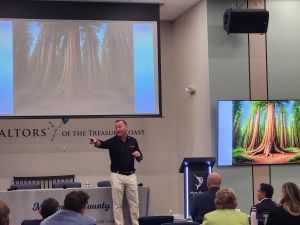 Earlier in 2025, we teamed with Martin County REALTORS of the Treasure Coast to host Horizons, an event that focused on key economic and commercial real estate trends. And we were of course excited to host the 2025 Martin County Business Awards. The marquis annual event, which honors innovators from across the local economy and sells out every year, was among our most successful yet.
Resolutions
Near the start of the year we updated our mission statement, affirming, in part, our role of helping business owners, entrepreneurs and executives “start, grow, stay, invest, and make it in Martin County.” Considering our previous progress, that sounds like the perfect resolution to pursue in 2026.
Happy New Year, everyone!
William T. Corbin's opinions are his own and may not reflect Friends & Neighbors viewpoint.
Cervical cancer is one of the most preventable cancers, and January’s Cervical Health Awareness Month presents a timely opportunity to help educate ourselves and save lives.
Cervical cancer typically develops slowly and is often linked to long-lasting infection with high-risk human papillomavirus (HPV), a very common virus spread through close intimate contact.
Dr. Paulette Griffin, a minimally invasive gynecologic surgeon at Cleveland Clinic’s Stuart Family Health Center says that because the early stages are usually silent, many women feel healthy and may not realize they are at risk—making routine screening essential.
Dr. Griffin tells us there’s a lot women can do to protect themselves:
- Cervical cancer is preventable through HPV vaccination, regular Pap and HPV tests, and timely treatment of abnormal cells.
- Do not wait for symptoms to seek care, as symptoms can be a sign of advanced disease. These symptoms may include abnormal vaginal bleeding, unusual discharge and pelvic pain.
- Lifestyle steps—such as not smoking, maintaining a healthy weight, using condoms and keeping up with well-woman visits—also reduce risk and support overall gynecologic health.
Expertise in Stuart
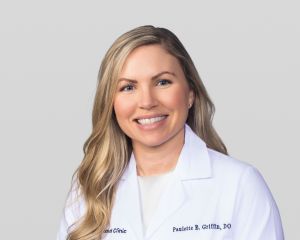 Paulette Griffin, DO, comes to Stuart after completing a fellowship in Minimally Invasive Gynecologic Surgery (MIGS) at Mayo Clinic in Jacksonville, Florida. She cares for women with a wide range of cervical and gynecologic conditions and is experienced in treating these issues:
- Abnormal bleeding
- Fibroids
- Endometriosis
- Ovarian cysts
- Fertility
- Pelvic pain
- Minimally invasive and robotic surgery
- Answer questions about Pap and HPV testing
- How HPV vaccination protects the next generation
- Helping patients sort through symptoms that should never be ignored.
Dr. Griffin is part of a team of six OB/GYN specialists who offer patient consults at Stuart Family Health Center at 3801 Soth Kanner Highway in Stuart, Florida. Four of those doctors also see patients for outpatient appointments at Tradition HealthPark Two in Port St. Lucie. This group of doctors has strong support from nurse practitioners with vast experience in obstetrics and gynecology. The OB/GYN specialists in Stuart can be reached via 877.463.2010.
The gynecology practice in Stuart augments services to women in our community and provides a venue for outpatient gynecological services, adding a minimally invasive gynecological surgeon like Dr. Griffin to offer advanced surgical options. We want to ensure patients receive focused, high-quality care in every stage of life. We welcome Dr. Griffin and the expertise she brings to the team.
Dr. Chirag Choudhary's opinions are his own and may not reflect Friends & Neighbors viewpoint.
Turning Hesitation Into Action: How Mike Gonzalez Became an Adopt-A-Road Champion
By Amanda Barry, KMB Program Coordinator and Adopt-A-Road Ambassador
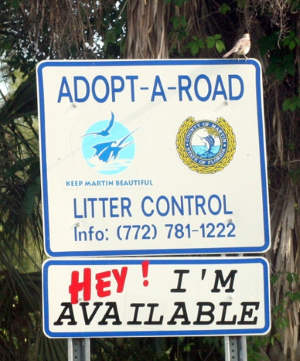 “What do I gotta do?” is what Mike Gonzalez thought when he was first encouraged to get involved with Keep Martin Beautiful’s Adopt-A-Road program. Like many people, he had seen Adopt-A-Road signs around town but didn’t fully understand what being an adoptee meant. Assumptions about cost, time, and commitment kept him from taking the first step.
Today, Mike is the 2024 Outstanding Adopt-A-Road Environmental Stewardship Award winner, recognized for his video content that highlights what adopting a road really looks like. We sat down with him to discuss how that initial hesitation turned into involvement and why he continues to be such a dedicated participant in the program.
That turning point came after talking with a friend who had already adopted a road, when Mike realized getting involved was much easier than he expected. Keep Martin Beautiful provides everything adoptees need, including gloves, trash bags, and Mike’s personal favorite, the pickup stick, which he affectionately calls his “handy dandy picker upper.”
Now fully involved, he heads out for cleanups every other month and shares the experience through video content on his social media. “I always try to post a video to show how Keep Martin Beautiful supports adoptees and that it does not take up a lot of your time,” Mike said, hoping to pass along the same knowledge that once inspired him to get involved.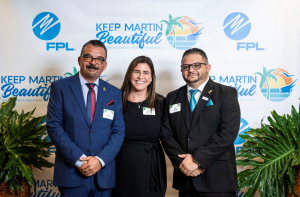
That consistent effort did not go unnoticed, but being recognized as an Environmental Stewardship Award winner still came as a surprise to Mike. “It was as shocking as when I won my second-grade spelling bee,” he joked, noting that in both cases there were many deserving participants. Attending the awards opened his eyes to just how deeply environmental stewardship runs through Martin County.
From children and community groups to local businesses and developers, the event highlighted the many ways people are stepping up to protect the environment.
You can see that dedication firsthand at the 2026 Environmental Stewardship Awards, taking place on April 30, 2026, at 6:00 p.m. at Willoughby Golf Club. Tickets go on sale soon and sponsorship opportunities are available!
Whether you attend the celebration or choose to take action in your own neighborhood, now is a great time to get involved. Roads are currently available for adoption through Keep Martin Beautiful’s Adopt-A-Road program. Visit keepmartinbeautiful.org to see available roads, or email info@keepmartinbeautiful.org to learn more and discover other ways to get involved.
Amanda Barry's opinions are her own and may not reflect Friends & Neighbors viewpoint.
It’s the beginning of a new year, and it is always fun to put out predictions of what we will see. Keeping in the technology field, I put together a list of technological predictions for both small business and the consumer. Of course, they are heavily AI leaning but that truly is where the industry is going.
Here we go:
For Small Business:
- Agentic AI Assistants
Affordable AI tools will handle scheduling, invoicing, marketing campaigns, and even customer support autonomously — reducing overhead and freeing up time. - Edge AI & Smart Devices
Smart sensors and IoT will make inventory tracking, energy management, and predictive maintenance accessible without big IT budgets. - Hybrid Cloud Solutions
SMBs will adopt lightweight hybrid setups—cloud for flexibility, local edge for speed—without needing enterprise-scale infrastructure. - Enterprise Metaverse → Virtual Collaboration
Instead of full metaverse investments, SMBs will use immersive meeting tools and virtual showrooms for remote clients. - 5G-Advanced Connectivity
Faster, more reliable mobile networks will enable real-time video consultations, AR product demos, and better remote work. - Cybersecurity-as-a-Service
Identity-first security and AI-driven threat detection will come as subscription services, making advanced protection affordable. - Blockchain for Payments & Contracts

Expect easier access to stablecoin-based payments and smart contracts for freelancers and small vendors—reducing transaction fees and fraud. - Composable AI Tools
Instead of one big AI platform, SMBs will mix specialized AI apps for marketing, HR, and analytics—often pay-as-you-go. - Robotics-as-a-Service (RaaS)
Small warehouses and retail shops may rent robots for inventory or delivery tasks without huge upfront costs. - Quantum Computing (Indirect Impact)
Not direct use yet—but SMBs in finance or logistics will benefit from quantum-powered services offered by cloud providers.
For the Consumer:
- Personal AI Agents
Think AI that books travel, negotiates bills, and manages subscriptions automatically. - Smart Homes with Edge AI
Appliances will predict maintenance needs, optimize energy use, and integrate with health monitoring. - Immersive Shopping & AR
Virtual try-ons and AR product previews will become standard for e-commerce. - Ultra-Fast Connectivity
5G-Advanced will make streaming, gaming, and VR seamless—even on mobile. - Better Privacy & Security
Consumers will see more identity-based security (biometrics, passkeys) and AI fraud detection for banking and social platforms. - Digital Assets & Tokenization
Mainstream apps will let users invest in fractional real estate or art via tokenized assets. - Affordable Robotics
Home robots for cleaning, elder care, and delivery will become more accessible.
 How many of these will become reality? Always a good question, but I think some of these will start hitting by the end of 2026 and become common within a couple years. The speed at which AI is changing the world is phenomenal, and it will affect us in what we do and how we do it.
If you saw something that piqued your interest, let me know. I would love to get your thoughts as well.
Eric Kiehn’s opinions are his own and may not reflect Friends & Neighbors viewpoint.
The start of a new year is an ideal time to review your plans and ensure your personal, financial, and healthcare affairs are organized. Planning ahead isn’t just for seniors—it’s something every adult should consider. Life can change unexpectedly, and having the right legal documents in place ensures your wishes are respected and your loved ones are protected.
Why Legal Planning Matters
As we age, decisions about healthcare, finances, and personal care become increasingly important. Without proper planning, families can face unnecessary stress, delays, and even legal disputes. Legal services provide peace of mind by helping you prepare for these situations before they arise.
A Board-Certified Elder Law Attorney specializes in these issues and can guide you through the process. Here are some essential documents and considerations:
Key Legal Documents for Aging Adults
1. Power of Attorney
A Power of Attorney (POA) gives someone you trust the authority to act on your behalf in financial or legal matters.
- Why it’s important: If you become incapacitated without a POA, your family may need to go through a lengthy court process to manage your affairs.
- Tip: Test your POA with banks and financial institutions early. Many require specific language, and failing to include it can cause delays when you need it most.
2. Health Care Surrogate
Also called a health care proxy or medical POA, this document appoints someone to make medical decisions for you if you cannot.
- Expanded authority: You can allow your surrogate to act even when you are not incapacitated, which can be helpful during hospital stays or complex treatments.
- Tip: Choose someone who understands your values and is comfortable making difficult decisions.
3. Living Will and Advance Directives
These documents outline your preferences for medical care, such as life support or end-of-life treatment.
- Why it matters: Advance directives prevent confusion and disagreements among family members during critical moments.
- Tip: Review these documents regularly and update them as your wishes change.
4. HIPAA Releases
Without HIPAA authorization, your loved ones may not be able to access your medical information.
- Tip: Include HIPAA releases with your healthcare documents to avoid delays in treatment decisions.
Additional Planning Tools
 Beyond these basics, you may also need:
- Trusts: To manage assets and avoid probate.
- Guardianship documents: For situations where someone needs legal authority to care for you.
- Property deeds and title transfers: To ensure smooth transitions of ownership.
Area Agency on Aging of Palm Beach/Treasure Coast, Inc.
The Area Agency on Aging is here to support seniors, adults with disabilities, and caregivers. We advocate for independence and well-being, and we encourage you to know us before you need us.
For guidance and resources, call our Helpline at 1-866-684-5885.
Dwight D. Chenette's opinions are his own and may not reflect Friends & Neighbors viewpoint.
Last year, the majority of Martin County voters elected to adopt a penny tax to purchase conservation lands in an effort to preserve the real Florida here in Martin County.
While the final purchase decision comes from the Board of County Commissioners, the initial evaluation and recommendation comes from the Environmental Land Oversight Committee (ELOC)—a diverse group dedicated to maximizing the funds and stretching that penny just as far as it will go.
One of the smartest ways the ELOC can stretch conservation dollars is by identifying lands already prioritized by Florida Forever, the state's flagship conservation program. When a property sits on both the county's wish list and the state's, there are suddenly two pools of money available. This partnership approach means local dollars unlock state investments, accelerating conservation outcomes and protecting more land than either entity could manage alone.
One of the first uses of these conservation funds was the purchase of a conservation easement on the Bar B Ranch. This serves as a powerful case study for how strategic purchasing decisions can maximize impact. Bar B Ranch is a large working ranch that protects critical wetlands, wildlife habitat, and water quality—preserving space where rainfall refills the aquifers that supply our drinking water and protecting habitat for gopher tortoises, fox squirrels, and hawks.
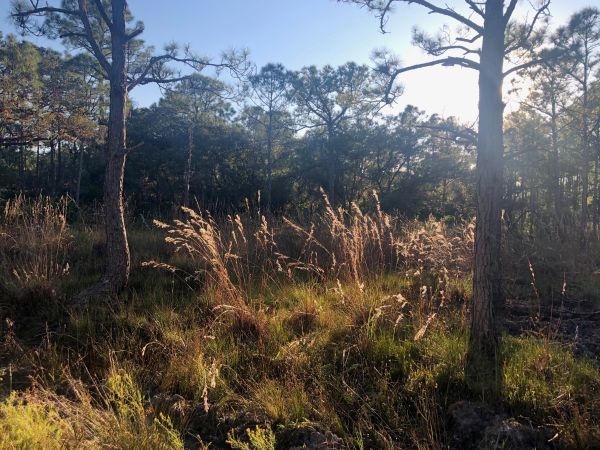
What makes this purchase especially noteworthy is that Martin County pursued a conservation easement rather than outright ownership. This approach stretched the conservation dollar in two key ways: First, the county partnered with state funding, sharing the cost. Second, because it's an easement rather than a fee simple purchase, the land remains in private ownership—meaning Martin County taxpayers are not responsible for ongoing maintenance, invasive species control, or public access management.
As the ELOC evaluates future acquisitions, understanding these two approaches is essential:
Fee simple purchase gives the public full ownership and control, ensuring permanent protection and potential public access. However, it also removes land from the tax roll and places the perpetual burden of invasive species control, infrastructure maintenance, and public access management on taxpayers.
Conservation easements are typically lower cost, keep land in private ownership (preserving some tax revenue), and leave maintenance and access management with the landowner—significantly reducing long-term public expense while still ensuring the land remains unavailable for development.
Both approaches accomplish the same conservation goal: protecting habitat and preserving the natural systems that make Martin County special. The Bar B Ranch demonstrates how conservation easements can deliver maximum environmental benefit while minimizing the financial burden on county taxpayers—a model that may serve the ELOC well as it evaluates future purchases.
Kara Grace Muzia's opinions are her own and may not reflect Friends & Neighbors viewpoint.
This is a column that Kara rewrote after the original one ran.
Quarterly goals, a fresh mindset, and what business owners should focus on
If 2025 wore you down, you’re not alone. Many small business owners are starting 2026 with equal parts hope and exhaustion. Here’s the truth: you don’t need a perfect plan to win the year. You need a clear direction, a simple system, and one small action that proves to your brain, “We’re back.”
Step 1: Reset before you set goals
When you’re feeling down, big goals can feel like pressure. Start with a reset that takes 30 minutes:
- Write down what you’re done with (bad clients, chaos pricing, inconsistent posting, overworking).
- Write down what you want more of (peace, predictable revenue, better boundaries, stronger community).
- Pick one theme for 2026: “Stability,” “Visibility,” “Profit,” or “Simplicity.” One theme keeps you steady when motivation dips.
Step 2: Set quarterly goals the smart way
Yearly goals are too far away. Quarterly goals create urgency without overwhelm. For each quarter, set 3 goals max: one money goal, one marketing goal, and one operations goal.
Use this structure:
- Outcome (what you want): Example: “Increase monthly revenue by 15% by end of Q1.”
- Lead measure (what you do weekly): Example: “10 sales conversations/week” or “3 videos/week.”
- Proof (how you’ll track it): Example: weekly dashboard: leads → appointments → sales → cash collected.

Now map it across the year:
- Q1: Foundation & cash flow. Fix offers, pricing, collections, and systems.
- Q2: Visibility & lead generation. Content, referrals, email list, community presence.
- Q3: Optimization & scaling. Improve conversion rates, automate follow-ups, hire help if needed.
- Q4: Retention & legacy. Client renewals, reviews, year-end promotions, tax-smart planning.
Step 3: How to start when you feel low
Motivation is unreliable. Momentum is your best friend. Use the 10-minute rule: work on the most critical business task for 10 minutes only. Most of the time, you’ll keep going. If you don’t, you still win because you showed up.
Also, lower the bar and raise consistency. One good hour a day beats a “someday” weekend marathon.
Step 4: What a Martin County small business should be thinking about
Martin County runs on trust, relationships, and local reputation. Your goals should reflect that:
- Be findable locally: Google Business Profile updates, real photos, weekly posts, and consistent reviews.
- Community visibility matters: networking events, chambers, local nonprofits, school sponsorships, and neighborhood groups.
- Seasonality is real: plan for busy winter months and quieter stretches, build a cash cushion and a lead pipeline before you “need” it.
- Your story is your edge: people buy from people here. Show your face, your values, and your results.
Your first two weeks of 2026
If you do nothing else, do this:
- Choose your 2026 theme.
- Set Q1’s three goals (money, marketing, operations).
- Make a simple weekly schedule: one sales block, one marketing block, one admin block.
- Ask for five reviews and reach out to 10 past clients to reconnect.
2026 doesn’t require a brand-new you. It requires a committed you…one quarter at a time.
Do you have questions or areas of business that you would like to have discussed? Let me know Chriss@ChrissDavidAndAssociates.com | Voted Best of Florida - AI Digital Marketing & Video
Chriss David’s opinions are her own and may not reflect Friends & Neighbors viewpoint.
Together, We Made a Lifesaving Difference
The American Red Cross mission is simple yet powerful: to prevent and alleviate human suffering in the face of emergencies. Thanks to partners like you, our Palm Beach & Treasure Coast Chapter delivered hope, safety, and resilience to thousands of neighbors this year.
Disaster Response & Home Fire Campaign
When disaster strikes, the Red Cross is there. In FY 2025, we:
- Responded to 179 local disasters
- Assisted 246 families with food, shelter, and recovery support—all at no cost
But we don’t just respond—we work to prevent tragedies. Home fires claim seven lives every day in the U.S., yet working smoke alarms can cut the risk of death by half. Through our Home Fire Campaign, we:
- Installed 1,407 free smoke alarms
- Created 532 home fire preparedness plans
- Taught 1,987 people lifesaving preparedness skills
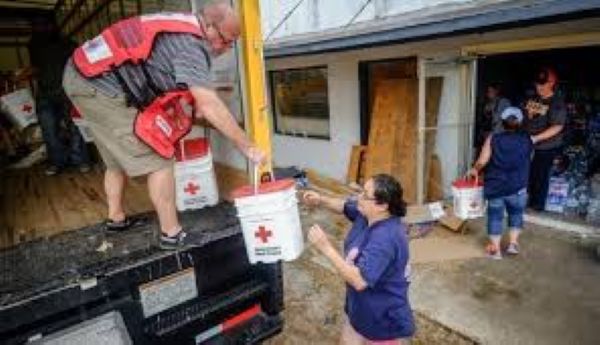
Since 2014, this campaign has helped save 2,519 lives nationwide and installed over 3 million smoke alarms in vulnerable homes.
Training Services 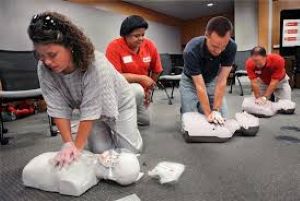
Swift action saves lives. This year, we empowered thousands through training:
- 10,979 people enrolled in CPR/AED and First Aid courses
- 3,660 people learned Aquatics and Water Safety skills
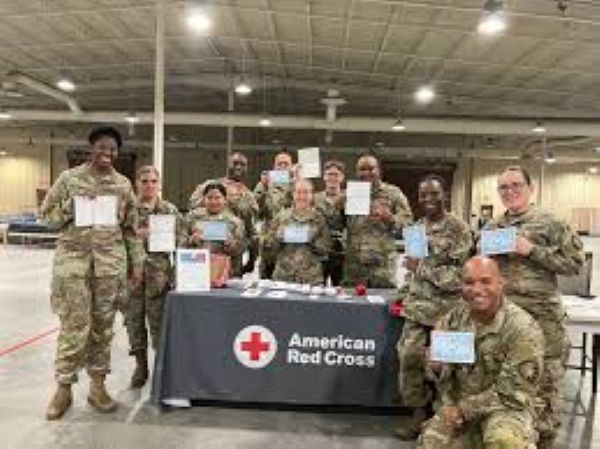
Service to the Armed Forces
Through the Hero Care Network, we provided 817 critical services to military members, veterans, and families—connecting them to emergency communications, financial assistance, and reintegration support.
 Volunteer Power
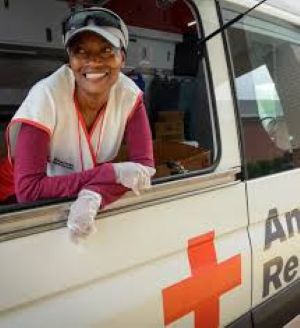
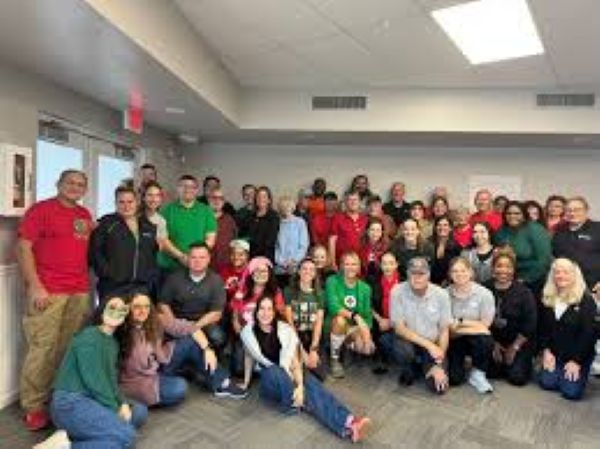
Nearly 90% of our services are delivered by volunteers. In FY 2025, 375 trained volunteers gave their time and compassion to help families prevent, prepare for, and recover from emergencies.
Join Us in Bringing Our Mission to Life
Your support makes this lifesaving work possible. As we look ahead to 2026, we invite donors, community partners, and volunteers to stand with us. Together, we can:
✅ Install more smoke alarms
✅ Train more lifesavers
✅ Support more families in crisis
Be the difference. Visit redcross.org/local/florida to donate, volunteer, or partner with us today.
Traci Mitchell's opinions are her own and may not reflect Friends & Neighbors viewpoint.
In recent years, our community has faced an alarming rise in fraud targeting the elderly. At the Martin County Sheriff’s Office, reports of losses approach $4 million, with our seniors being the primary victims. Fraudsters employ various tactics—from romance scams to phone and internet trickery—to exploit the vulnerabilities of our elderly population. This reality presents a pivotal challenge, one that demands collective action from families, friends, and the broader community.
The Martin County Sheriff’s Office has worked diligently to combat this issue. Over the past few years, we have implemented various strategies to raise awareness and educate seniors about crime prevention in terms of scams. Our initiatives have included sending direct mailers to individuals 65 and older, warning them about these predatory scams. However, despite our efforts, the ongoing threat persists. This is why it’s now more critical than ever for families and communities to step up and take an active role in protecting our seniors.
As a family member of a senior citizen, you are uniquely positioned to make a significant difference in their safety and well-being. Here’s how you can play an essential role in protecting our seniors:
Start the Conversation:
Don’t wait until a scam occurs to discuss the dangers. Initiate these conversations during family gatherings, phone calls, or visits. Be open and approachable, encouraging your loved ones to share their experiences and concerns. Hearing about their daily interactions and any strangers they may encounter can provide insight into potential risks.
Educate with Empathy:
Seniors may feel ashamed or embarrassed if they have fallen victim to scams. Approach the topic with sensitivity, ensuring that they feel supported rather than judged. Share stories of how others have been misled, highlighting that scammers are skilled at deception and not to blame the victim.
Share Resources:
Provide your senior loved ones with resources—articles, flyers, or pamphlets—that detail common scams. Help them understand how to recognize warning signs and consider involving them in discussions about these topics during family dinners or gatherings, making it a group effort.
Monitor Financial Transactions:
If your loved one is open to it, offer to help them manage their finances. Regularly reviewing bank statements, credit card bills, and online activity together can help identify any suspicious transactions early on. Keeping an eye on their financial health can deter scammers and provide peace of mind.
Foster Community Connections:
Encourage your seniors to participate in community activities or groups that focus on creating awareness about scams. Social interaction not only helps them stay engaged but also builds a strong network of supportive friends who can share information and look out for one another.
In closing, protecting our seniors is a shared responsibility. The Martin County Sheriff’s Office remains committed to battling fraud, but after our extensive outreach efforts, including direct mailings and public awareness campaigns, it’s clear that the greatest impact will come from families and communities. Together, through open dialogue and mutual support, we can safeguard our elderly loved ones and ensure they can navigate the world with confidence and security.
Sheriff John Budensiek’s opinions are his own and may not reflect Friends & Neighbors viewpoint.
A Tale of Two Cities – Sewall’s Point vs. Port Salerno
Sewall’s Point and Port Salerno are remarkably similar communities. Sewall’s Point has approximately 1,042 lots and 642 acres; Port Salerno is a bit larger at 862 acres. Both are waterfront communities with a mix of residential and commercial uses, and both face serious septic and sewer challenges.
That is where the similarities end.
At the recent BOCC meeting, Sewall’s Point requested a waiver from the County rule limiting grinder systems to 300 homes. They wish to install 340. On the surface, the request is reasonable. A grinder system costs nearly half as much as a vacuum system, and Sewall’s Point simply asked for relief from a regulation to keep their project affordable.
Meanwhile, Port Salerno is being required to install a vacuum system at nearly double the cost because the same rules will not be waived for us. To make matters worse, Sewall’s Point’s sewer connection is optional, while Port Salerno’s connection is mandatory and will be placed directly on our ad valorem taxes.
Port Salerno has the same environmental and public-health challenges, but we are not an incorporated municipality with a board, engineers, or a professional staff advocating daily for our interests. We share the County’s limited resources with much larger, better organized communities, and historically we have been last in line.
We’ve learned how to survive that way. We fight for the scraps we’re given. We adapt. We learn the rules because we are told those rules are non-negotiable.
But the Sewall’s Point sewer decision proves something uncomfortable: the rules are not the same for everyone. It is one thing to be last in line. It is another thing entirely to discover you have been standing in line while others walk to the front and receive exceptions, waivers, and accommodations we are told are impossible.
You can’t fault Sewall’s Point for advocating aggressively for its residents—that is their job. And while we would hope for more consistency from our Commissioners, political realities are what they are.
The responsibility now falls on us—the residents of Port Salerno. If we continue to assume the rules applied to us are applied uniformly across Martin County, we are mistaken. They are not. And if we continue to wait quietly, expecting someone else to advocate for us, we will continue receiving the least, while others receive flexibility, relief, and exceptions denied to our community.
J. Corey Crowley's opinions are his own and may not reflect Friends & Neighbors viewpoint.
 Lisa Oster 1st Vice-President
The Jensen Beach Garden Club’s much-loved Garden Expo is growing — literally! Now in its 5th year, the popular spring event is moving to Memorial Park in downtown Stuart, offering more space, more food trucks, and more fun than ever. Visitors can enjoy free parking, an easy shuttle service, and free raffle prizes every hour throughout the day.
With over 40 plant and garden vendors, this year’s Expo will showcase the best local vendors offering lush tropical plants, native species, vibrant orchids, and unique finds like bonsais, herbs, and outdoor art. Stock up on gardening supplies, learn from live presentations, and enjoy hands-on demos. It’s a fun and educational day for all plant lovers, from beginners to seasoned pros! Presenters include sessions on succulents, vegetable gardening, anthuriums and everything you wanted to know about the C-44 Reservoir and Storm Water Treatment Area. It’s a full day of shopping, learning, and celebrating everything green and blooming.
More than just a garden show, the Garden Expo helps the community grow, too, thanks to the many sponsors and volunteers. One hundred percent of Expo proceeds fund college scholarships for local students pursuing horticulture and environmental studies, as well as camperships for children attending the Florida Oceanographic Society and Environmental Studies Center summer programs. The Club also supports Junior Master Gardener programs and the House of Hope Community Gardens.
“This event has truly blossomed,” said Dana von Rinteln, JB Garden Club President. “Each year we see more people discovering the joy of gardening, learning from our experts, and taking home something beautiful.” Don’t miss this incredible day of plants, community, and fun—see you at the Expo! Follow the Jensen Beach Garden Club on Facebook and Instagram, or visit
www.jensenbeachgardenclub.com/garden-expo
Lisa Oster's opinions are her own and may not reflect Friends & Neighbors viewpoint.
There is more significance to “January 1” than
celebrating New Year’s Day!
When it comes to ad valorem property taxes in Florida, everything revolves around a date of assessment of January 1. When you receive your tax bill in November, those taxes are based on a snapshot of your property valuation which took place eleven months prior on January 1. As a result, the Property Appraiser studies the previous year’s real estate market activities and transactions to establish the current year values.
The illustration below shows this sequence, where 2026 property valuation, notification, and billing tie back to January 1, and in essence market activity taking place in 2025.
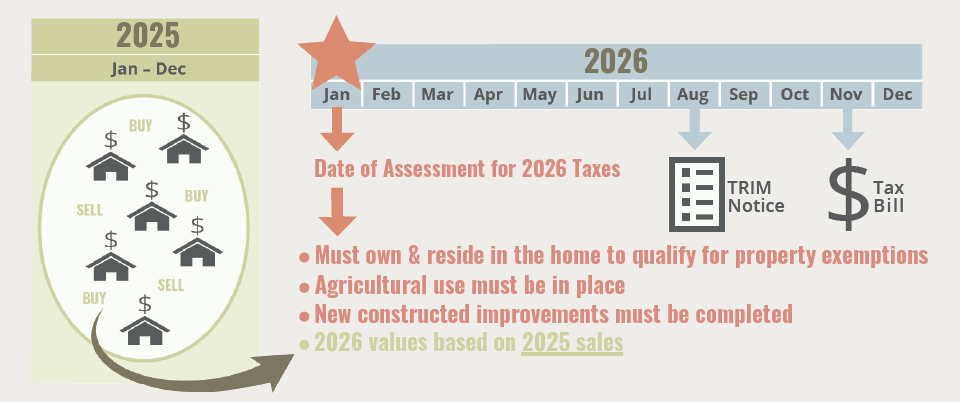
Under Florida law, the taxability of newly constructed improvements is determined based on whether those improvements were substantially complete as of January 1. For example, the addition of a new swimming pool which was not completed until February 2025 should not have been reflected on the November 2025 tax bill. Instead, the value of the pool will be added and the additional taxes will be reflected on the November 2026 tax bill.
The eligibility of all property tax exemptions is also determined based on whether you qualify on or before January 1. To qualify for the Homestead Exemption, an individual must own and occupy the property as a permanent Florida resident on or before January 1. Likewise, those wishing to apply for the Limited Income Senior Exemption, which has an age requirement of 65 years old, must be 65 or older as of January 1 and meet the income restrictions to qualify.
Agricultural classification is a tax savings benefit for property owners that use their land primarily for bona fide commercial agricultural use. This benefit results in the land being valued based on the probable income, which is often substantially less than market value. To qualify for this benefit, the agricultural use must be in place on or before January 1 of the year you apply.
It is important to note that the January 1 date of assessment greatly affects new homebuyers.
When a buyer purchases a home after January 1, their first-year tax bill is based on the previous owner. This may result in the new homebuyer inheriting the previous owners’ exemptions and Save Our Homes benefits, if the previous owner qualified as of January 1. Estimating a new buyer’s taxes based off the previous owner’s tax bill can lead to a significant discrepancy in the escrow payment and may not adequately reflect what the new buyer may expect to pay in taxes the following year. Since Florida law requires property values to reset to current market value on January 1 following the date of purchase, new homebuyers are encouraged to use their purchase price when estimating their taxes.
Please visit www.pamartinfl.gov to take advantage of a Property Tax Estimator and additional resources available to educate and assist new homebuyers and property owners. For additional questions, please do not hesitate to contact the Martin County Property Appraiser’s Office by phone at 772-288-5608 or email hx@pamartinfl.gov.
Pulitzer Prize-Winning Columnist Bret Stephens to Open
2026 Rappaport Speaker Series in Stuart
Stuart, Fla. – Pulitzer Prize–winning journalist and New York Times op-ed columnist Bret Stephens will open the 2026 Rappaport Speaker Series on January 15, bringing his sharp analysis and fearless commentary to the Treasure Coast.
 Known for challenging conventional wisdom and grounding his arguments in hard facts, Stephens commands attention across the political spectrum. His global reporting and outspoken views have earned him international recognition - and even a ban from Russia - making his appearance in Stuart a highly anticipated event.
Stephens kicks off the 2026 season with his presentation titled “America at a Crossroads – The Future of Conservatism.” A political contributor for NBC and MSNBC, Stephens will offer a candid examination of the ideological forces shaping American politics and the evolving role of conservatism in a divided nation.
Stephens brings decades of journalistic experience to the discussion. In addition to his work at The New York Times, he previously served as deputy editorial page editor at The Wall Street Journal, overseeing international opinion, and spent 11 years as the paper’s principal foreign-affairs columnist. Earlier in his career, he was editor-in-chief of The Jerusalem Post, directing its news, editorial, digital, and international operations.
Each year the Rappaport Speaker Series brings nationally recognized voices to Temple Beit HaYam in Stuart establishing itself as a trusted forum for thoughtful dialogue and intellectual exchange on the Treasure Coast.
Following Stephens’ January presentation, the series continues with two additional speakers:
- On February 26, Dr. Laurie Santos, Yale University professor, psychologist and host of the popular podcast The Happiness Lab will present “Calm Amidst the Chaos – The Science of Happiness.”
- On March 26, Eve Samples, former journalist and executive director of Friends of the Everglades, will speak about “Everglades on Trial – A Test for Environmental Policy in America.”
Tickets for Bret Stephens’ January 15 event are $50. Series tickets for all three events are $100. All presentations begin at 7 p.m. at Temple Beit HaYam. Tickets are available at www.RappaportSpeakerSeries.com.
The Rappaport Speaker Series is supported by the Phyllis & Jerome Lyle Rappaport Foundation through a grant to Temple Beit HaYam and is designed to broaden civic understanding on issues of national and global importance. Past speakers have included renowned figures such as David Gergen, advisor to four U.S. presidents; Marty Baron, former editor of The Washington Post; and bestselling author Mitch Albom, author of Tuesdays with Morrie.
“My husband Jerry and I founded the Rappaport Speaker Series to bring distinguished, intellectually honest voices to Florida’s Treasure Coast,” said Phyllis Rappaport. “The 2026 lineup reflects that mission, and Bret Stephens exemplifies it. His willingness to challenge assumptions, confront difficult truths, and elevate public discourse makes him exactly the kind of speaker we believe our community needs right now.”
More information about the Rappaport Center, the Speaker Series, and the 2026 presenters is available at www.RappaportSpeakerSeries.com and on Facebook at www.facebook.com/RappaportCenterSpeakerSeries.
About the Rappaport Foundation
The Phyllis & Jerome Lyle Rappaport Foundation partners with leading institutions in Boston and beyond to cultivate emerging leaders in public policy, mental health, neurodegenerative research, and the arts. The Foundation has a long and proud history of supporting emerging leaders, including civic leaders who improve the lives of their constituents and communities, medical researchers who have unlocked the mysteries of the brain, mental illness and Alzheimer’s disease, and artists who enrich lives, ignite imaginations, and challenge us to see the world in a new light. In Stuart, Florida, the Foundation sponsors the Rappaport Center Speaker Series to promote informed dialogue on issues of national and international importance.
About Temple Beit HaYam
Founded in 1993, Temple Beit HaYam is a Reform Jewish congregation in Stuart dedicated to Torah (lifelong learning), Avodah (worship), and Gemilut Chasadim (acts of kindness and justice). Temple Beit HaYam is a Reform Jewish Congregation committed to Torah (life-long Jewish education), avodah (worship through prayer and service) and gemilut chasadim (acts of loving kindness). The Temple offers Hebrew and religious training to youngsters from kindergarten through high school, has active Sisterhood and Brotherhood programs, and is an active cultural hub, hosting concerts, lectures, and community events that enrich the Treasure Coast.

United Way of Martin County’s Toys For Tots Holiday Project Brings Joy and Hope to Hundreds of Families
STUART, FL – For nearly four decades, United Way of Martin County has ensured the holiday season is a time of hope and joy for local families. This tradition continued with the successful completion of the annual Toys For Tots Holiday Project, a community-wide effort designed to support children and families facing financial hardship.
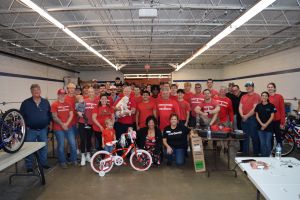 M.C. Fire/Rescue assembled 250 bikes from the Zweben Bike Drive
As the local coordinating organization for the Marine Corps Reserve Toys For Tots program, United Way of Martin County partners with the Martin County School District and dozens of nonprofit agencies, schools, and community organizations to screen and refer families in need. Through these partnerships, the 2025 Holiday Project provided assistance to more than 854 families, reaching 2,674 children across Martin County.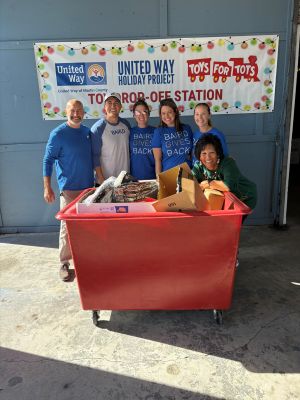
Baird one of 151 collection sites
Just after Thanksgiving, the Martin County Fairgrounds transformed into a bustling distribution department store. Over the course of the project, 359 volunteers donated 1,536 hours to sorting, organizing, and distributing gifts, ensuring families were met with a welcoming, respectful, and dignified holiday shopping experience.
Thanks to the generosity of community members and local businesses, the Holiday Project collected and distributed 24,523 toys, including 428 bicycles and 26,878 pounds of food, helping families celebrate the season with joy and relief. Any remaining gifts were thoughtfully redirected to children and students served by local social service agencies, extending the project’s impact even further.
Event Sponsor Phil Wintercorn and Williamington Trust
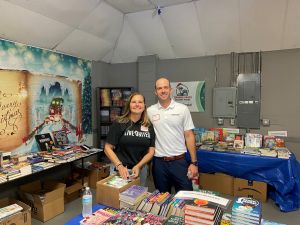 Ashley Capital launched a new litterary initiative this year
“The Toys For Tots Holiday Project represents the very best of our community,” said Carol G. Houwaart-Diez, President & CEO of United Way of Martin County. “Because of our partners, volunteers, and supporters, hundreds of families were reminded that they are seen, supported, and not alone during the holiday season.”
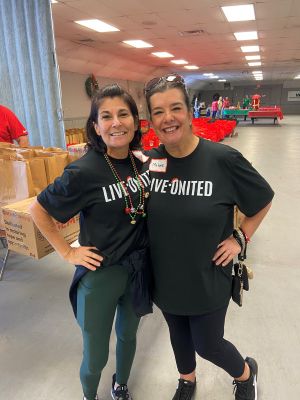 Leaders United's Stephanie Quirantes and Melanie Fleming
This monumental effort was made possible by the generosity of volunteers, local businesses, community organizations, sponsors, and individual donors. United Way extends a special thank you to Wilmington Trust, Ashley Capital, STS Aviation Group, Zweben Law Group, iHeart Radio, WPTV, Waste Management, Martin County Fire Rescue, AmeriCorps Seniors, and House of Hope, as well as our referral partners and the 151 local businesses that served as toy collection sites throughout the county. Together, their generosity strengthened families, uplifted children, and helped ensure the holidays were brighter for those who needed it most.
The Toys For Tots Holiday Project is one of United Way of Martin County’s largest volunteer-driven initiatives, requiring months of planning, coordination, and collaboration. Each year, it serves as a powerful reminder of what can be accomplished when community comes together with a shared purpose.
 Santa
Santa
For more information about United Way of Martin County and opportunities to get involved, visit UnitedWayMartin.org.
###
About United Way of Martin County
Since 1972, United Way of Martin County has been dedicated to creating long-term social change and providing support to residents. With a mission to improve the education, financial security, and health in Martin County, United Way invests in impactful programs that enhance quality of life and ensure everyone has the opportunity to thrive. To learn more about United Way of Martin County, visit www.UnitedWayMartin.org.
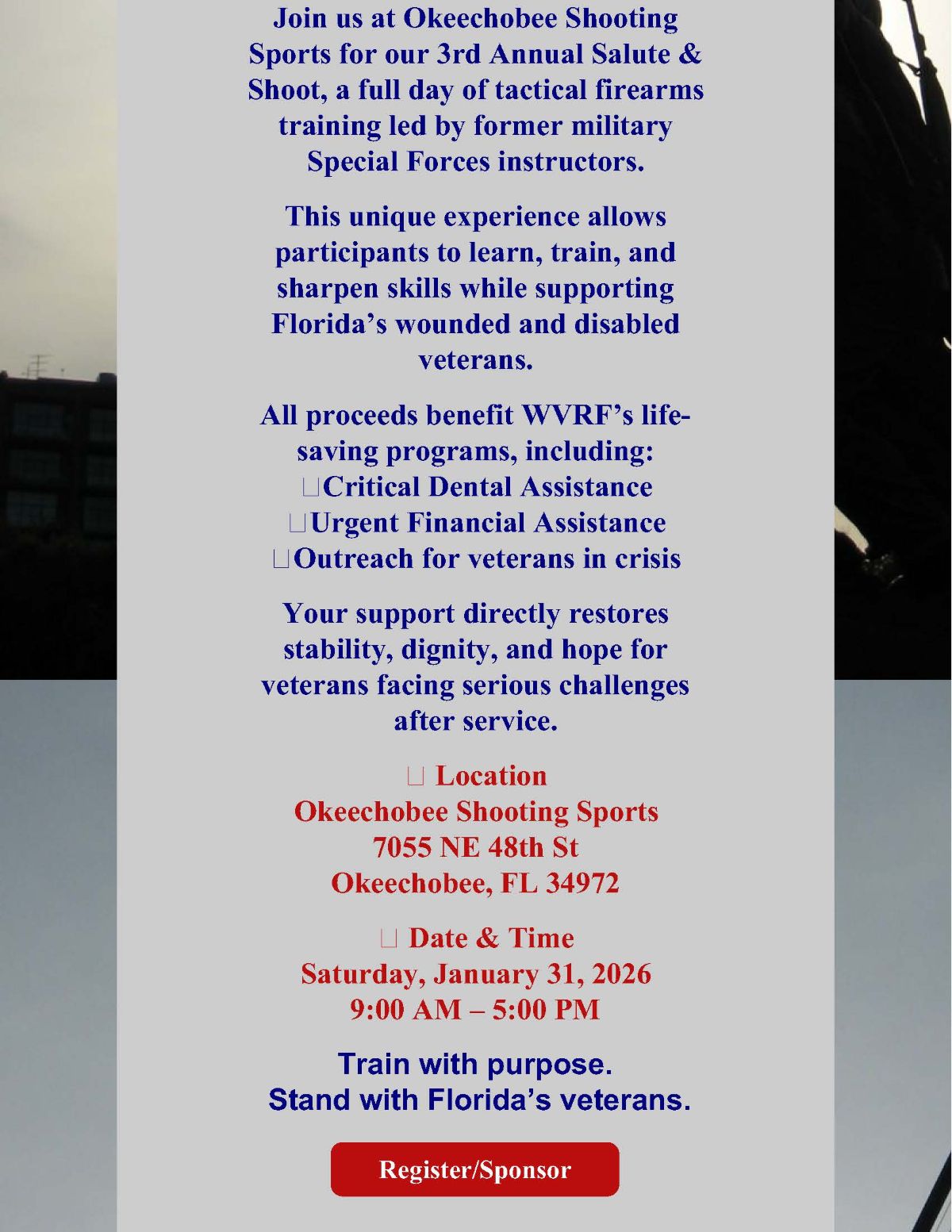

Aim for Freedom Sporting Clays Event Returns Jan. 31, 2026
Sebastian, Fla. – After raising more than $13,000 in its inaugural year, the Aim for Freedom Sporting Clays Shoot is returning for 2026, and organizers are setting their sights even higher. SafeSpace, in partnership with the Indian River County Sheriff’s Office, will host the Second Annual Aim for Freedom Sporting Clays Shoot on Saturday, Jan. 31, 2026, at the Indian River County Shooting Range.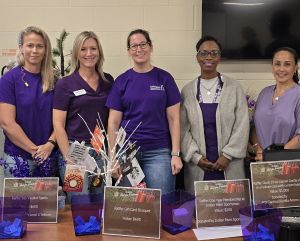
Committee Members: Aimee Cooper, Jennifer Fox, Chelsea Deveau, Natalie Thomas-Darissaw, Ann Rodriguez
The community-driven event brings together local businesses, residents, and law enforcement for a day of friendly competition with a shared purpose: supporting survivors of domestic violence across the Treasure Coast.
The Aim for Freedom Clay Shoot offers an energetic day on the course, complete with great food, exciting raffle items, and special awards for top shooters. Participants may register as a team or individually, making the event accessible for all experience levels.
Proceeds from the event benefit SafeSpace, helping fund emergency shelter, counseling, advocacy, and other essential services for individuals and families seeking safety and healing.
“Aim for Freedom is about more than hitting targets. It’s about standing with survivors and showing them they are not alone,” said Indian River County Sheriff's Office Chief Financial Officer Aimee Cooper, “The response to this event has been incredibly encouraging, and we’re excited to welcome the community back for another impactful day in 2026.”
2025 Clay Shooting Team Owen Viersma, Robert Munni, Tim Weimer, Bryan Gardner
Registration Details
- Team of four: $600
- Individual: $150
Sponsorship opportunities are now available, including a limited number of premium sponsorships. Early registration is encouraged, as space is limited.
Event Details
- Date: Saturday, Jan. 31, 2026
- Location: Indian River County Shooting Range
10455 102nd Terrace
Sebastian, FL 32958 - Registration & Breakfast: 8:00 a.m.
- Shotgun Start: 9:00 a.m.
To register or learn more about sponsorship opportunities, visit SafeSpaceFl.org.
SafeSpace extends its sincere thanks to the 2026 Aim for Freedom Clay Shoot sponsors, whose generosity helps ensure the continued delivery of life-changing services across the Treasure Coast.
Bob Fields 2025 Clay Shooting Winner
2026 Event Sponsors: Toyota of Vero, Hayes Construction, Kay Betancourt Orthodontics, Emerald Medical, Jimmy’s A/C & Refrigeration, MBV Engineering, Thompson’s Remodeling, Piper Aircraft, Coastal Protective Products, Level 4 Telecom, PCP Tactical/Gorilla Ammo, Bob Schlitt, Minute Man Press, Elevate Vero Beach, Gino Nutrition.
SafeSpace and the Indian River County Sheriff’s Office look forward to another meaningful day on the course in support of a future free from domestic violence.
About SafeSpace
SafeSpace is the Treasure Coast’s only state-certified domestic violence center, serving survivors and their children 24/7. Since its founding, SafeSpace has provided more than 500,000 safe nights of shelter to over 40,000 victims and children. Its comprehensive programs include shelter, legal advocacy, financial literacy, counseling, prevention education, and specialized children’s services.
Funds raised through the Aim for Freedom Clay Shoot will directly support these essential services, ensuring survivors find refuge, support, and the resources needed to build safe, independent lives.
Save the Date!
The 5th Annual Garden Expo Bigger & Better Than Ever! Saturday, March 7, 2026 – 9 AM to 3 PM
*NEW LOCATION* Memorial Park, 300 SE Ocean Blvd, Stuart, FL
The Jensen Beach Garden Club’s much-loved Garden Expo is growing — literally! Now in its 5th year, the popular spring event is moving to Memorial Park in downtown Stuart, offering more space, more food trucks, and more fun than ever. Visitors can enjoy free parking, an easy shuttle service, and free raffle prizes every hour throughout the day.
With over 40 plant and garden vendors, this year’s Expo will showcase the best local vendors offering lush tropical plants, native species, vibrant orchids, and unique finds like bonsais, herbs, and outdoor art. Stock up on gardening supplies, learn from live presentations, and enjoy hands-on demos. It’s a fun and educational day for all plant lovers, from beginners to seasoned pros! Presenters include sessions on succulents, vegetable gardening, anthuriums and everything you wanted to know about the C-44 Reservoir and Storm Water Treatment Area. It’s a full day of shopping, learning, and celebrating everything green and blooming.

More than just a garden show, the Garden Expo helps the community grow, too, thanks to the many sponsors and volunteers. One hundred percent of Expo proceeds fund college scholarships for local students pursuing horticulture and environmental studies, as well as camperships for children attending the Florida Oceanographic Society and Environmental Studies Center summer programs. The Club also supports Junior Master Gardener programs and the House of Hope Community Gardens.
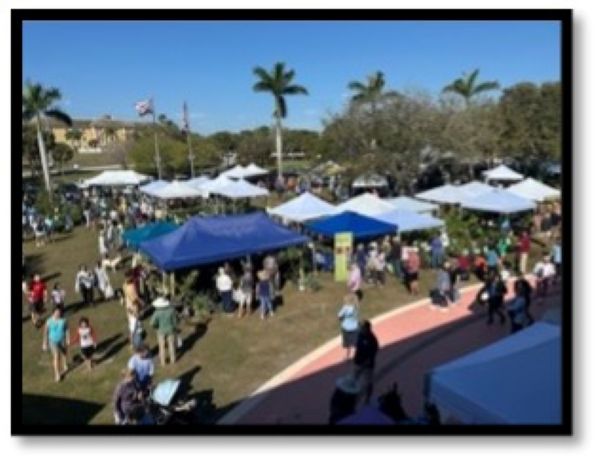
“This event has truly blossomed,” said Dana von Rinteln, JB Garden Club President. “Each year we see more people discovering the joy of gardening, learning from our experts, and taking home something beautiful.” Don’t miss this incredible day of plants, community, and fun—see you at the Expo! Follow the Jensen Beach Garden Club on Facebook and Instagram, or visit
👉 www.jensenbeachgardenclub.com/garden-expo

Santa brought holiday cheer to Banner Lake Academy and the Early Learning Center on Friday morning, December 19th! His visit began in the infant rooms and continued room by room through the toddlers and up to VPK.  The VPK students were especially thrilled, cheering, jumping, and smiling as Santa entered their classrooms. After visiting the Early Learning Center, Santa continued on to the Academy, where he took time in each classroom to talk with every
student and listen as they whispered their holiday wishes. One of Santa’s favorite moments was hearing from a second-grade student named Chris, who shared that his dream is to become a business owner one day. The visit ended with kind words, smiles, and hugs shared betweenSanta, students, and staff.
The holiday fun continued on Saturday morning, December 20th, as community children and families gathered to welcome Santa once again. Santa arrived in a firetruck with local firefighters. Despite the warm morning, Santa sat with each child, talking and listening as gifts were distributed through Harry and the Natives and Banner Lake’s Outreach Program. It was another successful morning celebrating the season.
Banner Lake would like to extend a heartfelt thank you to Friends at Loblolly for their generous gift donations for our students. We also appreciate Premiere Realty, United Way, and Chasin a Dream. Thank you for all that you do for our children!

MartinArts Presents 35th Annual All Florida Juried Art Show
Exhibit Dates | January 9 - February 28, 2026
Juror’s Talk by Donne Bitner | Saturday, January 10, 11AM
Court House Cultural Center Gallery: 80 SE Ocean Blvd, Stuart FL 34994
https://www.martinarts.org/court-house-cultural-center/currentexhibitions.html
Celebrating a 35-year legacy, this exhibition showcases recent works by Florida artists across a wide variety of media. The collection highlights the diverse creativity and talent flourishing throughout the state, from traditional to contemporary art.
Featuring Artists:
Ilene Adams, Glen Allen, Josie Capozzi, Suzanne Carlson, Daria Cheatham, Karen Christopher, Ariel Collins, Stephanie Cunningham, Michael Davis, Katie Deits, Nancy Dillen, Gabriele DiTota, Janas Durkee, Christian Feneck, Susan Finn, Marine Fonteyne, Todd K. Fox, Torenzo Gann, Viktor Genel, Arlet Gomez, Jill Heveron, Jack Hill, Heather Ivins, Lynn Kalber, Richard Kaminskas, Claudia Jane Klein, Lisa Lloyd, Susan Martin, Judith Mistor, Leonardo Montoya, Leslie Neumann, Raymond Olivero, Jeff Olson, Sally Painter, Sar Powell, Elizabeth Quigley, Sudie Rakusin, Galal Ramadan, Dan Remmel, Linda Reymore, Jack Rink, Paula Rucket, Ricky Schenk, Kyle Selley, Eileen Shaloum, Renee Simler, Jennifer Sky, Greg Smith, Mark Stall, Richard P Stevens, Monica Swartley, David Taylor, Ryan Toth, Marcelle Zanetti

The second annual Festival of Giving, held in November 2025, was a tremendous success—creating meaningful impact across our community and celebrating the true spirit of the season.

Formerly known as the Festival of Trees, this beloved event was hosted for 16 successful years by Tykes & Teens before coming home to The Children’s Museum of the Treasure Coast in 2024. In its new location, the Festival of Giving has expanded its mission to spotlight the inspiring stories of dozens of nonprofits across the five counties served by the Museum’s education team.
What hasn’t changed is the magic. Guests were dazzled by beautifully decorated trees, wreaths, and centerpieces generously donated by individuals, businesses, and organizations throughout the 10-day event. Each display helped bring attention to the nonprofit it supported, blending creativity with purpose.
The 2025 Festival of Giving was proudly presented by Tracey MacLeod, Realtor with Illustrated Properties, The Ngo Group. Tracey’s passion for the event and its impact runs deep—we’re thrilled to share that she has already committed to returning as presenting sponsor for 2026!
In just its second year, the Festival of Giving benefitted 50 nonprofits whose missions align with the Museum’s focus on children, families, education, and even our furry friends. These organizations benefitted not only financially, but also through increased visibility as their stories were shared with the community throughout the Festival.
Thanks to the incredible generosity of our supporters, the event raised more than $70,000, with over $34,000 distributed directly to the participating nonprofits.
The week was filled with excitement and special moments, beginning with a visit from T.A. Walker, who filmed a Shining a Light segment for WPTV, followed by a VIP Reception honoring our event and entry sponsors. We welcomed more than 150 business leaders to a networking breakfast and that same day hosted WPTV’s Let’s Hear It event, where over 50 individuals and groups shared stories about what’s happening in our community—it was truly inspiring.
 Throughout the Festival, we enjoyed outstanding performances from Martin County High School Opus, Treasure Coast Community Singers, Indian River Pops Orchestra, Florida Arts & Dance Company, Crystal Lake Elementary School, Jensen Beach Elementary School, and Radiant Voices. Thanks to the generosity of Seacoast Bank, we were proud to make a donation to each of these talented groups.
Midweek fun included a family night with a special visit from Santa, sponsored by Deakins Carroll Insurance. We wrapped up the Festival in style with our signature Night Before Christmas Adult Pajama Party, sponsored by Hurricane Boat Lifts. With more than 140 guests in attendance, it was the perfect festive finale.
We are deeply grateful to everyone who helped make the 2025 Festival of Giving such a success—our sponsors, donors, nonprofits, performers, and community partners. Thank you for sharing in the spirit of giving.
We can’t wait to welcome you back November 13–21, 2026, for the Third Annual Festival of Giving!
U.S. Sugar Invests in Transformative Mental Health and Adult Literacy Initiatives in the Glades
New Partnership with the Community Foundation for Palm Beach and Martin Counties
Lays Foundation for Long-Term Community Impact
West Palm Beach, FL (January 6, 2025) – The Community Foundation for Palm Beach and Martin Counties, a nonprofit organization that leads partnerships with donors, nonprofit organizations, and community members to address the region’s chronic and emerging issues, today announced a new investment by U.S. Sugar to strengthen mental health support and expand adult literacy opportunities for families in the Glades. The total investment is approximately $105,000.
With this commitment, U.S. Sugar is forming a strategic partnership with the Community Foundation to address root-cause challenges and build long-term community resilience. With strong agricultural, economic, and cultural ties to the Glades, U.S. Sugar is deepening its community role through a more structured, intentional approach to lasting regional transformation.
“This partnership represents a new chapter for the Glades, one rooted in collaboration, long-term investment, and a shared vision for healthier, stronger families,” said Danita R. DeHaney, president & CEO of the Community Foundation for Palm Beach and Martin Counties. “U.S. Sugar’s commitment goes beyond a grant. It signals a deeper, strategic role in creating the kind of lasting change this community deserves.”
U.S. Sugar leaders echoed that sentiment: “U.S. Sugar has been part of the Glades community for generations, and we are committed to investing in the long-term success of the families who live and work here,” said Brannan Thomas, Community Relations Director for U.S. Sugar. “By partnering with the Community Foundation, we can support proven programs that strengthen mental health, expand literacy, and create meaningful opportunities for young people and parents alike. This work reflects our belief that strong communities grow from strong families.”
The partnership will fund two high-impact initiatives: Rebound and Recovery Mental Health Initiative and a new Adult Literacy Program that designed to support intergenerational learning and family engagement.
Rebound and Recovery: Strengthening Youth Mental Health
U.S. Sugar’s investment will support the implementation of Rebound and Recovery, an evidence-based cognitive-behavioral program developed by Florida State University (FSU) that improves the emotional and social well-being of adolescents. Delivered at Crossroads Academy, the program will equip students with skills to build resilience, understand the connection between emotions and behavior, manage stress, and improve decision-making. The program is scheduled to begin mid-January 2026 and includes:
- Train-the-Trainer Model for Long-Term Sustainability: Crossroads Academy interventionists, including behavioral health staff, ESOL and ESE coordinators, and school counselors, will complete 15 hours of FSU-led training through after-school sessions and professional development days.
- Student Leadership Development: After completing the curriculum, about ten students will be selected for a Student Train-the-Trainer cohort. These emerging leaders will receive five hours of training to reinforce program messages among peers and help strengthen the overall social-emotional climate of the school.
- Student Sessions: Fifteen structured modules will be delivered during the school day or in after-school programming, covering topics such as emotional-behavior connections, stress management, healthy relationships, problem solving, and recognizing anxiety or depression.
Adult Literacy in the Glades: Strengthening Families Through Education
In addition to youth mental health support, U.S. Sugar is helping expand family-centered literacy initiatives in a region where 47% of third graders read below grade level. Building on the Community Foundation’s $200,000 grant to Boldin Community Impact for after-school literacy programming, U.S. Sugar’s investment supports a new Adult Literacy Program delivered partnership with the Literacy Coalition of Palm Beach County.
The program provides parents with foundational literacy and language skills, boosting their confidence and strengthening the home-to-school connection. A dedicated Adult Literacy Specialist will oversee all instruction and engagement. The initiative will launch in January 2026 and continue throughout the calendar year.
The program includes three integrated components:
- Parent Learning Academy: Held twice weekly while children participate in Boldin Community Impact’s after-school programming, the Academy provides structured literacy instruction and teaches parents how to support their children’s learning. Each cohort will enroll approximately ten families, with two to three cohorts anticipated in 2026.
- Parent and Child Together (PACT) Time: Twice a week, parents and children participate in guided shared reading, discussions, and hands-on literacy activities. PACT helps families reinforce skills at home and build routines that make reading a meaningful, everyday experience.
- Family Literacy Nights: Hosted quarterly at Pahokee Elementary, these two-hour evening events bring families together for interactive literacy activities, projects, and shared meals. These evenings reinforce skills introduced in the Academy and celebrate family learning.
About the Community Foundation for Palm Beach and Martin Counties
The Community Foundation for Palm Beach and Martin Counties is a nonprofit organization that leads philanthropy locally. The foundation provides charitable expertise and vehicles to increase the investment options on behalf of individuals, family foundations, and corporations. Since 1972, the foundation has distributed nearly $275 million in grants and scholarships aimed at closing the area’s opportunity gaps. With its vast network of donors and nonprofit partners, the foundation supports initiatives that improve youth and education, economic opportunity, thriving communities, and crisis preparation and response. Learn more at https://yourcommunityfoundation.org.
About U.S. Sugar
U.S. Sugar is a South Florida-based farming and processing company that sustainably grows sugarcane, citrus, sweet corn and other winter and spring vegetables that feed American families. The company was founded in 1931 by Charles Stewart Mott, a visionary leader who hailed from a long line of farmers. Since the beginning, the company’s success has been rooted in traditional farming values and respect for the land. U.S. Sugar also operates a sugar refinery in Savannah, Georgia that produces retail and store-brand sugar for customers throughout the southeast. Along with operating its 300-mile railroad, in total, U.S. Sugar sustainably farms 255,000 acres in Highlands, Glades, Hendry, Palm Beach and Martin counties in Florida and serves as a vital part of our rural communities, providing 3,000 jobs, community leadership, and philanthropic support. For more information, please visit www.ussugar.com.
Nonprofit video spotlight of Boldin Community Center: https://www.youtube.com/watch?v=MWemOzB2l00
As we begin 2026, Play Treasure Coast Sports is off to a strong start with a packed schedule of winter training and competitive events. From rowing and swimming to gymnastics, softball, and karate, here’s a look at what’s happening on the Treasure Coast in the weeks ahead:
Upcoming Events
- Dec. 8 – Jan. 14: IRSC Swimming Winter Training
Indian River State College – Massey Campus - Dec. 27 – Jan. 14: CSCAA Swimming & Diving Winter Training
Sailfish Splash Waterpark - Jan. 1 – Mar. 31: Vero Beach Rowing Center Winter/Spring Training
Vero Beach Rowing Center - Jan. 1 – Feb. 28: Jackie Robinson Training Complex Spring Training – Session 1
Jackie Robinson Training Complex - Jan. 1 – Jan. 30: MLB Umpire Prospect Development Camp
Jackie Robinson Training Complex - Jan. 9 – Jan. 11: Coastal Classic Gymnastics
Havert L. Fenn Center - Jan. 17 – Jan. 18: Florida Half Century Softball
South County Park - Jan. 31: Florida AAU Karate Kick-Off Tournament
Havert L. Fenn Center
If you’re considering a location for your next sporting event or training program, the Treasure Coast (Indian River County, St. Lucie County & Martin County) offers exceptional venues, strong community support, and reliable year-round weather. We’d love to show you what’s possible. Feel free to reach out to one of Play Treasure Coast Sports staff members and let us help you find your gold on the Treasure Coast.
You can explore our facilities here or check out more upcoming events here.
All the best this month,
“When Policy Hurts People” — Forum to expose local impact of immigration policies on Treasure Coast Families
STUART, Fla. — Pro-Families, a non-profit organization based in Martin County, and concerned citizens who have formed a coalition, will present “When Policy Hurts People,” a free, public forum which will be held from 2 to 4 p.m. on Sunday, Jan 11, at Unity of Stuart, 211 SE Central Parkway. The forum will address immigration enforcement and how it affects Treasure Coast residents, and ways to support impacted neighbors.
“Our immigration policies are hurting families, our friends and neighbors here in Martin County and the Treasure Coast,” said Roberta Scott, a board member of Pro-Families who is involved in organizing the event along with Larry Condon. “Some people are not aware of what is going on right here in our local community, because ICE and Border Control agents are not as visible in our streets as they are in cities like Chicago and Los Angeles, but as of December 17, according to the official Florida Board of Immigration Enforcement, Martin County was ranked as highest in the state for “suspected unauthorized alien encounters, with 728 such ‘encounters.’”
Local immigrants will share their stories on how immigration policies and practices are affecting their families and friends. An immigration lawyer will also be present to share insights into some of the legal issues and how the changing regulations are affecting clients. Community efforts to help will be discussed. A Q&A session with the attorney, immigrants and volunteers who are helping in the community will follow.
For more information, contact Roberta Scott at 772-631-1233.

VERO BEACH, FL – The Vero Friends of the Atlantic Classical Orchestra (ACO) is pleased to announce its annual benefit concert on January 12, 4:30pm, at Orchid Island Golf & Beach Club. This year’s program, entitled “Violin Virtuosity,” will spotlight violinist Hina Khuong-Huu and pianist Lindsay Garritson.
 Hina Khuong-Huu, winner of the Elmar Oliveira International Violin Competition, and award-winning pianist Lindsay Garritson will perform Beethoven’s Sonata for Violin and Piano, No. 5, Op. 24 (“Spring”), Ernst’s The Last Rose of Summer, Kreisler’s Three Pieces (Schön Rosmarin, Liebesfreud, La Gitana), and Sarasate’s Caprice Basque, Op. 24.
Guests will have an opportunity to meet and mingle with the musicians and the ACO's Maestro David Amado during an après-concert reception featuring cocktails and hors d'oeuvres.
Tickets are $160 per person. Seating is limited.
The public is invited to attend.
For more information or to purchase tickets, call (772) 460-0851 or click HERE.
Orchid Island Golf and Beach Club is located at One Beachside Drive, Vero Beach. For more information, visit OrchidIslandFL.com.
ABOUT ORCHID ISLAND GOLF & BEACH CLUB
Orchid Island is a private and intimate residential golf course community, offering gracious waterfront and golf course homes, an award-winning Arnold Palmer golf course, a state-of-the-art Tennis & Fitness Center and an intimate Beach Club perfectly suited for leisurely gatherings, club activities and exceptional dining. For two consecutive years Orchid Island has gained certification as being one of "America's Healthiest Clubs" from Prevo Health Solutions, as well as being awarded the designation of being a "Distinguished Emerald Club of the World." For more information, visit orchidislandgolfandbeachclub.com.
ABOUT ATLANTIC CLASSICAL ORCHESTRA
Established in 1990 by founders Andy and Jean McMullan, the Atlantic Classical Orchestra has earned a stellar reputation as one of the premier professional orchestras in the region. Under the distinguished leadership of Music Director David Amado since 2016, the orchestra continues to make waves in the classical music world. Amado, a two-time Grammy nominee and Music Director Laureate of the Delaware Symphony, brings his immense talent and passion to every performance. With a diverse repertoire encompassing baroque to contemporary music, the Atlantic Classical Orchestra's talented ensemble of 42 musicians captivates audiences with their exceptional artistry. Annually, they deliver 12 mesmerizing Masterworks concerts in Vero Beach and Stuart, Florida, showcasing their versatility and virtuosity. For more information, call (772) 460-0851 or visit atlanticclassicalorchestra.com.
|
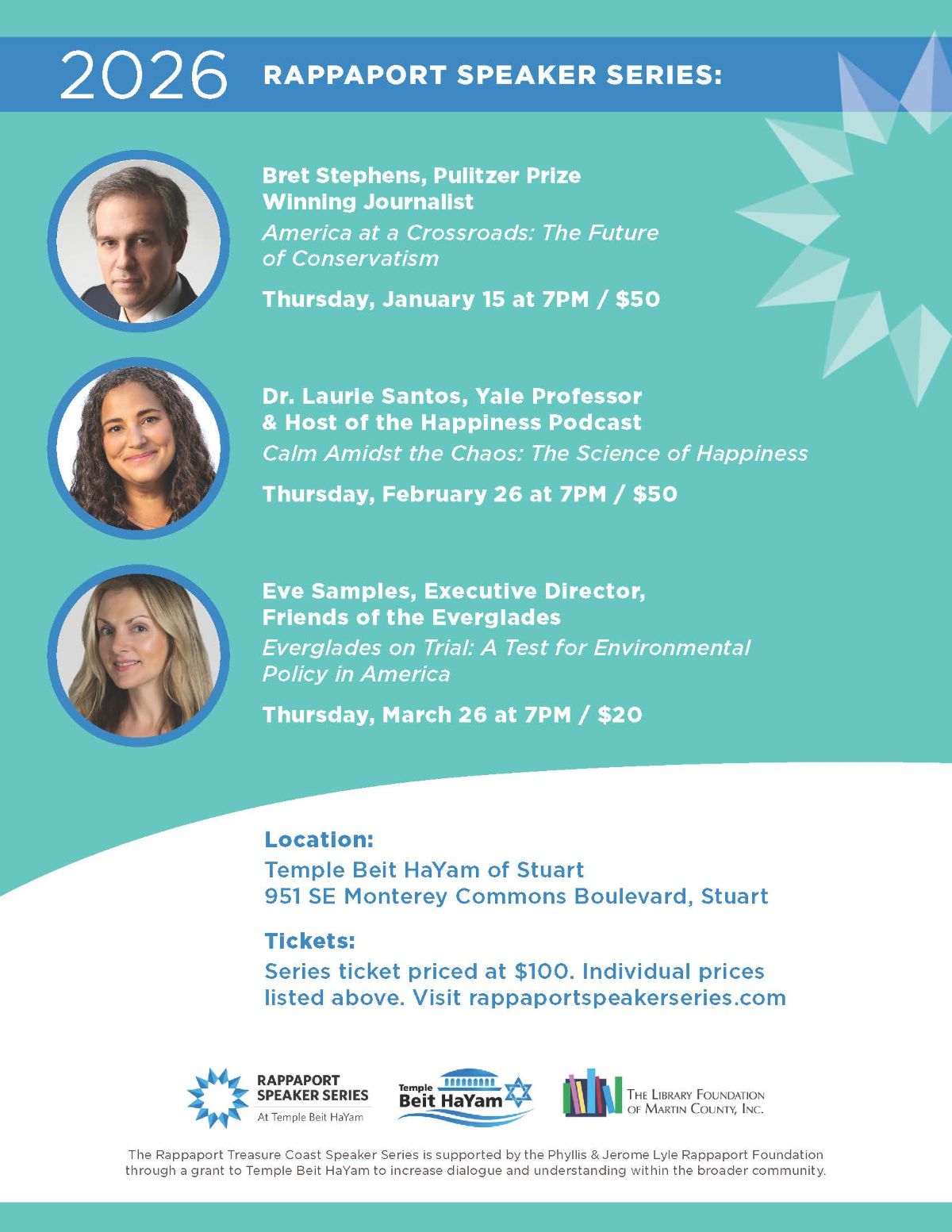
I urge those who are reading this newsletter to send an email expressing their opinions on subjects. When a reader sends one, it will be included if I find it relevant and I have adequate space. I may edit the letter because of length and clarity. You don’t have to agree with me to have your letter in Friends & Neighbors. All you must do is send it to TOM CAMPENNI or fill out the form on the website.
Kevin Docherty
President, Town Council Town of Ocean Breeze
Good morning, Tom,
Once again, I wanted to thank you for updating the Town Council picture a few months ago in "Friends and Neighbors". Now with the new Council in place, I will get you a new picture of the Council.
As for Sea Walk we are nearing the end for their close-out. It has been a long and difficult journey for both the residents of Sea Walk and the Town in dealing with the developer (D.R. Horton). At lease one thing, the Town can come away with the thought that we did our very best for the residents of Sea Walk. And I truely believe that most residents will come to the conclusion that the Town did fulfilled and achieve the requirements that they are entrusted to do. I hope that the majority of the residents will realize that we did do our job and "not" vote to deannex from the Town.
As always, thank you for attending our Town meetings and providing your opinion (pro or con) based on your wealth of knowledge.

On December 30th the BOCC had an emergency meeting to move ahead with a voluntary corrective action plan (vCAP) with the FAA for Witham Field. To fully understand why there needs to have a corrective action plan for the airport one must go back in time.
In 1942 during WWII, Martin County leased the 900-acre site to the U.S. government for use as a training field. It was an auxiliary naval air station. In 1947 the property was returned to the county and Gruman leased most of the property from the county. Gruman eventually downsized and returned much of the field to Martin County.

Northrop Gruman’s presence at the field became Vought Aircraft Division and then Triumph Group before selling the business to Daher, which is a French aerospace company. They are a contractor for the United States government. The facility employs currently about 700 people in very high paying manufacturing jobs.
The FAA, which knew about this lease, is now saying that strictly manufacturing facilities cannot be located on airport properties. The original lease was signed in 1950 with Gruman, and extensions in accordance with the original lease have been signed with the different parties since. The FAA came into existence in 1958.
In 2014 the BOCC’s policy was to prioritize business leases at the airport. Triumph wanted to expand, and it seemed ideal for an airport that did not want commercial aviation. Finally in 2024 a new lease was negotiated with Daher that was written by outside counsel for Martin County. The same year the FAA changed some of their rules for what would be allowed on airport property. You must have flight activity not just be a manufacturer of aeronautics.
Daher agreed to the changes to be in conformity with FAA regulations. It was to be done over a 5-year transition period. Someone that was not picked through an RFP as a tenant over Daher filed an informal complaint what is known as a Part 13. It has since become a formal complaint known as Part 16.
From what I ascertained the complainant’s proposal was not accepted by the county because a lease was contingent on his receiving a bank loan. Daher had no such contingencies.
 Daher is a French aeronautics company building aircraft parts in the United States. The Witham factory supplies intricate and important components to the U.S. Department of Defense. They have spent millions of dollars in order to be a government contractor in Martin County.
However given its relationship to the government, I am sure their lobbyists already are speaking to the Trump administration. Besides isn’t that what the president has been trying to accomplish which is having foreign manufacturers build their products in America especially critical ones for the Defense Department. It would seem counter productive to stop Daher when the FAA only changed its policy in 2024.
Besides Daher employs seven hundred Treasure Coast residents and plans on training several hundred more. This is one of the stated goals of the county increasing good paying jobs. Then I was perplexed over why Commissioner Vargas was excised over this at the meeting.
 Her tone was threatening saying several times “she isn’t letting this go.” I am not quite sure what this means. It seemed the other commissioners if they have any problem with staff are expressing it behind closed doors… where it belongs.
Staff don’t make their own deals. Policy is set by the board whoever the individuals are that sit on the dais. It was the stated policy of the BOCC to sign leases with tenants for even tangential affiliation with flight services. If circumstances have changed and the policy is different you can hold staff responsible from the time the commission changes direction not retroactively. Besides, all leases are approved by the BOCC.
Even more egregious than the Daher lease is the fact that Martin County Public Works Department has been sitting on airport property for I don’t know how long. And there have been halfhearted attempts to move it for the past quarter century without success.
At a meeting last month, the commission voted to negotiate and enter into an agreement with a PPP partner that was unsolicited to build a new public works facility on property bought specifically for that purpose in Western Martin County. They expect once the deal is signed it will take about 18 months to complete and move public works off the airport site. The vote was 3-1 to move forward with Campi absent and Vargas voting no.
The show must go on.
Indiantown High School sits on a parcel next to the proposed Martin County Fairgrounds. The school is a charter school of Indian River State College (IRSC). It was built with private funds from a donor plus additional public funds. There is still room for new students. What they don’t have are any athletic fields.
The lease amendment under discussion will allow the college to build those fields. A private donor will give an additional $2 million while the college will kick in about $13 million. That will bring the total public and private funding to $50 million for the high school. That is a lot of investment into a property that will serve the growing Indiantown population primarily.
With the addendum to the lease, Indiantown High School will have a lease on 55 acres of county-owned land. The rent is all but de minimus. Quite frankly keeping in line with what the county charges many other public institutions including for the neighboring Martin County Fair Board, it would be my opinion that a school is more important than a Fair and therefore should at least be treated equally.
While it is a good thing, Chair Heard wanted to know where in the lease or amendment it gave the public access to the athletic fields and facilities. Dr. Moore, the president of the college, said they could add that to the amendment with no problem. Knowing that athletic facilities are a much sought-after amenity, why wouldn’t staff have included it in the lease?
Commissioner Vargas has continued to rail against 99-year leases which was the term of the lease with IRSC. She would have a point if the county were leasing the college a building that was built. For the most part, ground leases are quite rare and are even unlawful in Florida under certain circumstances. In this instance, the tenant is constructing the building and needs adequate time for depreciation and payback of its investment. IRSC is taking on the expense of building the school and now athletic fields.

In most of the real estate deals that Vargas critiques, there is a public good that the BOCC wants to foster and is therefore willing to make the ground rent more attractive. The few dollars that the county would collect on a ground lease should not stop the deal from happening.
I agree with Commissioner Capps. This is an enormous benefit to the Village of Indiantown. As new residential development comes online, having a high school and sports facility will only enhance the tax base. The tax base is not only Indiantown but also the county.
It passed 5-0.
When the commission met in early December, they voted to hear the 2nd reading for the Gomez brownfield site after 5:05 pm to allow for more public participation.
The site is located on Gomez Avenue on an old carnation farm and nursery. The owner wants it to be declared a brownfield so that they are eligible for state tax credits for doing the cleanup. The only part the county plays is designating it as such.
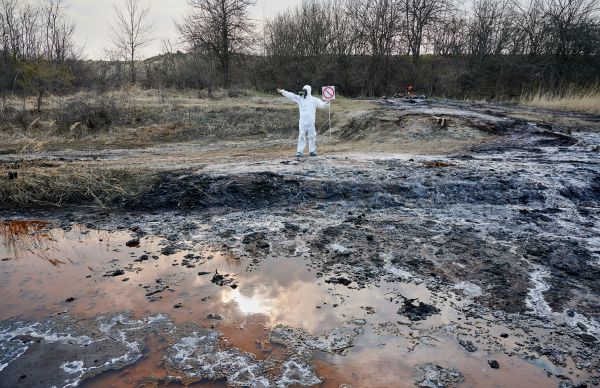
It is quite simple, and the steps are spelled out under Florida Statute 376.78. If the owner meets the 5 criteria spelled out in the statute, then the county must designate. It is a state program.
The five criteria are:
- The applicant must ask and control the property.
- After the cleanup a minimum of 5 new FTE jobs must be created. The construction and consultancy work cannot be included,
- That the proposed end project be in conformity with the Comprehensive Plan,
- The owner must follow statutory notice requirements,
- Reasonable Assurance that the applicant can pay for the cleanup.
The end project will be 38 homes. It will not go before the commission for approval because it is considered a minor project and meets all zoning and comp plan requirements. It is without question that the owner meets criteria 1,3, and 4. At Commissioner’s Ciampi insistence, the owner went above and beyond and mailed notice to all property owners within 500 feet.

With criteria 5, the applicant showed letters and statements for well over $20 million. There was skepticism because of some past trouble with one of the individuals involved and bankruptcy. As they say, that was then this is now.
The third one that both Vargas and Heard leaned into was the jobs analysis that was presented. It showed 22 FTE being created. The report was done by an economist. When it was presented, the attorney for the applicant went through his prima facia case qualifying him as an expert in his sworn testimony.
In general, when an applicant is required to have expert advice in order to meet the requirements, the county will rely on the applicant’s expert. They are providing what is known as competent substantial evidence. It is not just a lay person’s opinion.
Vargas said things like the applicant could afford to clean up the site without the tax credits, that the economic expert is wrong, and that she didn’t want to claw back the tax credits if they didn’t produce the jobs. All those statements mean she doesn’t understand her role in the process.
This is a state program. The tax credits are state-provided ones. The county will have nothing to do after this hearing.
Martin County and all jurisdictions rely on experts mostly paid and hired by applicants. Unless the county is hiring its own experts, then the county must rely on the testimony of the hired ones. The county would go broke if they hired their own experts to verify. That is why it is known as competent substantial evidence.
Why wouldn’t every commissioner want to have a toxic site cleaned? It appeared the neighbors did from their comments. I don’t understand why anyone would make it more difficult if the applicant has satisfied the statute.
The resolution was approved 4-1 with Vargas dissenting.
There is nothing more frustrating to a citizen than volunteering his time and realizing that it isn’t appreciated.
I have sat on quite a few government advisory boards over the years, and there is something that I am convinced about. From the elected officials for whom you are supposedly advising to the public, no one cares what you do.
Since all decisions are made by the elected boards, your participation is not that important. You are a cog in the wheel. The board member must accept his inferior status because no matter how he votes, it won’t mean much.
On the consent calendar, there was an item to make the Parks & Recreation Advisory Board (PRAB) have meetings quarterly instead of monthly. The reason for the change was the problem with having quorums because of attendance issues. I understand…
Commissioner Vargas has said that she heard from members that they may want to continue meeting monthly. I don’t doubt that. Vargas believes nothing should be done until the board meets again and votes to change the meeting schedule. In my opinion, she is right.
I was on that board for a couple of years including as chair. There was a problem with having a quorum, but I think the reason is because both staff and the commission do not care enough about the reasons the board meets. Nobody wants to go to a meeting after work and feels it was a big waste of time.
The LPA has not met since early December. It will not meet again until at least early February. There are two meetings a month scheduled. However, if there are no projects, there are no meetings.
Appointees come on the board expecting to be part of the process. Most are like me…we work our schedules around the meeting dates. Then there are no meetings. Why?
On both boards, we received no training at all. The PRAB could and should meet to be part of the planning process instead of waiting for staff to present. They should be required to have ideas on park and recreation programing.
As far as the LPA is concerned if there is nothing to vote on at a meeting, then we should have training. It could be on anything from Florida statutes to the county comp plan and proper procedure. Even board members don’t understand why they just can’t vote no if they don’t like a project.
Commissioner Capps, who I served with on the LPA, understands the frustration that board appointees sometimes have. He was the other commissioner that pulled the item from the consent agenda. Thanks to both Vargas and Capps for doing it. Now if they and other commissioners only spoke with and listened to the advisory opinions of their appointees on the boards.

In August of 2024, the owner of adjacent parcels asked the City of Stuart to re-zone one of the parcels on Federal Highway. That means both parcels would have the same zoning designation. If there are two different zoning classifications, it makes building anything hard.
The designations of the parcels were Urban Highway and Urban Waterfront. One classification required parking to be at the back and the other in the front of the building.
The applicant was going to build a 94-room hotel which is allowed under both designations. Both the LPA and CRB unanimously voted yes to recommend that the commission approve the applicant’s request. At the two commission meetings, there was no testimony against the proposed rezoning. Reed, Giobbi, and Collins voted no to the application.
Most of the public believe that the commissioners can vote no if they simply don’t like something. Government decisions must be based on codes and seeing whether a project meets the code. The standard used is what lawyers call competent substantial evidence.
The judge in the case found Mayor Boss and his Politburo puppets ignored the LDRs in making their decision. The three commissioners were so arrogant that in their denial they failed to give a reason which is required. In this case, the three wayward commissioners were arbitrary and capricious.
In DeGroot v. Sheffield, an earlier case cited in this decision, defined competent substantial evidence as:
Substantial evidence has been described as such evidence as will establish a substantial basis of fact from which the fact at issue can be reasonably inferred.
We have stated it to be such relevant evidence as a reasonable mind would accept as adequate to support a conclusion. In employing the adjective ‘competent’ to modify the word ‘substantial,’ we are aware of the familiar rule that in administrative proceedings the formalities in the introduction of testimony common to the courts of justice are not strictly employed. We are of the view, however, that the evidence relied upon to sustain the ultimate finding should be sufficiently relevant and material that a reasonable mind would accept it as adequate to support the conclusion reached. To this extent the ‘substantial’ evidence should also be ‘competent.’
The city’s attorney could not direct the court to the competent substantial evidence to support its denial. The court itself reviewed the record and transcript of the hearings and came to the same conclusion. Just ignoring the codes and statutes and coming to an outcome that is not supported by the facts gets the decision tossed.
I would like to know how much the city spent on man hours internally and how much was paid to outside counsel. The current city attorney, unlike former city attorney Mike Mortell, doesn’t litigate. We all know that attorneys are expensive and I have no doubt thousands were spent to come to this forgone conclusion.
The court found for the petitioner, Polk Street Hotel Inc., against the city and squashed the resolution denying the zoning change. Polk Street will have a new hearing. I wonder if Collins, Giobbi, and Reed will now vote yes, or will they remain in their Facebook world where everything is roses and lollipops and stubbornly continue to vote no. At some point, the petitioner will ask for attorney’s fees and damages.
If more people sued the city to uphold their rights, the better we would all be. This is just one more instance where Collins ignored the law and has the attitude that “stop me if you can.” This is not how citizens should be treated. As I wrote above it is arbitrary and capricious.
Tell me if you voted for the Boss and Politburo, is this what you voted for?
You can see the decision here
This was a special meeting of the commission. More on that in our next edition.
The first thing on the agenda was an appeal from a bidder who was rejected to work on one of the projects for the town. Any candidate for an RFP must make sure that they qualify under the town’s requirements. One of the requirements was that the company be in business for 5 years. This firm did not meet those qualifications.
The bid itself was the lowest amount. Bids are seldom based on lowest amounts alone but rather that is just one factor in the selection of a qualified bidder. Another consideration is whether the bidder has been in business long enough to have a track record. His bid was disqualified for that reason.

The commission went back and forth but, in the end, decided to deny the appeal based on the length of time in business. If they made an exception for this one, what about others that did not submit a bid because of the restriction. As the town attorney said, they would be opening Pandora’s box for other lawsuits.
What the commission did agree to do at their March meeting was to see whether they could change the five-year requirement for future RFPs. Is this a standard that can and should be relaxed?
Not many of us will take a stand for what is right. We come up with all kinds of reasons not to do so.
Luckily, most times things resolve themselves. You must know when to let things go and when to step in and help solve a problem. It is like raising a child…knowing when to be a parent and when to let the kid solve their own dilemma.
 There is no difference in a country or community. How much do you let a problem or problems fester before calling out the wrong and the culprit. Many times, we expect others to save us from the perceived bully. How often does that happen?
Let’s face it, most of us will know about a problem but figure the other guy will take care of it. When the other guy doesn’t step up, we sheepishly retreat into our holes and wait. Wait for the bad guy to go away. Wait for the courts or other government entities to protect us.
 We do anything but confront evil and wrongdoing. The excuse could be everything from “it’s not our job” to “I don’t want to lose my livelihood.” The bad actors are seldom frightened by a lack of action. Giving in to a tyrant is the surest way of being the mark again and again. They just keep on their merry way until they are stopped.
Martin County and the City of Stuart are typical of much of society. They complain but do nothing to make things better. The citizens are confronted with wrongdoing yet do not use the avenues open to them to confront the culprits. The people figure they can hunker down and wait until the storm passes. There have been many “gathering storms” in history. Somehow mankind survived.
Wherever we look, we can see storms gathering. That is not something unique to our moment of history. Churchill entitled his first volume on the history of World War II “The Gathering Storm.” We know that neither people nor nations stood up to Hitler when they could have stopped him. The result was millions of deaths.

The same is happening in our world today. In Europe, China, Gaza, now in Venezuela, and many other places, the worst type of leaders are involved in carrying out war. There is nothing “just” for the aggressor in any of the wars the world now has. Ukraine on the other hand is justified (jus ad bellum) in opposing Russian aggression. Not much has changed since Cicero and then St. Augustine wrote those three Latin words.
“For they have sown the wind, and they shall reap the whirlwind” Hosea 8:7. This is the state we find ourselves. What would be new is if we stood up for principle and did the right thing.
IF YOU ARE NOT A SUBSCRIBER DO SO FOR FREE HERE www.friendsandneighborsofmartincounty.com
GET THE WORD OUT
Friends and Neighbors of Martin County is your eyes and ears so that you know what is going on in Martin County’s municipal and county governments. I attempt to be informative and timely so that you may understand how your tax money is being spent. Though I go to the meetings and report back, I am no substitute for your attending meetings. Your elected officials should know what is on your mind.
Tom Campenni 772-341-7455 (c) Email: thomasfcampenni@gmail.com
.
Tom’s Articles
From Medium
“It is a newspapers duty to print the news and raise hell” Lincoln
"Owning A Newspaper"
"TikTok TikTok Was It The Usual Crony Capitalism Deal"
Other Articles
The Capitolist: "Florida property tax relief could hurt city services, study says"
Wall Street Journal: "Forget the $1.50 Hot Dogs. Have You Tried a Costco Vacation?"
The Economist: "How wolves became dogs"
The Wall Street Journal: "Your Brain Ages in Five Distinct Stages, New Research Shows
Copyright © Jan 9, 2026 Friends & Neighbors of Martin County, LLC., All rights reserved.